

Listening to MQA
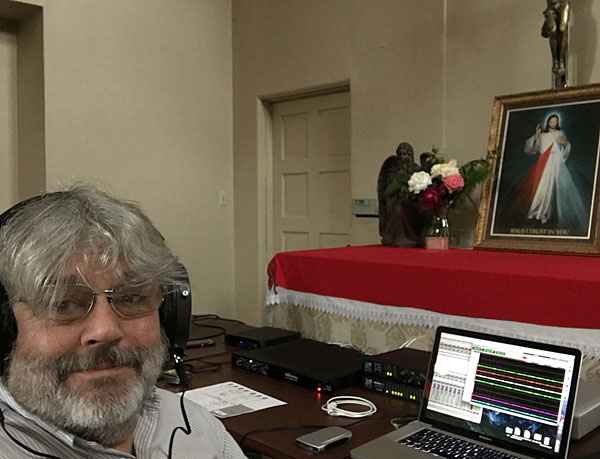
Last June, Jim Austin briefly discussed the operation of MQA in his review of the Meridian Explorer2 USB DAC, but you can find a more detailed explanation on Stereophile's website here and here. MQA involves two fundamental concepts, discussed in a paper presented to the Audio Engineering Society in October 2014. The first is responsible for a large reduction in the bandwidth required to store and stream high-resolution files, the second for a potential improvement in sound quality. . .
Looking Back at the 1980s
A freelance reviewer's workload is erratic. On the odd occasion one might have a few moments' respite, while at other times the coincidence of multiple deadlines for copy results in several weeks of panic. As I write this missive I have just completed one such overload period covering so much equipment that I thought that it would be worthwhile to look back and take stock at the audio in the past decade (footnote 1).
Luke Manley and Bea Lam of VTL: Vital Sound
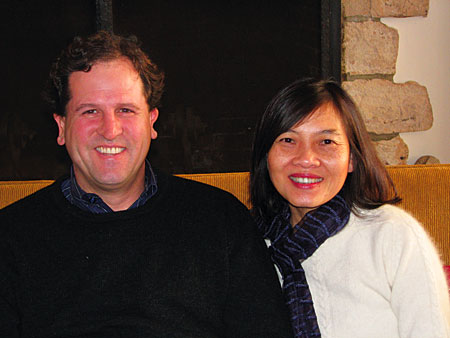
Our meeting was propitious and totally unexpected. The locus was Los Angeles' Sheraton Gateway Hotel last May, on which we had all descended for Home Entertainment 2006. As a contributor to Stereophile's Show">http://blog.stereophile.com/he2006">Show blog, my assignment was as liberal as they come: Go where you are drawn, listen as you will, and record your impressions.
Measuring Loudspeakers, Part One
This series of articles was initially written (in slightly different form), as a paper presented at the 103rd Audio Engineering Society Convention, New York, September 1997. The preprint, "Loudspeakers: What Measurements Can Tell Us—And What They Can't Tell Us!," AES Preprint 4608, is available from the AES, 60 East 42nd Street, Room 2520, New York, NY 10165-0075. The AES internet site, offers a secure transaction page for credit-card orders.
Measuring Loudspeakers, Part Three
This series of articles is based on a paper presented at the 103rd Audio Engineering Society Convention, New York, September 1997. The preprint, "Loudspeakers: What Measurements Can Tell Us—And What They Can't Tell Us!," AES Preprint 4608, is available from the AES, 60 East 42nd Street, Room 2520, New York, NY 10165-0075. The AES internet site, www.aes.orghttp://www.aes.org">www.aes.org;, offers a secure transaction page for credit-card orders.
Measuring Loudspeakers, Part Two
This series of articles was initially written (in slightly different form), as a paper presented at the 103rd Audio Engineering Society Convention, New York, September 1997. The preprint, "Loudspeakers: What Measurements Can Tell Us—And What They Can't Tell Us!," AES Preprint 4608, is available from the AES, 60 East 42nd Street, Room 2520, New York, NY 10165-0075. The AES internet site, www.aes.orghttp://www.aes.org">www.aes.org; , offers a secure transaction page for credit-card orders.
New Media Metrics
Looked at from one viewpoint, DVD-Audio and SACD appear to be exercises in sheer profligacy. In the case of DVD-A, why provide a maximum">http://www.stereophile.com/features/282">maximum bandwidth almost five times what is conventionally taken to be the audible frequency range, and couple it to a dynamic-range capability far in excess of that achievable by the microphones used to record the sound? In the case of SACD, why provide a potential bandwidth in excess of 1.4MHz, only to fill more than 95% of it with quantization">http://www.stereophile.com/features/374">quantization noise?
Noise, Resolution & Benchmark
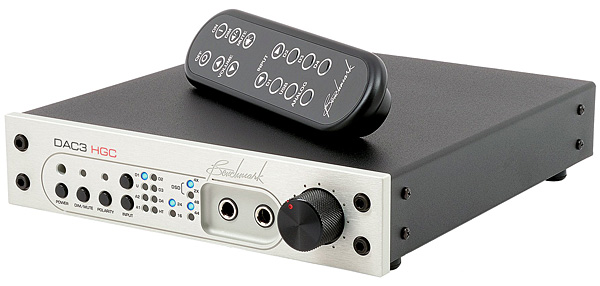
The most notable aspect of Benchmark Media Systems' DAC3 HGC ($2195), which I favorably reviewed in the November 2017 Stereophile (footnote 1), is its low noise floor. John Atkinson's measurements corroborated Benchmark's claim that the DAC3 is capable of "at least" 21-bit performance. While significantly less than the theoretical potential of a 24-bit data format, 21 bits is still the state of the art, and corresponds to a dynamic rangethe ratio of the highest achievable digital-domain volume to the DAC's internal noiseof 128dB. That's well above the dynamic range that most power amplifiers can achieve. A good-measuring high-end solid-state amplifier is likely to have a dynamic rangethe highest attainable ratio of signal to noiseof about 100dB ref. its maximum power.
Of Headphones to Come
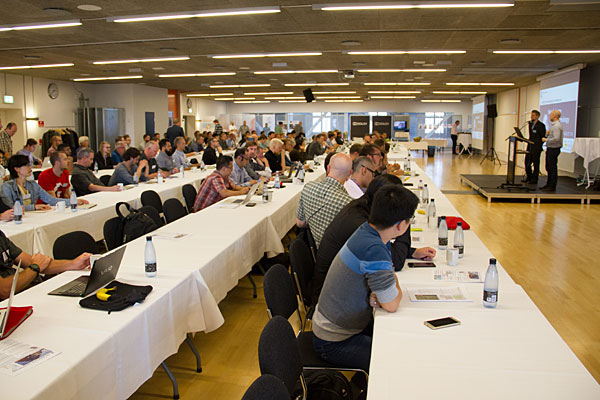
Some 100 engineers and scientists from around the globe assembled for the Audio Engineering Society's 2016 International Conference on Headphone Technology, in Aalborg, Denmark.
I figured it was coming, but it wasn't until just after I'd returned from the Audio Engineering Society's 2016 International Conference on Headphone Technologyheld last August in Aalborg, Denmarkand was writing up my report and summary on the event for InnerFidelity.com (footnote 1) that I knew for sure: Headphones are about to change . . . a lot.One by One: the Cantus Recording Project
 Just who were these guys?—Wes Phillips