Think Pieces

Sort By: Post DateTitle Publish Date

Musical Voices

Wandering through Tower Records the other night, I was struck by the amazing diversity of music available to us. There's music from every part of the globe, for every taste and interest, from "show-me-the-good-parts" compilations of classical highlights to obscure releases by unknown artists. There's music for the ecstatic, music for the angry, music for the straight, the gay, the bent, and the twisted. The subcategories replicate like rabbits, as if in a demographer's nightmare. Genus spawn species, which quickly mutates into subspecies, race, tribe: cult begets subcult.


As Easy as ABC

So you've spent thousands (hours, that is...in terms of dollars, don't ask!) trying to improve the sound of your stereo, and you're still dissatisfied. Here's a list of sure-fire steps which, if followed precisely, will without a doubt have you happy as a lark for days afterward. (What? You expected to be happy with these improvements for months or even years? Get with it! This is high-end audio we're talking about. When was the last time you were satisfied more than a few hours with your costly upgrades?!)


Audiophilia Nervosa

Do you suffer from Audiophilia nervosa, that dreaded disease afflicting long-time readers of Stereophile, The Abso!ute Sound, Hi-Fi News & Record Review, and various other sordid high-end rags? Well, take heart, my friends---relief is on the way. But before treatment can begin, as with all illnesses, proper diagnosis is of paramount importance. To help facilitate this, I have compiled a set of multiple-choice questions. Please take the time to read through these carefully, and jot down your best-guess response from the choices below. You really should use a #2 pencil, as the lead in a #2 is bound to give you the smoothest response, with the least amount of writer's fatigue, allowing the letters to flow effortlessly from the first movement of your hand to the last.


"If it sounds good..."

"...and measures bad, then you're measuring the wrong thing!" If one motto could sum up this magazine's philosophy, this would be it. Too many times we have discovered components that sounded musically fabulous while offering measured performance that was, at best, merely competent. Yet recently, I'm starting to lose confidence in that old saw.


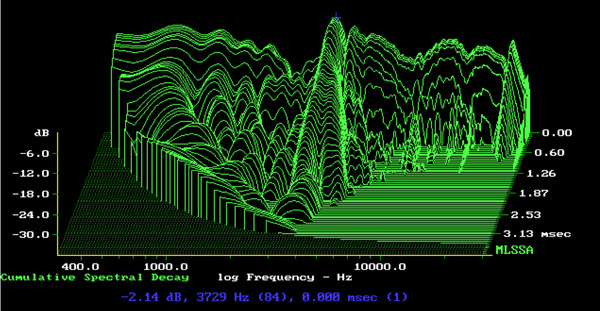
On a number of occasions, I or another of Stereophile's reviewing team has heard a product sounding flawed in ways later revealed by measurements. A closed story, you might think—but consider the NEAR-50M loudspeaker reviewed by Dick Olsher in this issue. Despite hearing many good things in the speaker's sound, Dick was bothered by a tonal-balance problem in the low treble. He was also disturbed by a lack of integration between the tweeter and midrange unit. When I measured the '50M, my response graphs (footnote 1) pretty much explained why Dick heard what he heard. Nevertheless, other reviews of this loudspeaker have been ecstatic in their praise, one even stating that it was "one of the most transparent and balanced dynamic loudspeakers available at any price" (my italics).

The Improvement Disease

It has been said that the high-end audio industry has a weakness which perversely has also helped to maintain its growth. The evolutionary process whereby designs are improved, upgraded, and supplanted at regular intervals keeps everyone interested, and of course affords reviewers useful employment. On the other hand, once a purchase has been made there may be resentment on the part of owners who find that, by the time their choice has become established and awarded sufficient review recommendation, a product upgrade is already in the pipeline.

High-End Democracy

It's useful to ponder the wonders of democracy in this election year—not because of elections, but despite them. Were you to judge democracy by this election year, you might conclude that it consists of judging who has the best PR people, who the best pollsters, and who can muster the nastiest, most effective "negatives" about the other guy.


Cables & the Case for Solder

When you graduate from mass-market hi-fi to high-end audio, one of the first things you notice is that audiophile gear dispenses with the gadgets and gimmicks that clutter up the front panels of most stereo receivers and integrated amplifiers. The dominant philosophy in mass-market design is that features sell products: the more functions a product has, the more desirable it will seem in the store. High-end designers, on the other hand, prefer the KISS approach: Keep It Simple, Stupid!

Humidity, Concert Hall Sound & Spectral Tilt

I want to talk about the acoustics of live music and recordings. As I write this I'm back in Boston for a week, re-calibrating my ears with (excuse the expression) the "absolute sound" of live music in various concert halls. On Friday the Boston Symphony played symphonies by Mozart and Shostakovich, producing (as always) magnificent sound with the aid of Symphony Hall's near-legendary acoustics.
Advertisement
Advertisement
Advertisement