Janet watched the record spin wildly, mildly awestruck. She nodded its way—a gesture that took in all the other 78rpm discs piled nearby—and asked, "How long have you had those?"
 "I got most of them in the '70s, when I was still in my teens," I said. "Some of those records were left behind by my stepfather's first wife, and I've carted them around ever since. I can't tell you how many times I've come close to throwing them out."
"Well, they really saved your ass today, didn't they?"
Remembering the Victrola
"I got most of them in the '70s, when I was still in my teens," I said. "Some of those records were left behind by my stepfather's first wife, and I've carted them around ever since. I can't tell you how many times I've come close to throwing them out."
"Well, they really saved your ass today, didn't they?"
Remembering the Victrola
It started as a joke. With gasoline prices rising daily, my wife and I have had many a dinnertime conversation about buying a Toyota Prius or similar car—that's not the joke part—and we often wonder what other belts will have to be tightened, now that our wasteful way of life has begun to twirl down the toilet. Will the speed limits on our highways be lowered to 55, as they were in the late 1970s? Will the travel agency where Janet works go out of business? If fruit and vegetable prices are driven through the roof by the cost of diesel fuel, will we have to grow our own? Will our electric service suffer brownouts—or worse?
After a long, pleasant dinner on a Friday evening in June, with an open bottle of wine still on the table, the answers weren't as serious as they should have been: We could buy a horse. We could buy a windmill. We could build a greenhouse. We could sell the hi-fi, spend the money on horses and lumber, and listen to 78s on my wind-up Victrola.
As so often happens when the conversation turns to something I'd forgotten I own, I became restless: I had to find the thing at once, just to see if it still worked. I excused myself and went upstairs to the guest room, where my 85-year-old music system waited for me: a shockingly modern thing in which the source component, amplifier, and loudspeaker were all engineered together in one elegant hardwood box. I looked around for my carton of 78s—they turned out to be in the basement, which wasn't at all smart of me—and for the bag full of extra needles I'd stuck somewhere.
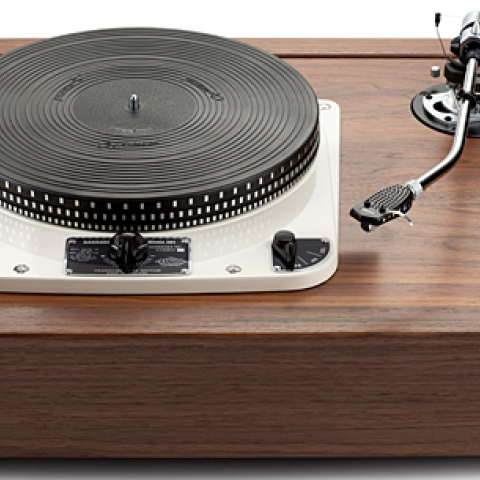
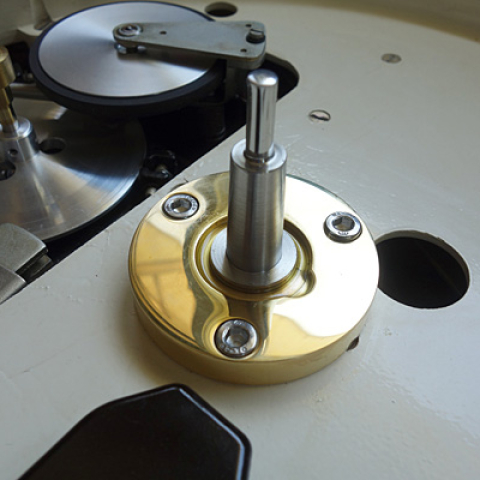
Only then did I remember: My Thorens. My Thorens TD 124 can play 78s.
The next day, I remembered a few other things as well: The record-cleaning fluid I use, made in France by a company called L'Art du Son, is safe for shellac records. The 10" platter mat on my borrowed Keith Monks record-cleaning machine is just right for 78rpm singles. And the EMT pickup head I recently bought for playing mono records, the OFD 25 ($1800), is also available in a special version for playing 78s, the OFD 65 (also $1800). I called Jonathan Halpern of Tone Imports, the EMT distributor, and he offered to send a review sample—along with another interesting toy.
Playing 78s
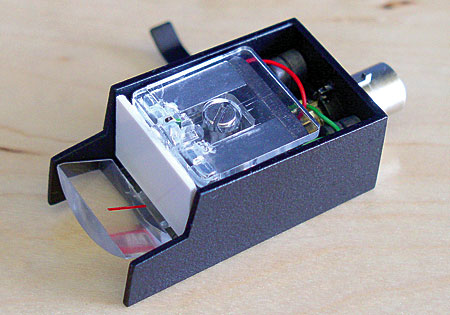
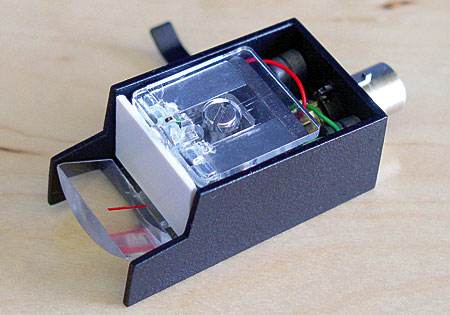
Magnetic cartridges meant for playing 78s are still available from six manufacturers: EMT, Grado, Ortofon, Rega, Shure, and Stanton. Whether they were designed for this application is another matter entirely—most appear to be little more than a stereo cartridge in which a special-purpose stylus has been installed. EMT and Ortofon seem to be the only companies that make cartridges expressly for 78s. Mechanically and electrically, their 78-specific models are designed to read horizontal groove modulations only, with signals appearing only on their right-channel pins: They are, in other words, true monophonic pickups. Not only that, but their suspensions exhibit the very low compliances made necessary by very high downforces—the latter required by 78s' high amplitude levels and generally uneven surfaces—and their spherical stylus tips are the correct diameter for standard pre-LP record grooves: 65µm. (A 25µm tip is regarded as the correct size for a monophonic microgroove; a stereo microgroove can be tracked with a tip of 15µm or less.) The EMT OFD 65 sent to me by Tone Imports is outwardly similar to the company's other pickup heads: an aluminum-alloy headshell with a built-in magnifying loupe at one end and an SME-style four-pin plug at the other—and, of course, an integral moving-coil cartridge, hidden from dust and prying eyes by a belly pan of light metal that's simply pressed into place. The cartridge's 4.25mV output is high for a moving coil—but slightly lower than that of the OFD 25, for some reason—and its DC resistance is 25 ohms, indicating the need for a step-up transformer with a low turns ratio.
The EMT's most colorful spec, of course, is its recommended downforce of 9gm—a little more than seven times the downforce recommended for an Empire 10PE. Audionerds will titter over that number in the manner of schoolboys who've just discovered the word damn in their classroom dictionary. Let them: After all, if you drop this sort of phono cartridge on the floor and it lands face down, you're more worried about the floor than the stylus.
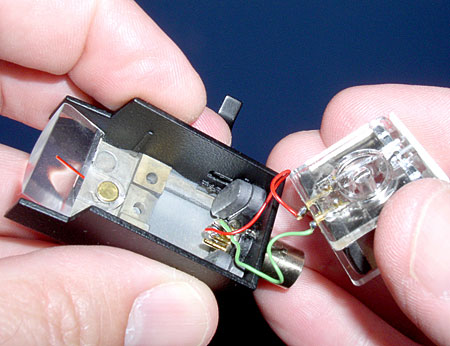
The OFD 65's generator is contained within a square little box of metal and clear plastic—the former accounted for by its combination of oblong magnets and polepieces, the latter by the upper and lower plates that sandwich the works together. The metal lever that holds the stylus—cantilever seems the wrong word altogether—extends straight down through the bottom, then takes a double bend before flattening out to the nib on which the stylus is mounted. The EMT's coil, which appears to have a greater number of turns than average for a moving-coil type, is snugged deep inside; to see it, you'd have to crack the thing open with a sturdy tool: a hammer, perhaps—or another OFD 65.
Paths of enlightenment
My microgroove-friendly OFD 25, which also has a spherical stylus tip, is designed to track at 5gm. Because the downforce mechanism on my EMT 997 tonearm maxes out at 5gm, the OFD 25 is an easy thing to use: All I have to do is fasten it to the end of the tonearm tube, adjust the counterweight until the arm is perfectly balanced, and pull the downforce lever all the way forward. (Because all EMT pickup heads have the same stylus-to-collar dimension of 32mm, they can be interchanged in a properly installed arm without the need to adjust overhang.)
 At first I didn't worry about setting up the OFD 65, until it dawned on me that no downforce gauge on the market has a range extending beyond 3 or 4gm. (I'm talking about real consumer products, not overpriced kits cobbled together out of Plexiglas and postage scales.) Then I remembered something that Jonathan Halpern of Tone Imports had told me about EMT: Because their O-series pickup heads are derived from the professional models sold to broadcast studios, they're designed to be interchanged quickly, without having to readjust overhang or stylus pressure. The latter is made possible at the factory, by adding specific combinations of 1gm weights to the headshells: The OFD 25, which tracks at 5gm, weighs 33gm total; the OFD 65, which requires an extra 4gm of force, weighs 37gm total. Cool.
Other paths of enlightenment were closed to me, such as the quest to know the horizontal and vertical resonant frequencies of the combined EMT OFD 65 pickup head and EMT 997 tonearm: I don't suppose the stereo microgroove of the Hi-Fi News & Record Review Test LP would survive many plays with a 65µm stylus.
At first I didn't worry about setting up the OFD 65, until it dawned on me that no downforce gauge on the market has a range extending beyond 3 or 4gm. (I'm talking about real consumer products, not overpriced kits cobbled together out of Plexiglas and postage scales.) Then I remembered something that Jonathan Halpern of Tone Imports had told me about EMT: Because their O-series pickup heads are derived from the professional models sold to broadcast studios, they're designed to be interchanged quickly, without having to readjust overhang or stylus pressure. The latter is made possible at the factory, by adding specific combinations of 1gm weights to the headshells: The OFD 25, which tracks at 5gm, weighs 33gm total; the OFD 65, which requires an extra 4gm of force, weighs 37gm total. Cool.
Other paths of enlightenment were closed to me, such as the quest to know the horizontal and vertical resonant frequencies of the combined EMT OFD 65 pickup head and EMT 997 tonearm: I don't suppose the stereo microgroove of the Hi-Fi News & Record Review Test LP would survive many plays with a 65µm stylus.
"I got most of them in the '70s, when I was still in my teens," I said. "Some of those records were left behind by my stepfather's first wife, and I've carted them around ever since. I can't tell you how many times I've come close to throwing them out."
"Well, they really saved your ass today, didn't they?"
Remembering the Victrola
It started as a joke. With gasoline prices rising daily, my wife and I have had many a dinnertime conversation about buying a Toyota Prius or similar car—that's not the joke part—and we often wonder what other belts will have to be tightened, now that our wasteful way of life has begun to twirl down the toilet. Will the speed limits on our highways be lowered to 55, as they were in the late 1970s? Will the travel agency where Janet works go out of business? If fruit and vegetable prices are driven through the roof by the cost of diesel fuel, will we have to grow our own? Will our electric service suffer brownouts—or worse?
Magnetic cartridges meant for playing 78s are still available from six manufacturers: EMT, Grado, Ortofon, Rega, Shure, and Stanton. Whether they were designed for this application is another matter entirely—most appear to be little more than a stereo cartridge in which a special-purpose stylus has been installed. EMT and Ortofon seem to be the only companies that make cartridges expressly for 78s. Mechanically and electrically, their 78-specific models are designed to read horizontal groove modulations only, with signals appearing only on their right-channel pins: They are, in other words, true monophonic pickups. Not only that, but their suspensions exhibit the very low compliances made necessary by very high downforces—the latter required by 78s' high amplitude levels and generally uneven surfaces—and their spherical stylus tips are the correct diameter for standard pre-LP record grooves: 65µm. (A 25µm tip is regarded as the correct size for a monophonic microgroove; a stereo microgroove can be tracked with a tip of 15µm or less.) The EMT OFD 65 sent to me by Tone Imports is outwardly similar to the company's other pickup heads: an aluminum-alloy headshell with a built-in magnifying loupe at one end and an SME-style four-pin plug at the other—and, of course, an integral moving-coil cartridge, hidden from dust and prying eyes by a belly pan of light metal that's simply pressed into place. The cartridge's 4.25mV output is high for a moving coil—but slightly lower than that of the OFD 25, for some reason—and its DC resistance is 25 ohms, indicating the need for a step-up transformer with a low turns ratio.
My microgroove-friendly OFD 25, which also has a spherical stylus tip, is designed to track at 5gm. Because the downforce mechanism on my EMT 997 tonearm maxes out at 5gm, the OFD 25 is an easy thing to use: All I have to do is fasten it to the end of the tonearm tube, adjust the counterweight until the arm is perfectly balanced, and pull the downforce lever all the way forward. (Because all EMT pickup heads have the same stylus-to-collar dimension of 32mm, they can be interchanged in a properly installed arm without the need to adjust overhang.)
At first I didn't worry about setting up the OFD 65, until it dawned on me that no downforce gauge on the market has a range extending beyond 3 or 4gm. (I'm talking about real consumer products, not overpriced kits cobbled together out of Plexiglas and postage scales.) Then I remembered something that Jonathan Halpern of Tone Imports had told me about EMT: Because their O-series pickup heads are derived from the professional models sold to broadcast studios, they're designed to be interchanged quickly, without having to readjust overhang or stylus pressure. The latter is made possible at the factory, by adding specific combinations of 1gm weights to the headshells: The OFD 25, which tracks at 5gm, weighs 33gm total; the OFD 65, which requires an extra 4gm of force, weighs 37gm total. Cool.
Other paths of enlightenment were closed to me, such as the quest to know the horizontal and vertical resonant frequencies of the combined EMT OFD 65 pickup head and EMT 997 tonearm: I don't suppose the stereo microgroove of the Hi-Fi News & Record Review Test LP would survive many plays with a 65µm stylus.