Housed at Abbey Road Studios, the UK Beatles session tapes have been guarded and preserved in a way that makes the security deployed around British Crown Jewels seem suspect. The US Dexter tapes are currently stored in the Iron Mountain facility in Pittsburgh. Despite their surprisingly good condition, there were several small physical issues with the US tapes.
"There weren't a lot of problematic things other than what was inherent in the recordings that I could not change," Reeves recalls. "There were only two spots that were problematic that were audible. Both of them were able to be restored so I could play them back. They had some adhesive that had come from edits that were there and had stuck in certain spots. I was very carefully and meticulously able to clean that stuff off. Those were remedied pretty quickly.
"Funny enough, other than that, there were a couple of instances where you have what I call '201 distortion,' which is where the oxide is starting to come off around the leaders at the ends of fades. You can hear some of that, which I tried to dip out as much as possible. But I was careful not to touch the music. Other than that, I was really surprised about how they sounded. I am sure these tapes have been used a lot, especially during the '60s and '70s for production parts, but they were in great shape."
More pleasant surprises awaited Reeves once he put the tapes up and listened. "Knowing that I had the actual tape that cut those actual records and was then able to listen to it and A-B it right on the spot, I was really surprised how different they sounded from the original American pressings. The tapes had a lot more depth. They had a lot more punch. You could look at the EQ notes that are attached to each one of these Capitol assets and you can see the cutting notes. You can see that there was a lot of low end rolled off. There's some adjustment in the high end and maybe a little poking of the midrange, and that's kind of what the pressings sounded like. I'm not going to say they were harsh, but they lacked a fullness about them that was immediately evident in the tapes. So I knew I was already in the ballpark without doing a thing to it. There was a lot more there than was put on those records. They were making more adjustments to the lacquers even after Dexter made monumental adjustments to the master tapes."
The legend of Dexter, supported by the obvious sonic differences between the UK and US pressings of the same music, is that he was enamored with the idea that reverb could improve virtually anything. He was also confident that what
he wanted to hear was the key to selling more music.
Reeves begins the discussion of his post-project conclusions about Dexter with a long, carefully chosen prologue. "Even though they had baked into them all this Dexter juice of more EQ, more compression, and more reverb from the chambers, the master tapes were much better sounding than the pressings. Assuming no ill will and trying not to hate the guy too much, 'cause I don't know him. And trying to be respectful and knowing there's a lot of animosity in and around the work that he did on these releases specifically. And the fact that he was cutting songs out and making them nice short records and putting a lot of records out in one year. A lot of people think that was a money grab. Maybe it was. I think maybe it was like any other great company, they probably saw, 'Oh my gosh, these guys are blowing up, everybody was going crazy so let's get as much out there as we can.'
"First of all, he doesn't like the music, and coming from a marketing and publicity background, it's not exactly what he's been used to selling in the US for Capitol. I think he thought the Capitol brand was something more than this little pop group from England that no one was ever going to care about. Obviously, those decisions have been proven controversial, as we know. But at the time I think he thought, this is not Sinatra, this is not Nat King Cole, this not Peggy Lee, this is not what the Capitol brand is. Lemme make these things so they'll sell to these teenagers. And he didn't really care about this too much because he had other things to do. That's certainly a hypothesis."
Beautifully packaged with a reproduction of the original Capitol inner sleeves (trumpeting "Join
the teen set on Capitol") included inside each glossy, heavy-cardboard Tip-on jacket,
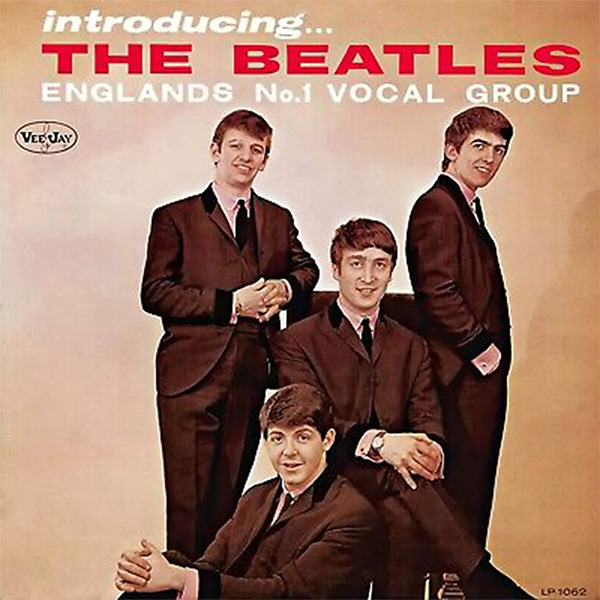
The Beatles 1964 Albums in Mono have definite sonic changes that distinguish them from the original American mono releases. These are not straight reissues by any means. Taking into account the nostalgia and love that many American listeners have for the original Dexter-modified US pressings, this set is a success.
Compared at length to near-mint original US mono copies of
Meet the Beatles and
Beatles '65, these new remasters are louder. The outlines in this mix of true-mono originals and mono fold downs from the stereo (done at the time of the initial releases) are now sharper, with better detail. Ringo's cymbal hits have a more pronounced edge. Paul's bass, which can fade into the background, is more clearly pronounced in the mix. The vocals have more luster and heft. Cut hotter than either the UK monos or the original US mono pressings, these new editions can also be too bright at times, though they do sound good at increased volume levels. The quality of all the pressings, from MPO in France, is very good, flat, quiet, nicely precise.
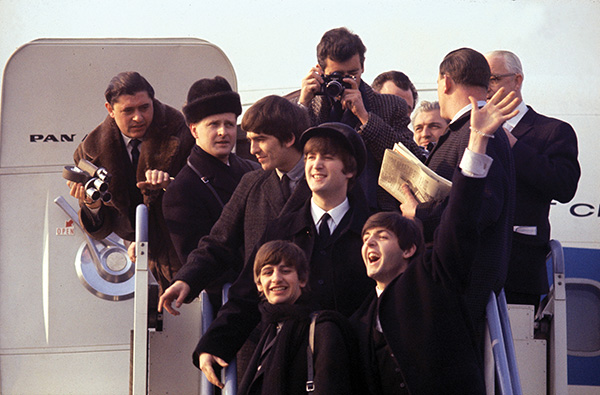
Boarding a plane to the US, 1964.
Beatles historian Bruce Spizer's new liner notes for each album add more detail to the story of Dexter and the original American mono releases. In the notes to the new edition of
Meet the Beatles! (original UK title:
With the Beatles), Spizer explains that Capitol saved four cents per album by cutting two songs from the UK release because royalties in America were calculated not for an entire album, no matter how many songs it contained, but for each song. He also adds that "youngsters" mostly bought singles in the '50s and early '60s and that "Albums priced at about $3 were considered expensive luxuries, usually with a few good songs mixed with mediocre filler."
Going so far as to characterize Dexter's "programming" as benign and "far from a butcher job," Spizer defends Dexter's decision to cut five of the cover songs on
With the Beatles, mirroring some of Dexter's arrogance when he asserts, "Americans would not be interested in hearing the Beatles perform songs previously released by American artists." He notes that the Japanese market also reworked the song order of original releases. He closes by noting that the reconstructed album sold 3,650,000 copies in the US in just three months, and mono albums accounted for 90% of album sales in 1964 because most fans only had mono players.
While some of Reeves's work on other projects has attracted the inevitable sniping—album cuts that are too harsh or lacking the presence of the originals—he's well aware that his work on
The Beatles 1964 US Albums in Mono will be subjected to the heightened scrutiny that comes with any Beatles project. He assumes that the surviving band members or their estates approved his remasters. Repeated listens confirm that he's done the band's legacy proud.
"There was quite a bit of heavy adjustment to the EQ while cutting the lacquers [that] made those first-generation 1964 LPs," Reeves concludes. "That was the part I chose not to replicate, since the tapes sounded so much fuller, richer, and deeper than the vinyl. Of course, I did not make any calls all on my own. Guy Hayden, who was the project producer, gave me the green light to make the tapes sound as good as possible and not try to match the altered sound of the LPs. But even that was a challenge, because there is a soul and spirit in the sound of those LPs that I couldn't stray too far from. Obviously, if they sounded completely different, that would not be a good listening experience for those folks who grew up with these records."
Did the surviving Beatles, Yoko Ono, and Olivia Harrison approve his work? "I assume so. I got no direct feedback, but I do know there was talk at one point about some of the creative decisions we were making might be run by those guys and they would all chime in on it. In the end, it was all approved. I believe strongly, for this project as well as anything I get to work on, that it's not my place to make those calls on my own. It's the Beatles' art, so they get to decide."