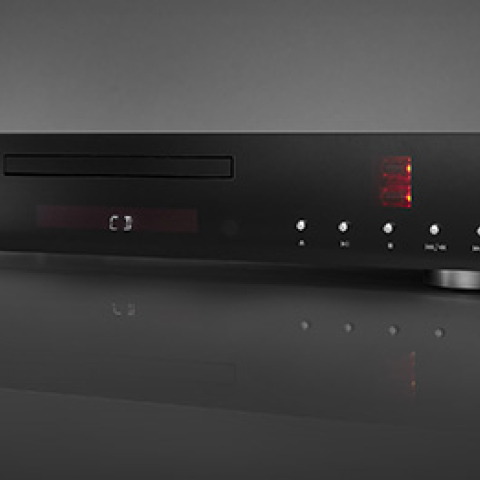
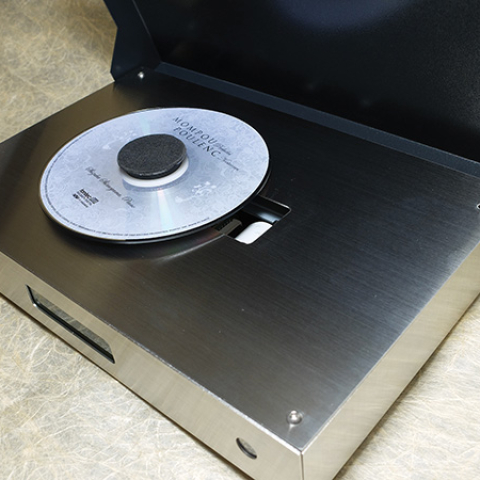
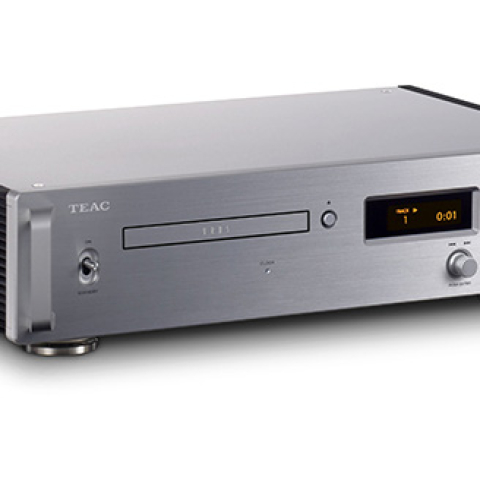
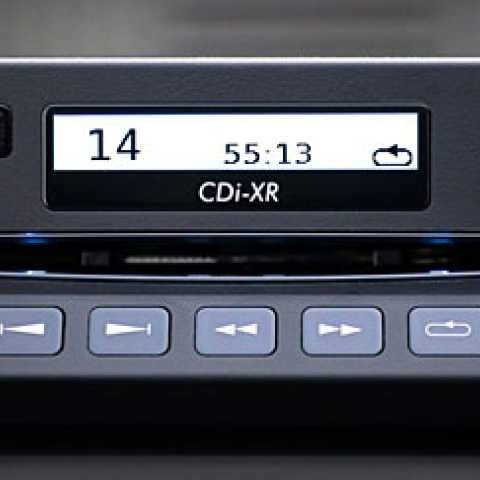
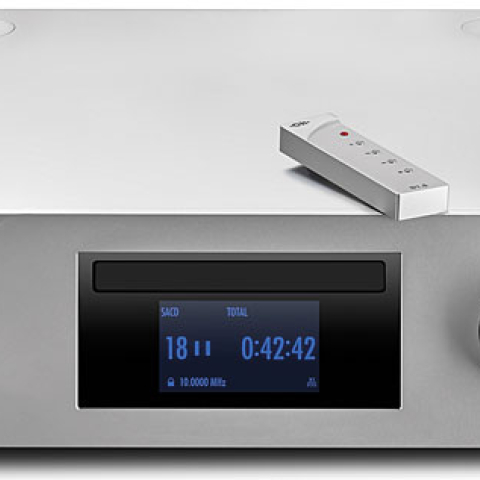
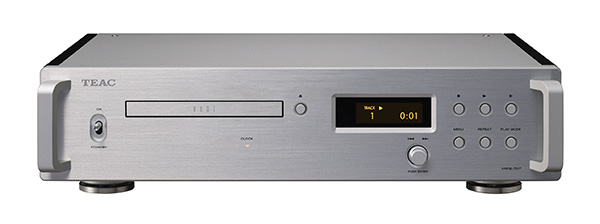
 TEAC's new transport looked expensive and pro-style cool on my rack. I liked its clearly labeled old school power toggle; it felt solid and direct-acting, as did all the front panel buttons. Aesthetics-wise, the VRDS-701T looked rugged enough for a recording studio and suave-fashionable enough for a domestic setting.
The top plate is extraordinarily thick, beautifully machined, and snug-fitting. The side panels look like thick heatsinks. The inside looks as serious as the outside, with two toroidal transformers, one for the CD mechanism and the other for the digital control section. According to the TEAC website, these "power transformers are mounted on a floating structure, separating and isolating them from the bottom panel." Which in turn is isolated from its environment by the 701T's three footers, which add another layer of anti-vibration isolation to the TEAC's heavy (22.2lb/10.1kg) chassis. According to the distributor's website, those heatsink-looking side panels have fins of different lengths. Their job is "to reduce sympathetic vibrations in the chassis."
TEAC's new transport looked expensive and pro-style cool on my rack. I liked its clearly labeled old school power toggle; it felt solid and direct-acting, as did all the front panel buttons. Aesthetics-wise, the VRDS-701T looked rugged enough for a recording studio and suave-fashionable enough for a domestic setting.
The top plate is extraordinarily thick, beautifully machined, and snug-fitting. The side panels look like thick heatsinks. The inside looks as serious as the outside, with two toroidal transformers, one for the CD mechanism and the other for the digital control section. According to the TEAC website, these "power transformers are mounted on a floating structure, separating and isolating them from the bottom panel." Which in turn is isolated from its environment by the 701T's three footers, which add another layer of anti-vibration isolation to the TEAC's heavy (22.2lb/10.1kg) chassis. According to the distributor's website, those heatsink-looking side panels have fins of different lengths. Their job is "to reduce sympathetic vibrations in the chassis."
 Everything I mock, I become
I have a history of mocking those "LedTull-era" guitar gods with their long hair, pastel trousers, and shirtless pyrotechnics. Likewise in classical music, I'm put off by instrumental virtuosity unless it is serving an obvious poetic or expressive purpose. My interest is in how the work is played, the spirit of the performance, not how many notes were hit or missed. I listen to detect by what means—temperament or technique—the artist communicates with their public. I endeavor to have a sound system that makes those means obvious.
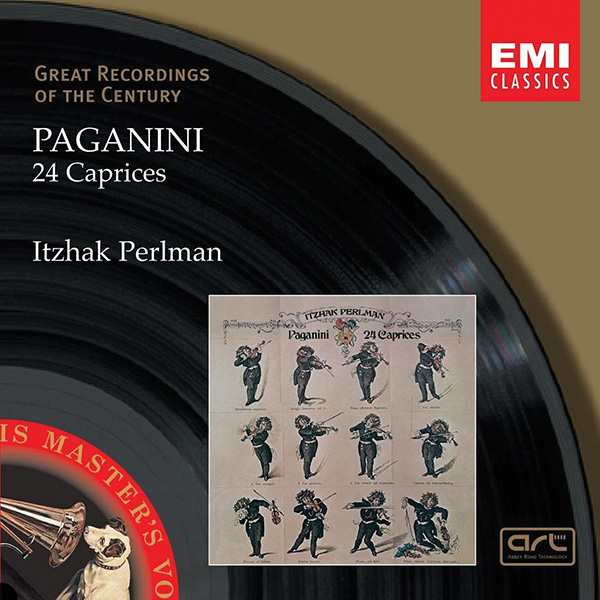 Niccolò Paganini (1782–1840) was the prototype Romantic virtuoso. Besides playing the violin fiendishly, reports claim he projected "mental powers" that gripped and mesmerized audiences.
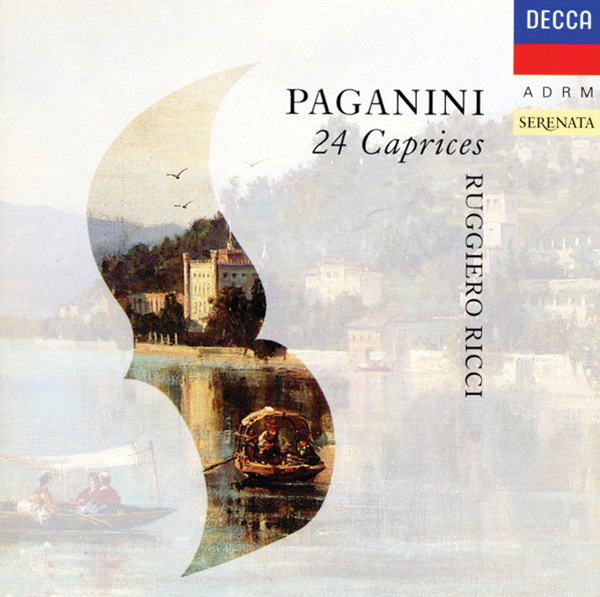
No previous classical music performer brought more mythopoetic force or hair-raising virtuosity to the music hall stage than bone-thin Paganini, who performed toothless after 1828. No musical artist has ever appeared more otherworldly, or more famously sold his soul to the devil, than Paganini. Almost 200 years after his death, Paganini's 24 Caprices (Op.1) remain among the most difficult challenges and most thrilling music in the violin repertoire. More than 100 years into the recording era, only two violinists have dared to record all 24 Caprices: Ruggiero Ricci (Decca CD 440 034-2) and Itzhak Perlman on the abovementioned disc, which on my system raised hairs, sprouted goosebumps, and forced my mind into states of lucid dreaming.
Niccolò Paganini (1782–1840) was the prototype Romantic virtuoso. Besides playing the violin fiendishly, reports claim he projected "mental powers" that gripped and mesmerized audiences.
No previous classical music performer brought more mythopoetic force or hair-raising virtuosity to the music hall stage than bone-thin Paganini, who performed toothless after 1828. No musical artist has ever appeared more otherworldly, or more famously sold his soul to the devil, than Paganini. Almost 200 years after his death, Paganini's 24 Caprices (Op.1) remain among the most difficult challenges and most thrilling music in the violin repertoire. More than 100 years into the recording era, only two violinists have dared to record all 24 Caprices: Ruggiero Ricci (Decca CD 440 034-2) and Itzhak Perlman on the abovementioned disc, which on my system raised hairs, sprouted goosebumps, and forced my mind into states of lucid dreaming.
 With TEAC's VRDS-701T transport sourcing Linear Tube Audio's new Aero R-2R DAC, in turn feeding the HoloAudio Serene preamp then on to the Parasound Halo A 21+ stereo amplifier, which in turn drove my Falcon Gold Badge LS3/5as, the sound was dense and precise in a way I'd never previously heard from digital. By "dense," I mean there was a tangible corporeality effected by seemingly infinite quantities of small, tightly packed molecules of musical information.
Itzhak Perlman's rendition of Paganini's 24 Caprices compels listeners to follow close up the infinitely varied touch of the performer's bow. The 701T into LTA Aero system gave me a focused, microscopic view of these nuanced bow-on-strings dramas, a wordless opera of tone and texture in uncanny transparency. I'd never heard a CD sound this clear before.
Connecting the TEAC transport to my reference dCS Lina's S/PDIF input with the TEAC-Lina combo, I could feel Perlman's concentration. Exposing an artist's personality and state of mind are intangibles I don't remember noticing with nonphysical media, or with those early Sony and Philips CD players everyone bought.
With TEAC's VRDS-701T transport sourcing Linear Tube Audio's new Aero R-2R DAC, in turn feeding the HoloAudio Serene preamp then on to the Parasound Halo A 21+ stereo amplifier, which in turn drove my Falcon Gold Badge LS3/5as, the sound was dense and precise in a way I'd never previously heard from digital. By "dense," I mean there was a tangible corporeality effected by seemingly infinite quantities of small, tightly packed molecules of musical information.
Itzhak Perlman's rendition of Paganini's 24 Caprices compels listeners to follow close up the infinitely varied touch of the performer's bow. The 701T into LTA Aero system gave me a focused, microscopic view of these nuanced bow-on-strings dramas, a wordless opera of tone and texture in uncanny transparency. I'd never heard a CD sound this clear before.
Connecting the TEAC transport to my reference dCS Lina's S/PDIF input with the TEAC-Lina combo, I could feel Perlman's concentration. Exposing an artist's personality and state of mind are intangibles I don't remember noticing with nonphysical media, or with those early Sony and Philips CD players everyone bought.
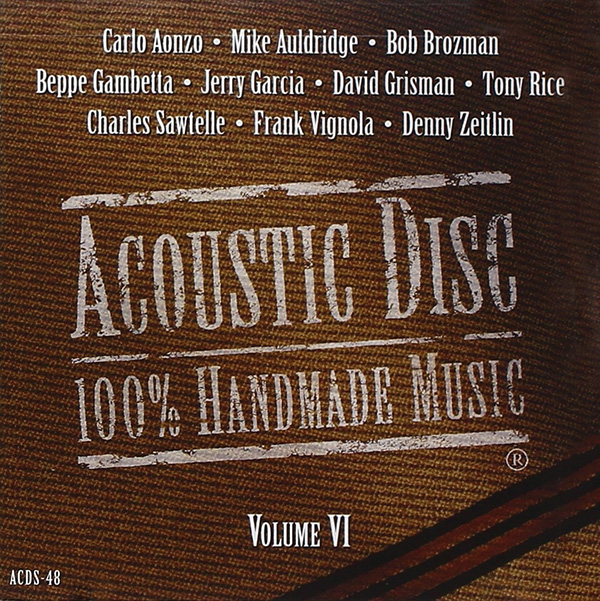 After a week of Euro-style violin virtuosity, I got an urge for some fast-paced, home-style American fiddle music, specifically Old & In the Way – That High Lonesome Sound (CD, Acoustic Disc ACD-19), with Vassar Clements playing fiddle, Jerry Garcia playing banjo and singing, Dave Grisman singing and pumping songs forward on mandolin, John Kahn plucking acoustic bass, and Peter Rowan on guitar and vocals. This iconic disc was produced by David Grisman for Dawg Productions and recorded live in 1973 at The Boarding House in San Francisco by Owsley Stanley and Victoria Babcock.
Every track on this superbly balanced live recording moves fast-train, scared-hare forward, none more swiftly or sweetly than Vassar Clements's unwinding on Ervin T. Rouse's "Orange Blossom Special." As part of what's known as Bear's Sonic Journals, Owsley Stanley recorded every artist that played through the Grateful Dead's giant Wall of Sound system, which he created with the help of audio designer John Curl and others. This "Orange Blossom Special" is the most full-tilt, electrifying version I know—a must hear. Pure, hare-rousing, hair-raising high lonesome. The TEAC-Lina combo aired it out while showing me the stage and space around it and every bow stroke. Playing this tune loud led to delirious head bouncing.
After a week of Euro-style violin virtuosity, I got an urge for some fast-paced, home-style American fiddle music, specifically Old & In the Way – That High Lonesome Sound (CD, Acoustic Disc ACD-19), with Vassar Clements playing fiddle, Jerry Garcia playing banjo and singing, Dave Grisman singing and pumping songs forward on mandolin, John Kahn plucking acoustic bass, and Peter Rowan on guitar and vocals. This iconic disc was produced by David Grisman for Dawg Productions and recorded live in 1973 at The Boarding House in San Francisco by Owsley Stanley and Victoria Babcock.
Every track on this superbly balanced live recording moves fast-train, scared-hare forward, none more swiftly or sweetly than Vassar Clements's unwinding on Ervin T. Rouse's "Orange Blossom Special." As part of what's known as Bear's Sonic Journals, Owsley Stanley recorded every artist that played through the Grateful Dead's giant Wall of Sound system, which he created with the help of audio designer John Curl and others. This "Orange Blossom Special" is the most full-tilt, electrifying version I know—a must hear. Pure, hare-rousing, hair-raising high lonesome. The TEAC-Lina combo aired it out while showing me the stage and space around it and every bow stroke. Playing this tune loud led to delirious head bouncing.
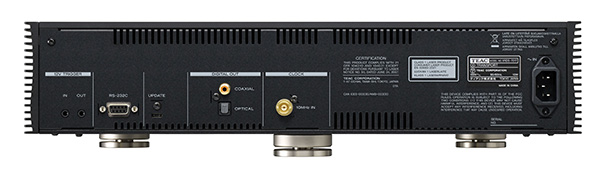
Using a 1m length of Kimber's D60 75 ohm coax cable, I connected TEAC's 701T to HoloAudio's Spring 3 KTE DAC ($2198 to $3698, depending on options). This combo of comparably priced components played with marginally more force and intensity than the TEAC plus the dCS Lina, but with the Spring 3, Perlman's tone was noticeably less than full-spectrum. There was some microblur and occasional brightness. The littlest notes went into hiding. What the Spring 3 did playing CDs from the 701T was maximize the presence and raw clarity of CD playback. Presence and jump factor went beyond mainstream digital. But wait. When I stream data from my router, it travels from the server to the DAC over USB or LAN. When I play a CD from a transport, it travels over S/PDIF or I2S. That has to mean something, right? HoloAudio's Spring 3 and May DACs have what their chief engineer, "Jeff," describes as a "powerful" Phase-Locked Loop (PLL) configuration that importer Tim O'Connor says reduces timing errors when using I2S via HDMI) and S/PDIF. When I engaged the Spring 3's PLL with TEAC's S/PDIF output, the sound became sweeter, more supple, less forward, less mechanical, and more like analog.
 This analog-like beauty was most obvious playing Kavi Alexander's sublime Saltanah (CD, Water Lily Acoustics WLA-ES-51CD) with Simon Shaheen on ūd and violin, Vishwa Mohan Bhatt playing mohan vīnī (veena), and Ronu Majumdar on bansuri. This is one of my forever favorite CDs, and it responded extremely well to the Spring 3's PLL treatment. Tone and three-dimensionality became a little bit tubelike. I can best describe the overall PLL/coax sound as seductive in a glamorous movie star kind of way. What previously seemed a bit brisk, bright, and overwrought now, with the PLL, sounded liquid, relaxed, and picturesque.
When I played Monk's Dream (CD, Columbia 88697957682-1), the sound (with PLL) was super-vivid, extra-bouncy, and more subtly detailed. HoloAudio's PLL made the Spring 3 a very compatible partner for TEAC's VRDS-701T transport.
Stay tuned for my review of the 701T's intended companion, TEAC's UD-701N DAC/Network Player.
This analog-like beauty was most obvious playing Kavi Alexander's sublime Saltanah (CD, Water Lily Acoustics WLA-ES-51CD) with Simon Shaheen on ūd and violin, Vishwa Mohan Bhatt playing mohan vīnī (veena), and Ronu Majumdar on bansuri. This is one of my forever favorite CDs, and it responded extremely well to the Spring 3's PLL treatment. Tone and three-dimensionality became a little bit tubelike. I can best describe the overall PLL/coax sound as seductive in a glamorous movie star kind of way. What previously seemed a bit brisk, bright, and overwrought now, with the PLL, sounded liquid, relaxed, and picturesque.
When I played Monk's Dream (CD, Columbia 88697957682-1), the sound (with PLL) was super-vivid, extra-bouncy, and more subtly detailed. HoloAudio's PLL made the Spring 3 a very compatible partner for TEAC's VRDS-701T transport.
Stay tuned for my review of the 701T's intended companion, TEAC's UD-701N DAC/Network Player.
But I swear, this TEAC transport was a revelation. It made digital more compelling than I thought it could be. I never anticipated this much drive, density, inner detail, or tone truthfulness from a digital source. It only took 40 years, but CDs are finally being reproduced in a manner I consider comparable to analog. And just like analog, the machine that spins the disc establishes the core virtues and vices of the disc's sound. If there's a better built, more highly resolving, more musically satisfying CD transport than the TEAC VRDS-701T, I have not encountered it.