Sidebar 3: Measurements
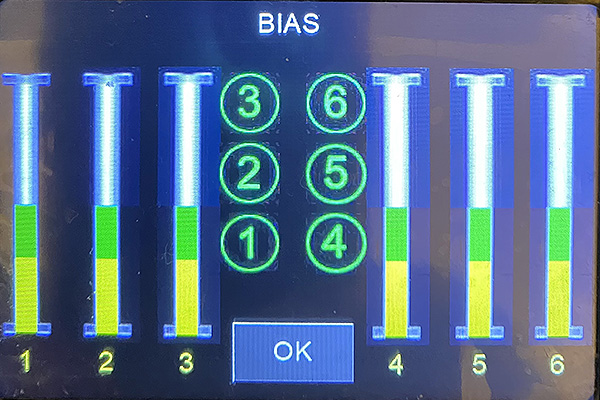
For logistical reasons, I measured a different sample from those auditioned by JVS; it had the serial number 72519930. JVS had told me that he performed all of his auditioning using KT120 tubes and with the Power set to Low, which means the output tubes operate in class-A up to the maximum power. Accordingly, I left the KT170 tubes in the box and after the six KT120 tubes had been installed, I turned the amplifier on, waited for the warm-up time to end, and used the touchscreen on the amplifier's top panel to set the tube type to "KT120" and the Power to "Low." Unlike the Octave Jubilee Mono SE that JVS reviewed in September 2022, the Jubilee Class A uses an autobias circuit. I ran the amplifier at 1W into 8 ohms for 30 minutes, then checked that the bias for each of the output tubes was optimal using the touchscreen menu. I used my Audio Precision SYS2722 system to examine the Octave Jubilee Class A's measured performance.
 The Octave Jubilee Class A preserved absolute polarity, ie, was noninverting, with both the balanced and single-ended inputs. The voltage gain at 1kHz was 31dB into 8 ohms for the single-ended input, 24.8dB for the balanced input. The balanced input impedance was a usefully high 26k ohms from 20Hz to 20kHz. As expected, the single-ended input impedance was half that value.
The Octave Jubilee Class A preserved absolute polarity, ie, was noninverting, with both the balanced and single-ended inputs. The voltage gain at 1kHz was 31dB into 8 ohms for the single-ended input, 24.8dB for the balanced input. The balanced input impedance was a usefully high 26k ohms from 20Hz to 20kHz. As expected, the single-ended input impedance was half that value.
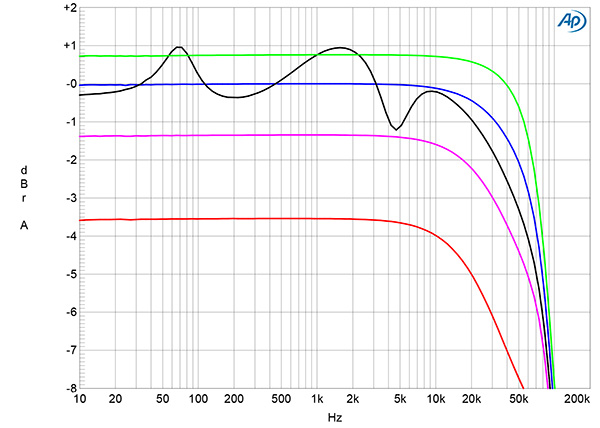
Fig.1 Octave Jubilee Class A, Low Power, frequency response at 2.83V into: simulated loudspeaker load (gray), 16 ohms (green), 8 ohms (blue), 4 ohms (magenta), and 2 ohms (red) (1dB/vertical div.).
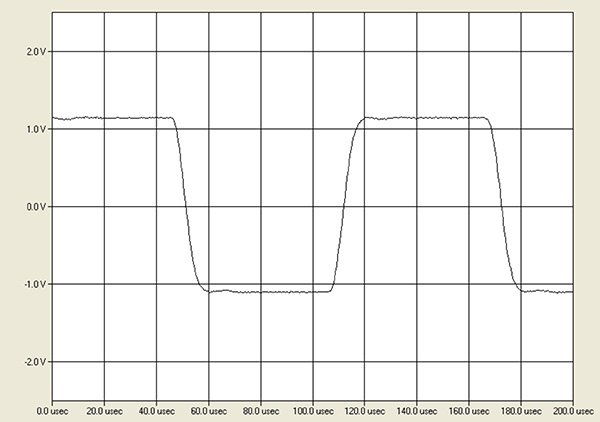
Fig.2 Octave Jubilee Class A, Low Power, small-signal 10kHz squarewave into 8 ohms.
Octave specifies the output impedance of the Jubilee Class A's single output transformer tap as 1 ohm. I measured 1.6 ohms at low and middle frequencies, rising to 2.25 ohms at the top of the audioband. The variation in the small-signal frequency response of the Jubilee Class A into our standard simulated loudspeaker (fig.1, gray trace) was ±1.1dB. The amplifier's response into 8 ohms (fig.1, blue trace) gently rolled off above 15kHz, reaching –3dB at 61kHz. The increase in output impedance in the top octave meant that the response increasingly rolled off as the load impedance was reduced. Into 2 ohms, for example, the output was down by 1.5dB at 20kHz (fig.1, red trace). The frequency response into 8 ohms with the single-ended input and with the Power set to High was identical to the blue trace in fig.1, though the output impedance in High Power mode was slightly higher than it was in Low Power mode, at 1.9 ohms at 20Hz and 1kHz, 2.625 ohms at 20kHz. Unlike the Jubilee Mono SE, which reproduced squarewaves with overshoot and ringing, the Jubilee Class A's reproduction of a 10kHz squarewave into 8 ohms in Low Power mode was clean (fig.2).
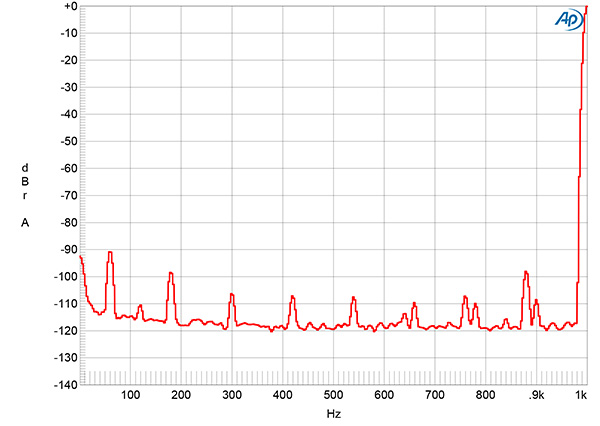
Fig.3 Octave Jubilee Class A, Low Power, spectrum of 1kHz sinewave, DC–1kHz, at 1W into 8 ohms (linear frequency scale).
The Octave's unweighted, wideband signal/noise ratio (ref. 1W into 8 ohms and measured with the unbalanced input shorted to ground) was a very good 79.4dB. This ratio improved to 80.6dB when the measurement bandwidth was restricted to 22Hz–22kHz and to 87.8dB when A-weighted. Spectral analysis of the low-frequency noisefloor with the amplifier driving a 1kHz tone at 1W into 8 ohms (fig.3) revealed that AC-related spuriae all lay at or below –90dB. That these spuriae are at 60Hz and its odd-order harmonics suggests they are due to magnetic interference from the power transformer, perhaps being picked up by the tubes' steel pins.
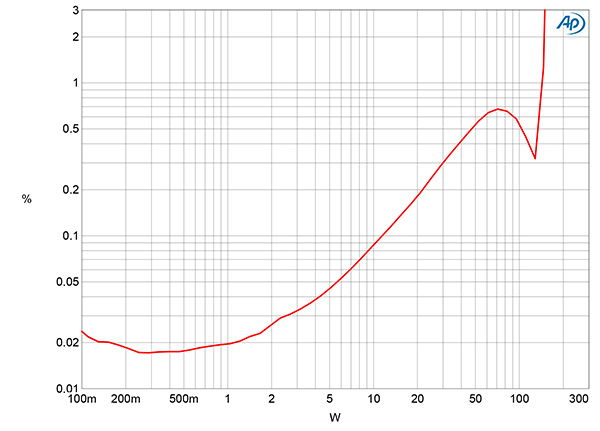
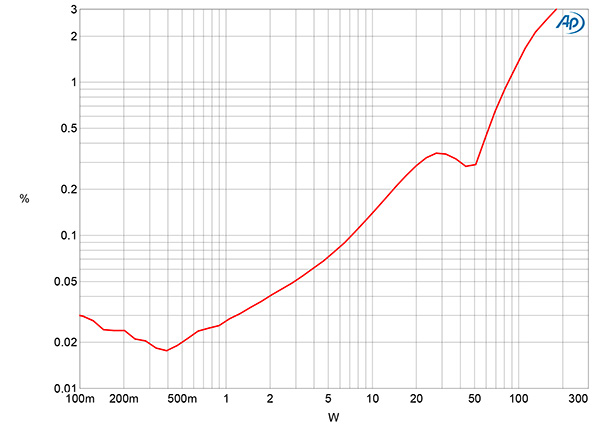
Fig.4 Octave Jubilee Class A, Low Power, distortion (%) vs 1kHz continuous output power into 8 ohms.
Fig.5 Octave Jubilee Class A, Low Power, distortion (%) vs 1kHz continuous output power into 4 ohms.
The Octave Jubilee Class A's maximum power in Low Power mode is specified as 160W, which is equivalent to 22dBW into 8 ohms and 19dBW into 4 ohms. With our usual definition of clipping, which is when the THD+noise reaches 1%, I measured clipping powers of 47W into 16 ohms (19.7dBW), 140W into 8 ohms (21.46dBW, fig.4), and 88W into 4 ohms (16.44dBW, fig.5). Relaxing the definition of clipping to 3% THD+N, the Jubilee Mono clipped at 183W into 4 ohms (19.6dBW). The 8 ohm clipping power in High Power mode is specified as 280W (24.5dBW). I measured 140W (21.46dBW), 1% THD+N, and 198W (23dBW), 3% THD+N. The FTC's updated "Amplifier Rule" states that maximum power should also be assessed at frequencies other than 1kHz; therefore, I repeated the power test at 20kHz. The Jubilee set to Low Power clipped at 35W into 8 ohms (15.44dBW) with this signal.
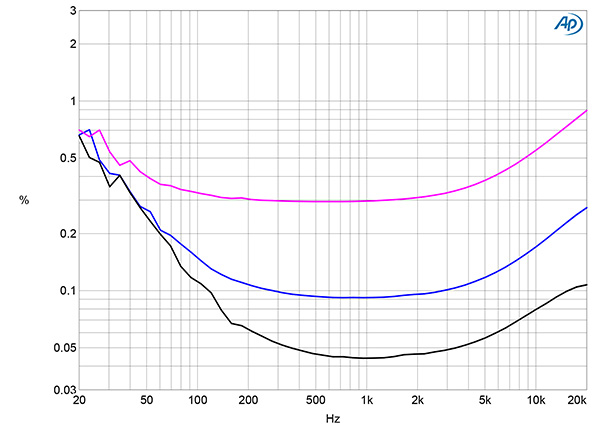
Fig.6 Octave Jubilee Class A, Low Power, THD+N (%) vs frequency at 9V into: 16 ohms (gray), 8 ohms (blue), and 4 ohms (magenta).
The rise in the THD+N percentage as the power increases in figs.4 and 5 will be due to the amplifier's circuit featuring a limited amount of overall negative feedback. Fig.6 shows how the percentage of THD+N varies with frequency into 16, 8, and 4 ohms at 9V (equivalent to 5W into 16 ohms, 10W into 8 ohms, and 20W into 4 ohms). I haven't shown how the THD+N varies with frequency into 2 ohms in this graph, as the amplifier was clipping with this voltage. While the THD+N was impressively low into 16 ohms (gray trace), it rose with each halving of the load impedance. The slight rise in distortion in the top audio octave will be due to the limited open-loop bandwidth; the larger rise in THD+N below 200Hz will be due to the output transformer's core starting to saturate at low frequencies.
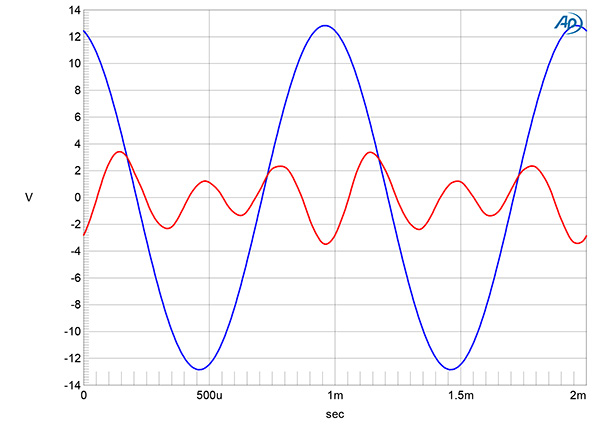
Fig.7 Octave Jubilee Class A, Low Power, 1kHz waveform at 10W into 8 ohms, 0.092% THD+N (blue); distortion and noise waveform with fundamental notched out (red, not to scale).
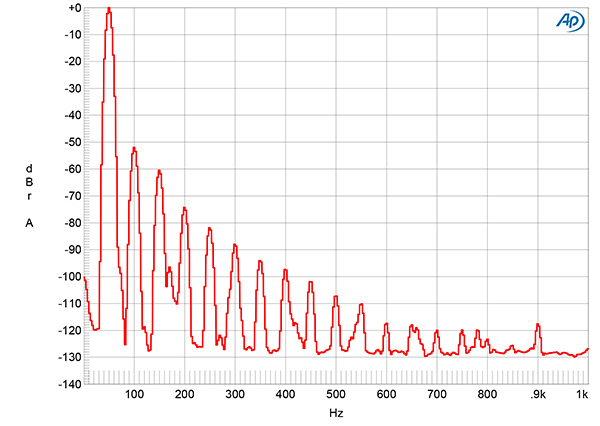
Fig.8 Octave Jubilee Class A, Low Power, spectrum of 50Hz sinewave, DC–1kHz, at 10W into 8 ohms (linear frequency scale).
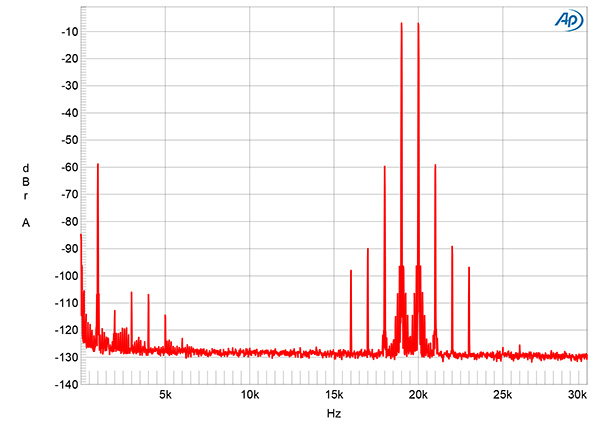
Fig.9 Octave Jubilee Class A, Low Power, HF intermodulation spectrum, DC–30kHz, 19+20kHz at 20W peak into 4 ohms (linear frequency scale).
The Octave's distortion signature into 8 ohms with a 1kHz signal predominantly comprised the third harmonic (fig.7), though the second harmonic was slightly higher in level at the same voltage at low frequencies (fig.8). Despite the slight rise in THD+N in the top octaves shown in fig.6, intermodulation distortion with an equal mix of 19 and 20kHz tones at 20W into 4 ohms was relatively low in level (fig.9). The 1kHz difference product and the higher-order products at 18 and 21kHz lay at –60dB (0.1%).
The Octave Jubilee Class A offered respectable measured performance, with low levels of distortion at moderate powers into higher impedances, coupled with a benign distortion signature and low levels of noise. However, as I noted with the earlier Jubilee Mono SE, I don't recommend the Jubilee Class A be used with loudspeakers whose impedance drops below 4 ohms. Also, I suspect that the slight shortfall in maximum power into 8 ohms was due to the use of KT120 output tubes rather than KT170s.—John Atkinson