Sidebar 3: Measurements
I examined the SPL Performer s900's behavior on the test bench with my Audio Precision SYS2722 system. Before I started the testing, I removed the two transit bolts on the bottom panel then preconditioned the amplifier by operating it at one-eighth the specified power into 8 ohms for 30 minutes. At the end of that time, the temperature of the perforated top panel was 139.6°F/58.9°C. This amplifier runs hot!
The Performer s900 has both balanced and single-ended inputs. I performed a full set of measurements at the balanced inputs, repeating some tests at the single-ended inputs. With the Input Trim switches set to "0," the voltage gain into 8 ohms was very close to the specified 26dB, at 26.1dB from the balanced inputs and 26.3dB from the single-ended inputs. The Input Trim switches reduced the gain in both channels in 0.5dB steps, to a maximum reduction of 5.5dB.
The input impedance is specified as 20k ohms. I measured 16k ohms at 20Hz and 1kHz for the single-ended inputs, dropping inconsequentially to 14.7k ohms at 20kHz. The balanced input impedance was 12.2k ohms from 20Hz to 20kHz, ie, 6.1k ohms per phase. Both input types preserved absolute polarity (ie, were noninverting). The XLR jack is wired with pin 2 hot.
The FTC's updated Amplifier Rule states that maximum power should be assessed at other frequencies—not just 1kHz. I therefore repeated the power test with a 20kHz signal. At this frequency, the amplifier clipped at 195Wpc into 8 ohms (22.9dBW).
The SPL Performer s900 offers high power with low, predominantly even-order harmonic distortion. While supply-related spuriae were present in the right channel's output, these are sufficiently low in level that they won't have sonic consequences.—John Atkinson
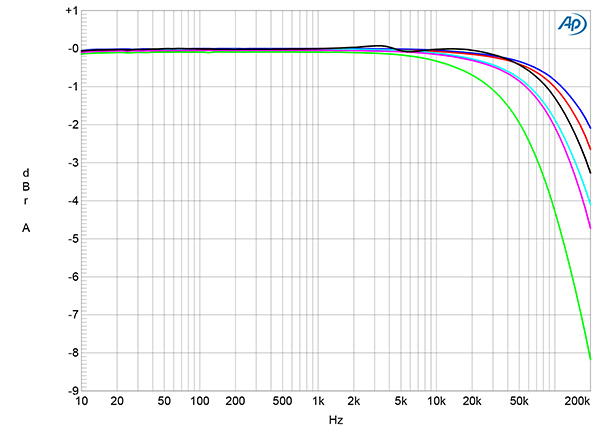
Fig.1 SPL Performer s900, frequency response at 2.83V into: simulated loudspeaker load (gray), 8 ohms (left channel blue, right red), 4 ohms (left cyan, right magenta), and 2 ohms (green) (1dB/vertical div.).
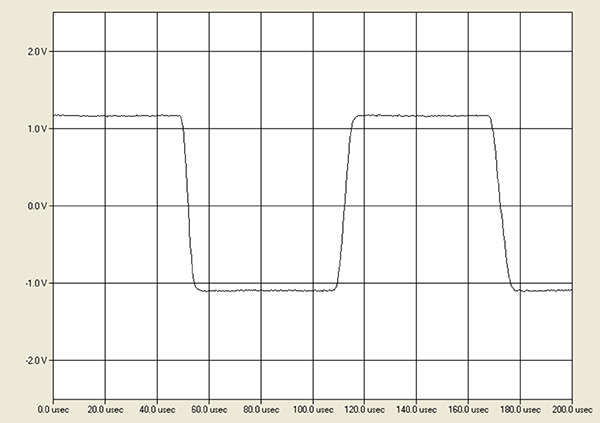
Fig.2 SPL Performer s900, small-signal, 10kHz squarewave into 8 ohms.
The SPL amplifier's output impedance at 20Hz and 1kHz was an extremely low 0.017 ohm, though it rose to 0.13 ohm at 20kHz. The modulation of the s900's frequency response driving our standard simulated loudspeaker was negligible (fig.1, gray trace), though with resistive loads the ultrasonic output progressively rolled off as the load impedance reduced. The response was down by just 2dB (left channel) and by 2.5dB (right channel) at 200kHz with the amplifier driving 8 ohms (fig.1, blue and red traces), but into 2 ohms it lay at –3dB at 72kHz (green trace). Fig.1 was taken with the balanced inputs and the Input Trim switches set to "0." The responses and the close channel matching were identical with the single-ended inputs and at different Input Trim settings. With the s900's wide bandwidth the 10kHz squarewave was superbly square, with no overshoot or ringing (fig.2).
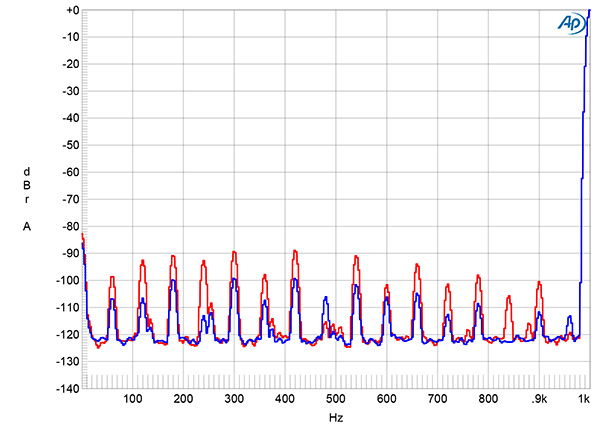
Fig.3 SPL Performer s900, spectrum of 1kHz sinewave, DC–1kHz, at 1W into 8 ohms (left channel blue, right red) (linear frequency scale).
Channel separation was excellent, at >80dB in both directions below 2kHz dropping to 60dB at the top of the audioband. The unweighted, wideband signal/noise ratio, taken with the single-ended inputs shorted to ground, ref. 1W into 8 ohms, was 68.8dB in the left channel but 57.2dB in the right channel. These ratios improved to 90dB left and 82dB right when I restricted the measurement to the audioband and by another 3dB with an A-weighting filter in circuit. Spectral analysis of the low-frequency noisefloor (fig.3) revealed a low level of random noise but higher levels of AC-supply–related harmonics at 60Hz and harmonics, particularly in the right channel (red trace), though these still lie at or below –90dB ref. 1W into 8 ohms. Fig.3 was taken with the balanced inputs; the spectra were identical with the single-ended inputs or if I lifted the ground connections on the Audio Precision's outputs. The even-order, supply-related harmonics in this graph are due to a nonzero impedance to ground somewhere in the circuit; the odd-order harmonics are due to magnetic interference from the hefty toroidal power transformer (described as "shielded" in the manual).
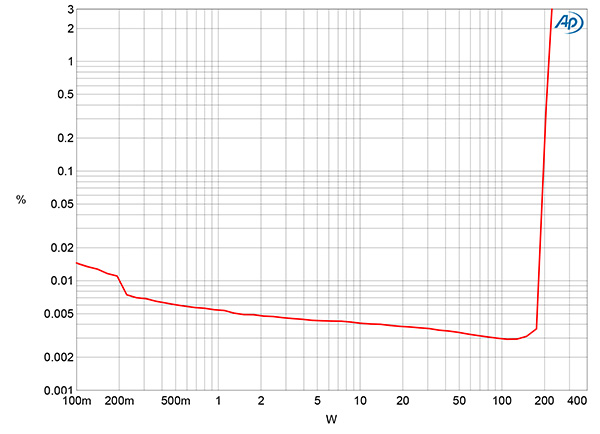
Fig.4 SPL Performer s900, left channel, distortion (%) vs 1kHz continuous output power into 8 ohms.
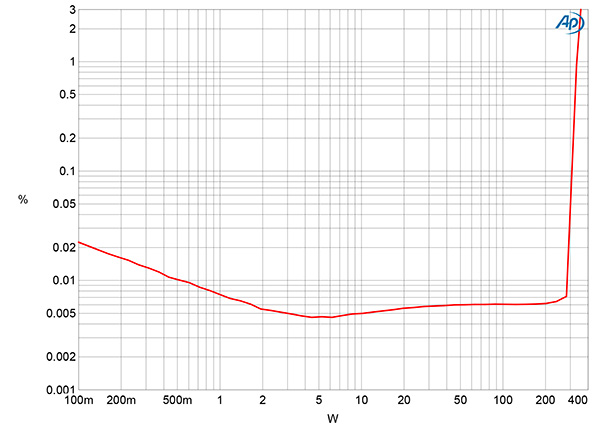
Fig.5 SPL Performer s900, left channel, distortion (%) vs 1kHz continuous output power into 4 ohms.
The Performer s900's maximum power is specified as 200Wpc into 8 ohms (23dBW), 370Wpc into 4 ohms (22.67dBW), and 420Wpc into 2 ohms (20.2dBW). With clipping defined as when the THD+noise in the output reaches 1%, the SPL's clipping power with both channels driven was 210W into 8 ohms (23.22dBW, fig.4) and 335W into 4 ohms (22.24dBW, fig.5). The latter is slightly lower than the specified power into 4 ohms, but my AC line voltage had dropped from 118.9V with the s900 idling to 116.5V with the amplifier clipping into 4 ohms.
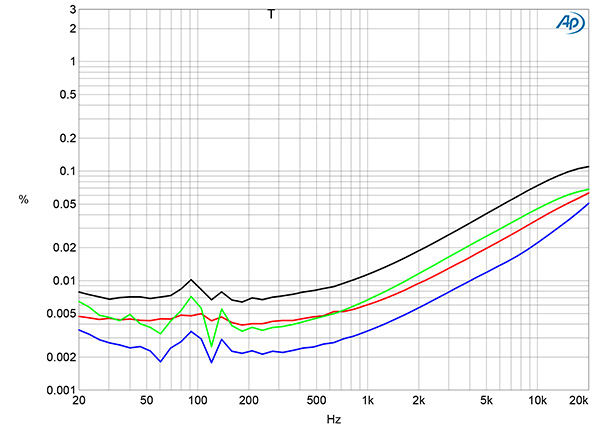
Fig.6 SPL Performer s900, THD+N (%) vs frequency at 20V into: 8 ohms (left channel blue, right red), 4 ohms (left green, right gray).
Fig.6 shows how the SPL amplifier's THD+N percentage varied with frequency at 20V, equivalent to 50W into 8 ohms or 100W into 4 ohms. The distortion was higher in the right channel (red and gray traces) than it was in the left channel (blue, green traces). The distortion into both loads rises in the top octaves; this will be due to the circuit's limited open-loop bandwidth, which means that less corrective negative feedback is available as the frequency rises.
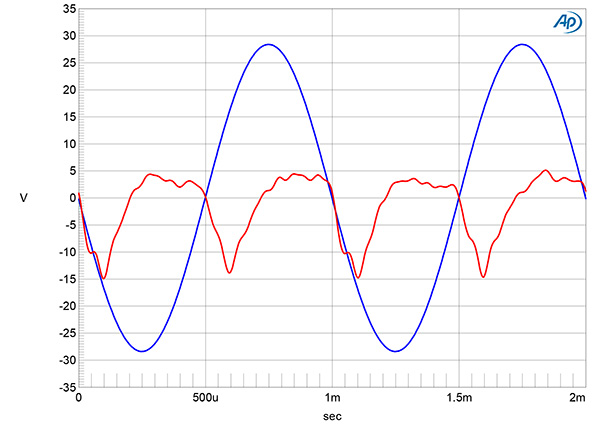
Fig.7 SPL Performer s900, left channel, 1kHz waveform at 100W into 4 ohms, 0.005% THD+N (blue); distortion and noise waveform with fundamental notched out (red, not to scale).
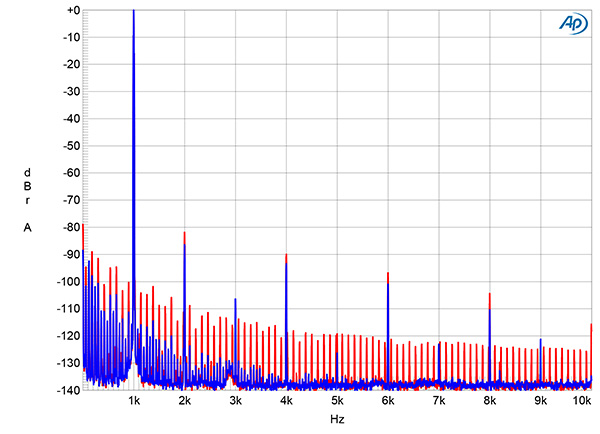
Fig.8 SPL Performer s900, spectrum of 1kHz sinewave, DC–10kHz, at 100W into 4 ohms (left channel blue, right red) (linear frequency scale).
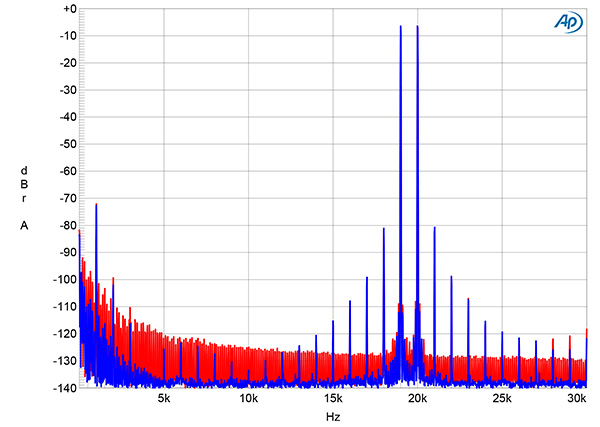
Fig.9 SPL Performer s900, HF intermodulation spectrum, DC–30kHz, 19+20kHz at 100W peak into 4 ohms (left channel blue, right red) (linear frequency scale).
The Performer s900's distortion signature was predominantly the second harmonic (fig.7), lying close to –80dB (0.01%) in both channels (fig.8), with the fourth harmonic 10dB lower in level. However, low-level supply-related spuriae are visible in this graph, particularly in the right channel (red trace). With an equal mix of 19 and 20kHz tones and the signal peaking at 100Wpc into 4 ohms (fig.9), the difference product at 1kHz lay close to –70dB (0.03%). The higher-order products all lay at or below –80dB (0.01%), though the supply-related spuriae are again higher in the right channel (red trace) than in the left channel (blue trace).