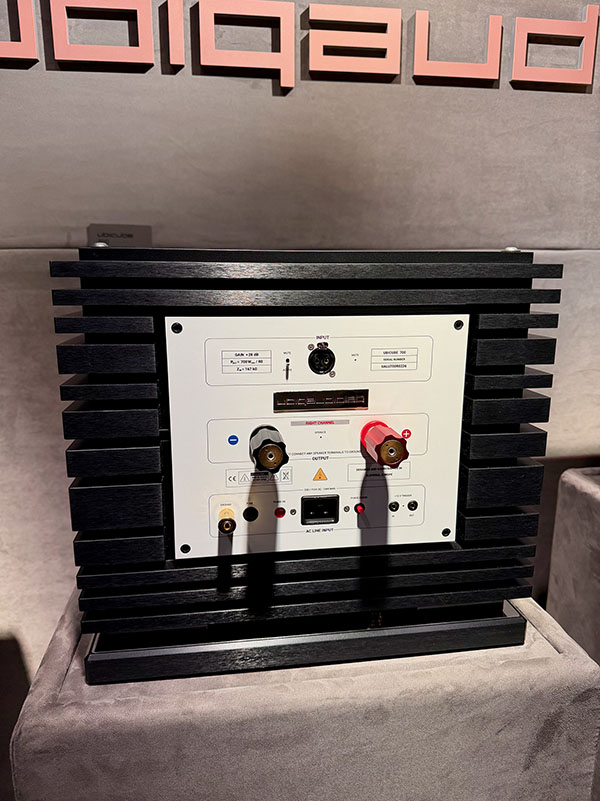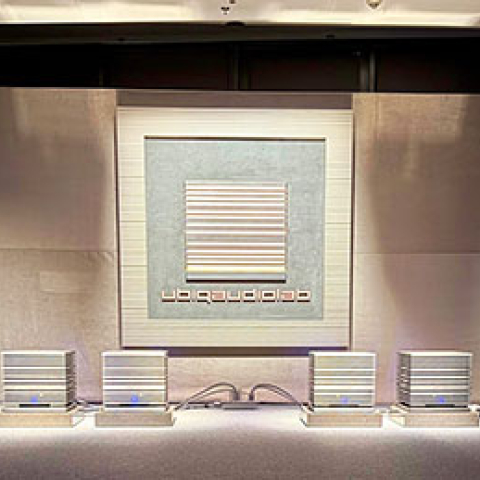

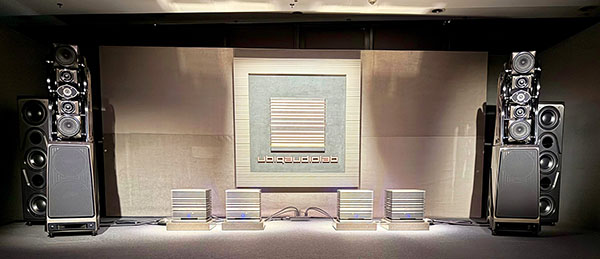
"The Most Expensive Audio System Ever Publicly Presented in Poland at Audio Video Show 2026!" So read the press release, which valued said system at approximately PLN 10 million. (A PLN is the Polish złoty, the country’s official currency; one złoty is worth about as much as one US quarter, so that translates to $2.5 million US.) A good share of the cost: the first active audio show presentation of Wilson Audio Autobiography loudspeakers, paired with Wilson Subsonic subs, a six-piece dCS Varèse DAC with transport, and the world premiere of Ubiqaudiolab's Ubicube 700 monoblock amplifiers and Ubiquitous 300B preamplifier.
At the risk of sounding like a politician beginning a major speech, there are rare moments when a show demonstration makes such a monumental impact on everyone in attendance that a short report will simply not suffice. Especially when the demonstration took place not in a large, partially treated air-walled room, but rather in a completely independent, no-expense-barred room-within-a-room that was assembled by a new and commanding presence, Ubiqaudiolab of Slovenia.
"The original space available was not ideal for a valid representation of the system, so we made the decision to design and construct an internal room," explained Ubiqaudiolab's sales director Pedro Jorge-Luis in a post-show email (which has been edited for brevity).
"After measuring the room, an internal skin was designed and built in Slovenia with ideal dimensions for a listening room. We constructed a metal frame clad with acoustical transparent cloth, in this case an equivalent look to Alcantara. Unseen acoustic treatment was applied between the walls of the room and inner room to allow complete acoustic control of the room. Furthermore, carefully calculated diffusers were mounted just above the listening area to avoid any interaction from the ceiling.
"All cosmetics were designed and built over a two-month period by Akrapovic Kreativa in conjunction with Igor Kante, artistic designer of Ubiqaudiolab, with acoustic design by Ricardo Franassovici of Absolute Sounds, distributor for Ubiqaudiolab. After the room was built in Slovenia, it was dismantled and transported to Warsaw, where it was built in situ in less than 24 hours."
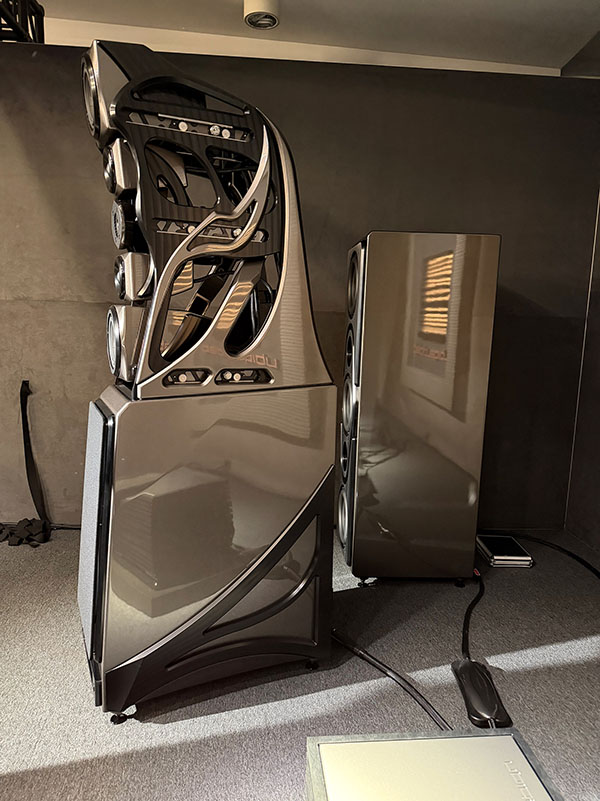
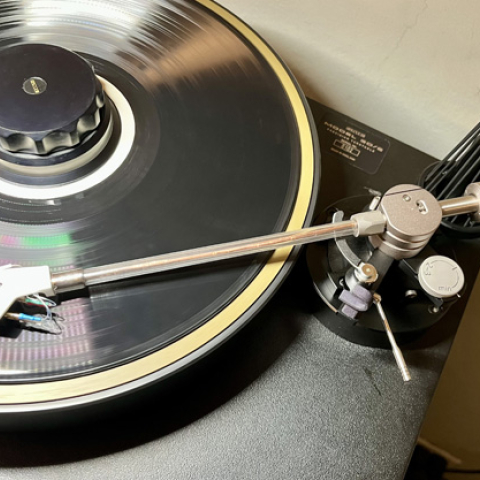
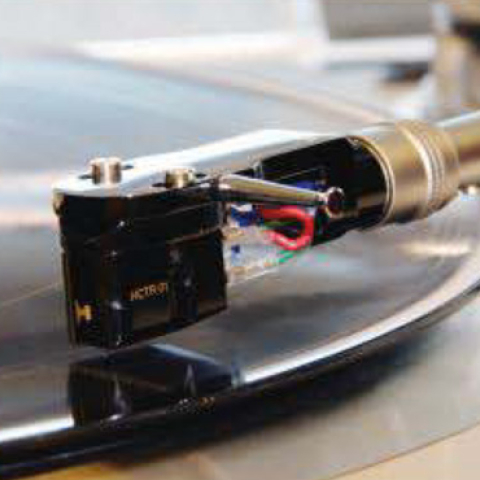
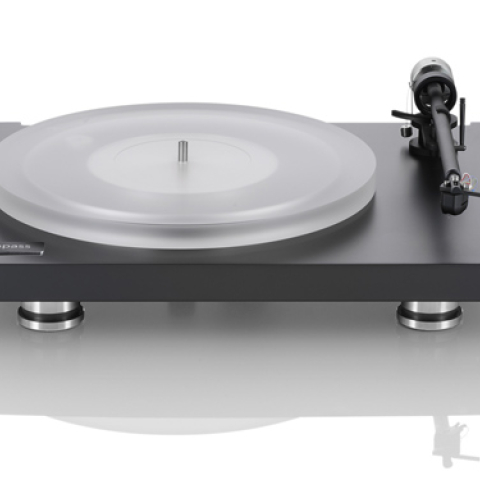
The no-expense spared equipment list: dCS Varese digital front end connected to an Oladra Presence server/player by USB, Dohmann Helix One turntable with Reed 5T tonearm and Analog Relax EX1000 cartridge, HSE ML7 phono stage, Ubiqaudiolab Ubiquitous 300B preamp and four Ubiqaudiolab Ubicube 700s driving Wilson Audio Autobiography loudspeakers and Wilson Audio Subsonic subs, Finite Elemente Pagode mkII Carbon Edition rack, Nordost QBase Reference AC distribution unit which fed all front-end components, Transparent Audio Magnus Opus interconnects (including Transparent ACTUS), speaker and power cables. Wilson Audio XO crossover was used for low pass; main speakers were used full range. hours. All equipment except the Uniqaudiolab components belonged to Igor Akrapovic, who was clearly determined to make a major impact on show attendees.
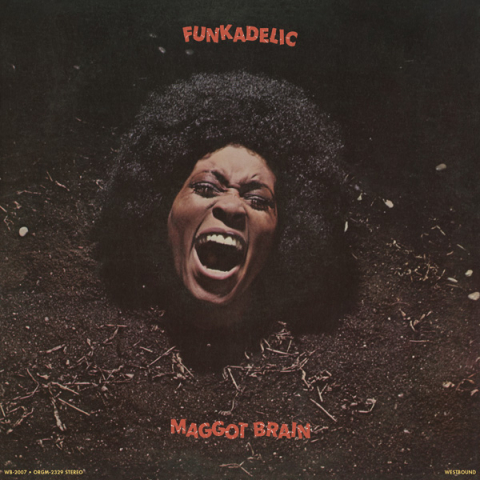
Thanks to calls to Wilson Audio's Peter McGrath and Franassovici, who is one of Europe's major distributors, I managed to secure a prime seat for both my visits. This wasn't easy, given that demos were timed and people lined up in advance at the door. At the first demo I attended, on Day 1, DJ honors went to Antoine Furbur; at the second, on Day 3, to Marco Cicogna, a music and equipment reviewer for Audio Review of Italy. Cicogna and Ubiqaudiolab assembled a 14-page, two-language 8.5x11-inch brochure that introduced 19 classical, jazz, film, and big band selections, some from old Telarc recordings, along with notes on each piece. Cicogna also spent a lot of time introducing each selection and telling us what to listen for. While he even told us what we would hear when we listened, he also provided the musical rationale for its importance.
The room's raison d'ětre, according to Akrapovic: "We wanted more music, less of a hi-fi sound. It has never been about the equipment; it was always about the emotion, and a way to experience the emotion of a concert in your home."
While I'm not certain you can fully experience emotion while listening to short snippets that were rendered even shorter due to their long introductions, the sound was sensational. It was the most glorious, arresting, colorful, solid, present, astoundingly large, and body/mind/spirit-enveloping reproduced sound I have ever experienced. (You can quote me.)
On Nat King Cole's "When I Fall in Love," transferred from tape to DSD64, his voice was the most gorgeous, warm, caressingly smooth, and liquid I've ever heard it. On a very different track that highlighted music students playing Bach, texture and color were perfection itself. Image size? Huge, of course. And on the quasi-obligatory Pink Floyd track, "Wish You Were Here," David Gilmour's opening guitar sounded obscenely good, the vocals and bass excellent.
Cigogna's choices were consistently as impressive, if not more so. From The Weavers' famed 1962 Carnegie Hall concert, "Guantanamera" blew my fragile little mind. Midrange truth, timbre, color, and natural warmth could not have been better. I hadn't heard a Jacques Loussier Trio's jazz take on classical music for many a year, but the sound was tremendous, with the slam on their version of Bach's Toccata and Fugue in D Minor perfect on every level. Oh my god, I said to myself, I never had any idea how good Telarc recordings could sound when I played them years ago. Equally impressive, albeit in a more massive, a might fortress is our God way: the huge size of the solid, as-low-as-you-can-possibly-go low C on a Bach Passacaglia, recorded in St. Michael's Church, Hamburg.
In my recent review of D'Agostino Momentum Z monoblocks (which will be posting soon; but you can read my news preview about them here), I noted how, with full orchestra, their Z technology brought out lowest bass lines, and bass in general, better than any other amplification I had heard in my room. In this much larger and purpose-constructed room, with Ubiqaudiolab electronics, bass was just as solid and perfectly pitched. Except, thanks to the speakers, bigger. Much, much bigger. And more detailed and palpable. We're talking Alexia V+Lōke subs vs. Autobiography +Subsonic subs.
Both listening sessions I attended kept me glued to my seat. The lowest notes and percussive pounds on the opening of Paavo Järvi and the NHK Symphony Orchestra, Tokyo's recording of Richard Strauss's Also sprach Zarathustra were sensational. (I would have given almost anything to hear the section that follows the opening, as well as the opening sunrise of Strauss's Alpine Symphony.) If I had to choose anything other than a prime orchestra seat in a great hall, I'd choose this spectacular system for music like this.
A brief word on the Ubiqaudiolab components, which are not yet available in the US. The Ubicube 700 monoblock contains "proprietary boutique-level ultra performing power modules," and has a DC-coupled, fully symmetrical, class-A JFET input stage, and a high-bias current class-A/B output stage. MOSFET power transistors, a Mundorf electrolytic capacitor bank, and Jupiter and Duelund copper foil decoupling capacitors are part of a design that outputs 700W into 8 ohms, 1200W into 4, and 2000W into 2. Input impedance is 167 kohms balanced. Weight: 222.667 lbs each. Two smaller monoblocks are also available.
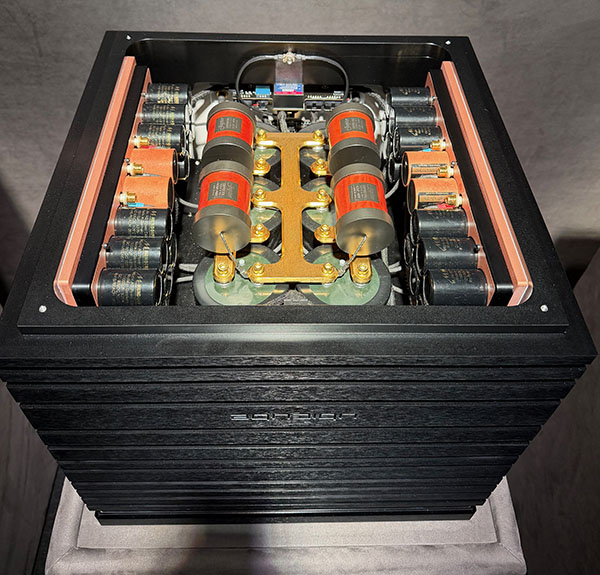
The "cost no object" Ubiquitous 300B preamplifier includes dual-mono class-A topology with a single modern Western Electric 300B tube per channel, a fully symmetrical balanced JFET class-A input stage, and more.
Ubiqaudiolab began in 2016, when artistic designer Igor Kanté and electronics engineer Andrej Lakner joined forces to design, create and build a monoblock amplifier. With encouragement and, I expect, financing from Igor Akrapovič, the founder of Akrapovič Kreativa who is known for his high-performance exhaust systems for racing motorcycles and expensive automobiles, Kanté and Lakner created Ubiqaudiolab. With Akrapovič's urging, they also began to create a 300B-based single-ended preamplifier. Eventually, Tomaz Majce joined the team as production manager.
Uniqaudiolab made its first public appearance at HiFi Deluxe during Munich 2024. (I missed them.) Franassovici picked them up, enlisted Jorge-Luis's technical support, and helped guide them to Warsaw.
Now I await news of their arrival in America.
For additional information, see https://issuu.com/akrapoviccom/docs/ubiqaudiolab_the_collection?fr=xKAE9_zMzMw.