As We See It

Sort By:  Post Date TitlePublish Date

To the Simple, Everything Appears Simple

My spirits sank as I read the comments on Stereophile's Facebook page. In the November issue, we had published reviews of UpTone Audio's USB Regen device by Kalman Rubinson, Michael Lavorgna, and myself. Michael and Kal had enthused about the positive effect the USB Regen had made, but I could detect no measurable difference. On Facebook, Dan Madden had written, "I think a device like this would need a blind listening test to verify that a listener could hear the difference in a statistically measurable way, in a very high percentage of times."
Too Good to Be True

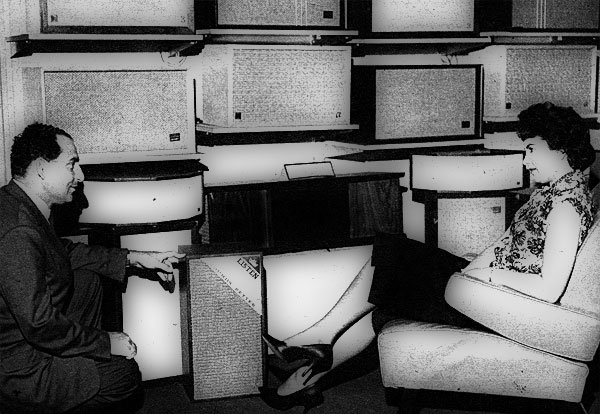
Two letters from readers (see below) started us thinking again about something we've mulled at, off and on, for the past year or so: Does today's high-fidelity equipment, for all its vastly improved performance, actually sound that much better than the best of the early components?

Two More Channels?

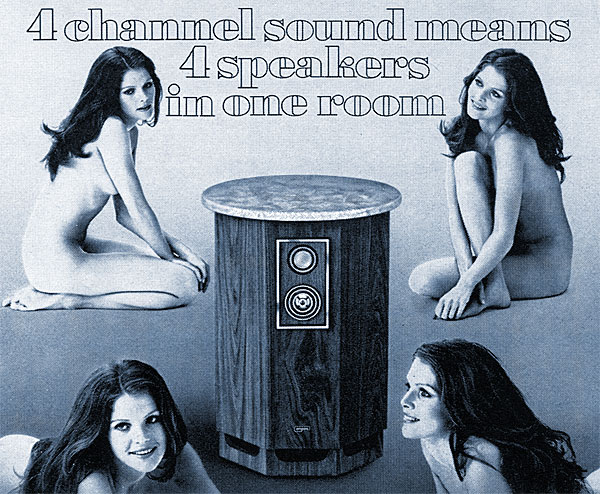
Four-channel stereo is here, but for how long? By the time this gets in print, it is extremely unlikely that any of our readers will have escaped being told that 4-channel stereo is here. "Two channels brought us direction," the announcements trumpet. "Now, four channels bring us dimension." Now, for the first time in the history of hi-fi, modern technology can bring us hall acoustics in stereo, to surround us with the sense of spaciousness that we hear in the concert hall.

We Don't Get No Respect

It never fails. Browse Stereophile's Facebook page, scroll through the comments to an article that refers to life as an audiophile, and splat—appearing like bird droppings on your glistening screen are anti-audiophile wisecracks pointing out exactly how far off the "normal" track our hobby has derailed. Occasionally, I catch myself in mid-sentence, already replying to one of these droppings, the gist of my intended message invariably being: "If you're an anti-audiophile, what are you doing using up what life you have left reading a webpage devoted to a hobby you don't get? Shouldn't you be hanging out with your own friends?" Then, realizing that I'm wasting my time.

A Measurement that Says Something

When we first heard rumors that Shure Brothers was about to unleash something called "trackability" on the audio world, our reaction was mainly one of indifference. We already had loudspeakers with listenability, tape recorders with portability, and amplifiers with stability and dependability. Trackability, we figured, was just another clever sales gimmick; a catchy word that the advertising department had thought up to describe what everyone wanted in a pickup.

Starting Over Again for the First Time

"There are two kinds of music. Good music, and the other kind," Duke Ellington is famously supposed to have said. But that doesn't tell us how to recognize "good music," and it doesn't define good. Nor will this essay. Many have described the music of, say, Mozart or J.S. Bach with such phrases as the music of heaven or the mind of God or—especially Bach's music—that it embodies the basic structure of the universe/existence/reality. I've said such things myself.

The Next Wave

I began working as a salesman of high-end audio gear in 1978. I was 29, and, as I recall, a healthy percentage of my customers were about my age. Most of the top high-end designers and entrepreneurs, too, were young: John Curl, Dan D'Agostino, Jon Dahlquist, Ray Kimber, Mark Levinson, Bill Low, Mike Moffat, Nelson Pass, Peter Snell, Bob Stuart, Jim Thiel, Ivor Tiefenbrun, A.J. van den Hul, Richard Vandersteen, Harry Weisfeld, David Wilson. The fact is, high-end audio's Golden Age—the late 1970s to the mid-1980s—was largely fueled by the under-40 set, and most high-end journalists were fellow baby boomers. Now we're all oldsters, with just a smattering of under-fortysomethings. That's about to change.

The Missing Specification

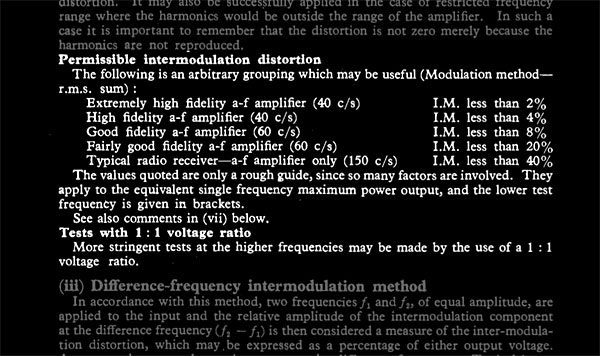
In the 1952 edition of the Radiotron Designer's Handbook, long recognized as the "bible" of the industry, the permissible level of IM distortion for a high-fidelity amplifier was given as 3%, with the alternate figure of 2% being cited as a "rather extreme" specification. We wonder what the author of that statement would think of today's solid-state amplifiers with their measured IM of 0.01% and less. And we wonder what he would think about the fact that these super-amplifiers still have audible distortion.

Why They Scorn Us—and Why We Should Care

Photo © Kipnis Studios 2015

Are you on Facebook? Twitter? Instagram? Reddit? Social media has done much to bring together people of every interest imaginable to share their fascinations, desires, and, occasionally, delusions. From fans of frogs (FrogStomp) and proponents of clean public toilets (Benjyo Soujer) to a group that challenged an Iranian cleric's statement that women's flimsy attire causes earthquakes (Boobquake), social media is a global town square in which anyone with a keyboard and an attitude has an equal voice.

The Silent Minority

Until about nine months ago, in the fall of 1970, FM radio station WFLN, Philadelphia, was just another one of that dying breed: the classical FM station. Like its counterparts in the few remaining classical-radio cities, it provides the major part of the high-fidelity listener's radio diet, and also like most similar classical stations, its fidelity was nothing to brag about.
Advertisement
Advertisement
Advertisement