

Book Review: "The Complete Guide to High-End Audio"
The Complete Guide to High-End Audio
by Robert Harley
450+xxiv pp., $29.95 softcover, $39.95 signed hardcover. Published by Acapella Publishing, P.O. Box 80805, Albuquerque, NM 87198-0805. Credit-card orders: (800) 848-5099.
by Robert Harley
450+xxiv pp., $29.95 softcover, $39.95 signed hardcover. Published by Acapella Publishing, P.O. Box 80805, Albuquerque, NM 87198-0805. Credit-card orders: (800) 848-5099.
Book Review: "High Fidelity Audio/Video Systems: A Critical Guide for Owners"
High Fidelity Audio/Video Systems: A Critical Guide for Owners
by Howard Ferstler
253 pages, $23.50 softcover. Published by McFarland & Company, Inc., Box 611, Jefferson, NC 28640. Tel: (919) 246-4460.
by Howard Ferstler
253 pages, $23.50 softcover. Published by McFarland & Company, Inc., Box 611, Jefferson, NC 28640. Tel: (919) 246-4460.
Book Review: Designing Audio Power Amplifiers

Designing Audio Power Amplifiers, Second Edition, by Bob Cordell, Routledge/Focal Press, 2019. 776pp. $160.00, hard cover; $97.95, paperback.
I first met Bob Cordell at clinics he gave at the last audio show Stereophile organized, Home Entertainment 2007, in Manhattan. At those clinics, Bob shared his views on why amplifier measurements are not always good at predicting differences in sound quality. So when I was scheduled to host a seminar"Amplifiers: Do Measurements Matter?"at this year's now-canceled AXPONA, Cordell was on the short list of designers I felt would offer valuable insight.
Book Review: Get Better Sound

Get Better Sound
By Jim Smith. Quarter Note Press (Cumming, GA), 2008. Paperback, 293 pages. ISBN 978-0-9820807-0-2. $44.50.
Web: www.getbettersound.comhttp://www.getbettersound.com">www.getbettersound.com;.
By Jim Smith. Quarter Note Press (Cumming, GA), 2008. Paperback, 293 pages. ISBN 978-0-9820807-0-2. $44.50.
Web: www.getbettersound.comhttp://www.getbettersound.com">www.getbettersound.com;.
Book Review: Sound Reproduction: Loudspeakers and Rooms
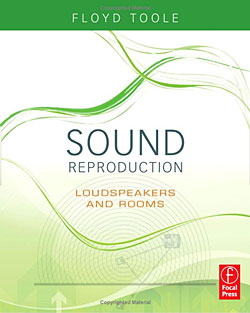
Sound Reproduction: Loudspeakers and Rooms
By Floyd E. Toole. Focal Press (Oxford, England, UK, www.elsevier.comhttp://www.elsevier.com">www.elsevier.com;, footnote 1), 2008. Paperback, 550 pages, ISBN 978-0240520094. $49.95.
By Floyd E. Toole. Focal Press (Oxford, England, UK, www.elsevier.comhttp://www.elsevier.com">www.elsevier.com;, footnote 1), 2008. Paperback, 550 pages, ISBN 978-0240520094. $49.95.
Book Review: Surround Sound: Up and Running (Second Edition)
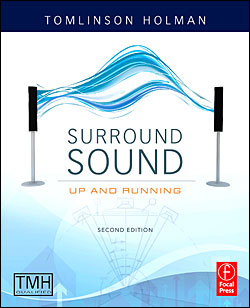
Surround Sound: Up and Running (Second Edition)
by Tomlinson Holman. Published by Focal Press, an imprint of Elsevier (footnote 1) (Oxford, England, UK; www.elsevier.comhttp://www.elsevier.com">www.elsevier.com;). 2008. Paperback, 248 pages, ISBN 978-0240808291. $44.95.
by Tomlinson Holman. Published by Focal Press, an imprint of Elsevier (footnote 1) (Oxford, England, UK; www.elsevier.comhttp://www.elsevier.com">www.elsevier.com;). 2008. Paperback, 248 pages, ISBN 978-0240808291. $44.95.
Book Review: Swiss Precision: The Story of the Thorens TD 124 and Other Classic Turntables

Swiss Precision: The Story of the Thorens TD 124 and Other Classic Turntables
Swiss Precision: The Story of the Thorens TD 124 and Other Classic Turntables
by Joachim Bung. Published by Joachim and Angelika Bung, Schmitten, Germany (info@td-124.de), 2008. Hardcover, 288 pages, four-color, ISBN 978-3-00-021162-1. Price: €59 plus overseas mailing.
Swiss Precision: The Story of the Thorens TD 124 and Other Classic Turntables
by Joachim Bung. Published by Joachim and Angelika Bung, Schmitten, Germany (info@td-124.de), 2008. Hardcover, 288 pages, four-color, ISBN 978-3-00-021162-1. Price: €59 plus overseas mailing.
Building the Hi-Fi House
Anyone who's ever looked for it knows how rare audio-friendly living space is. Perhaps someday an enterprising developer will build Audiophile Acres---a whole subdivision of audio houses or soundproofed condos that'll meet these needs---then stand by while hordes of long-suffering audiophiles stampede the sales office, frantically waving down-payments in their sweaty hands.
CD: Jitter, Errors & Magic
The promise of "perfect sound forever," successfully foisted on an unwitting public by the Compact Disc's promoters, at first seemed to put an end to the audiophile's inexorable need to tweak a playback system's front end at the point of information retrieval. Several factors contributed to the demise of tweaking during the period when CD players began replacing turntables as the primary front-end signal source. First, the binary nature (ones and zeros) of digital audio would apparently preclude variations in playback sound quality due to imperfections in the recording medium. Second, if CD's sound was indeed "perfect," how could digital tweaking improve on perfection? Finally, CD players and discs presented an enigma to audiophiles accustomed to the more easily understood concept of a stylus wiggling in a phonograph groove. These conditions created a climate in which it was assumed that nothing in the optical and mechanical systems of a CD player could affect digital playback's musicality.
Colloms on Cables
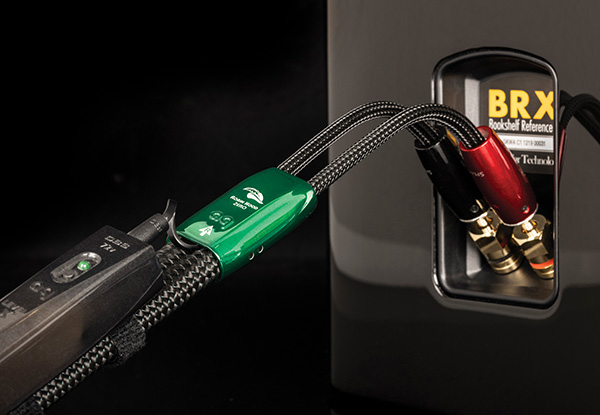
Underpinning a discussion about the merits of potentially costly specialist audio cables is an obvious question: Why do we need them? Doesn't almost all wire conduct audio signals with negligible distortion and very little loss of power? Specialist hi-fi cables seem expensive for what you get. Especially at the upper end, they seem like a worse value than electronics and loudspeakers. Depreciation is greater, too: Cables are almost a consumable.
But if you wish to finesse the quality endeavor of classic separates-based hi-fi systems, you cannot do without them. Fundamentally, it is not the efficient transfer of audio power that's the issue; that is the easy bit. Rather, it is a matter of optimizing the transmission of the more subtle information that describes recorded acoustic, instrumental detail, the performers, and, not least, dynamics and rhythm: Are your feet tapping unconsciously in time to the performance?