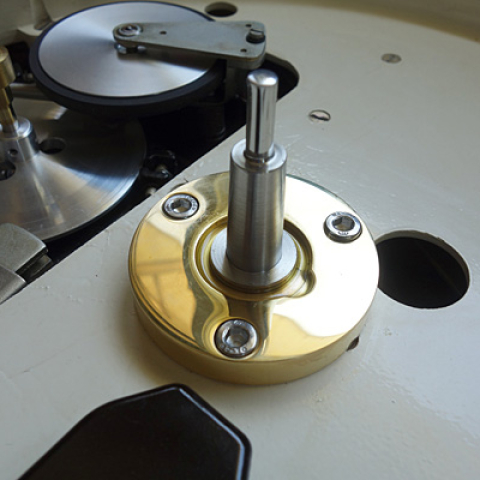
I was going through a box of old photographs, lingering over some pictures I'd taken at the Quad loudspeaker factory in Huntingdon, England, a number of years ago. It was my second trip overseas—1994 or '95—and while I remember being intrigued by the machinery and the test equipment and all, I know that the real impact of the tour was probably lost on me: I wasn't yet a Quad owner.
That's all changed, of course. In 2002, I bought Stereophile's review pair of the excellent Quad ESL-989, and used them regularly for the next four years. Then, a number of months ago, I bought a pair of vintage Quad ESLs (ca 1959) and spent several weeks bringing them back to life and up to spec (see my columns in the June and July 2006 issues).
Now I'm a Quad owner, and now I wish I could go back and see: How did they stretch those Mylar diaphragms? What kind of coating did they use on them? Precisely how did they test those ESL-63 panels? What were the people like who took in all the old Quad gear for repair?
The thing is, Quad electrostatics are now more to me than just appliances: They've helped to shape my point of view. They matter.
I've seen other brands have the same effect on other hobbyists—I can understand why some people have come to care about McIntosh, or Klipsch, or Thorens. Now Quad has affected me in much the same way.
Lowther's ticonal drivers
In 2007, the people who actually make Quad electrostatics are all in China, and I have no enthusiasm for very long airplane rides. But I can transpose a part of my enthusiasm to another venerable English brand that has shaped my point of view on domestic playback gear—and that, of course, is Lowther Loudspeaker Systems Ltd. As it happens, the Lowther factory, in Sidcup, Kent, is one of the few audio-equipment factories where I know I wouldn't be welcome.
 Neither would Mikey or Wes or Sam. Neither would you: The Lowther factory is off-limits to the press and the general public because the venerable company has diversified over the years, and Lowther now does a lot of contract work for the British military. These days, in fact, the making of Lowther loudspeakers seems to be the least important thing done at Lowther Loudspeaker Systems, in terms of profits and people-hours.
But even if they made only a dozen drivers per year, I'd still think it was the most important task in Kent, if not in all of England: Those distinctive and utterly fascinating drive-units, which have changed so little in the past 60 years, are the embodiment of certain combined qualities of which nothing else can boast.
I've written about Lowthers once or twice in this space—like a hibernating insect, I seem to obey a kind of a seasonal cycle when it comes to subjects such as this one, or that of the Linn LP12 and its various different power supplies—but the company's sheer endurance, and the unique relevance of their products to the modern single-ended-triode movement, are sufficient justification for that.
First and foremost, by combining low-mass paper cones with enormously powerful magnets and deliberately narrow voice-coil gaps, Lowther makes drive-units that are a great deal more sensitive than average. The Lowther PM2A, which is something of a standard-bearer among their 7" drivers, has a voltage sensitivity of 97dB in free air. Combined with a sensibly high impedance curve, that makes for a driver that's very efficient overall—a characteristic that will only increase under proper loading conditions (which I'll return to in a moment).
Second, for some of those same reasons, Lowthers are extremely fast, rivaling the best electrostatic panels in this regard.
Third, Lowthers are true full-range drivers. In a typical domestic installation, the aforementioned PM2A can reproduce a minimum of eight octaves—more, given a very good enclosure. Additionally, Lowthers perform that trick without electrical crossovers of any sort: A single voice-coil drives both a 7" parchment-like cone and a 3.5" treble "whizzer." And a clever spider design allows for the use of a specially shaped phase plug that prevents short-wavelength tones from being canceled out at the whizzer's apex.
Fourth, Lowthers are cool, in the same sense that Morgan automobiles, bamboo fly rods, and spirit-based woodworking finishes are cool. They appeal to the hobbyist who enjoys the challenge of working within certain technological limits, and who craves a higher-than-average degree of involvement with his or her hardware. In this instance, that's because the perfect Lowther enclosure has yet to be achieved, despite some tantalizing near-successes.
That Lowthers bring out the best in one small group also implies that they aren't for everyone: also very true. For one thing, the most successful Lowther enclosures have all been backwave horns or tapered, quarter-wave pipes—all of which tend to be large, conspicuous, domestically unacceptable things. For another, the drivers themselves have certain shortcomings, the likes of which make them unsuitable for less committed hobbyists. The narrow voice-coil gap is vulnerable to dust and other contaminants, and for that reason—and because the pull of the very heavy magnet can distort the driver's frame over time—the drivers may need occasional cleaning and realignment. That isn't too hard to do, but it requires a steady hand and lots of patience. (As in setting the breaker points on an old-fashioned distributor, a setting very painstakingly arrived at can be utterly ruined merely by tightening the locking bolts at the end of the procedure—and so you must start all over again.)
Neither would Mikey or Wes or Sam. Neither would you: The Lowther factory is off-limits to the press and the general public because the venerable company has diversified over the years, and Lowther now does a lot of contract work for the British military. These days, in fact, the making of Lowther loudspeakers seems to be the least important thing done at Lowther Loudspeaker Systems, in terms of profits and people-hours.
But even if they made only a dozen drivers per year, I'd still think it was the most important task in Kent, if not in all of England: Those distinctive and utterly fascinating drive-units, which have changed so little in the past 60 years, are the embodiment of certain combined qualities of which nothing else can boast.
I've written about Lowthers once or twice in this space—like a hibernating insect, I seem to obey a kind of a seasonal cycle when it comes to subjects such as this one, or that of the Linn LP12 and its various different power supplies—but the company's sheer endurance, and the unique relevance of their products to the modern single-ended-triode movement, are sufficient justification for that.
First and foremost, by combining low-mass paper cones with enormously powerful magnets and deliberately narrow voice-coil gaps, Lowther makes drive-units that are a great deal more sensitive than average. The Lowther PM2A, which is something of a standard-bearer among their 7" drivers, has a voltage sensitivity of 97dB in free air. Combined with a sensibly high impedance curve, that makes for a driver that's very efficient overall—a characteristic that will only increase under proper loading conditions (which I'll return to in a moment).
Second, for some of those same reasons, Lowthers are extremely fast, rivaling the best electrostatic panels in this regard.
Third, Lowthers are true full-range drivers. In a typical domestic installation, the aforementioned PM2A can reproduce a minimum of eight octaves—more, given a very good enclosure. Additionally, Lowthers perform that trick without electrical crossovers of any sort: A single voice-coil drives both a 7" parchment-like cone and a 3.5" treble "whizzer." And a clever spider design allows for the use of a specially shaped phase plug that prevents short-wavelength tones from being canceled out at the whizzer's apex.
Fourth, Lowthers are cool, in the same sense that Morgan automobiles, bamboo fly rods, and spirit-based woodworking finishes are cool. They appeal to the hobbyist who enjoys the challenge of working within certain technological limits, and who craves a higher-than-average degree of involvement with his or her hardware. In this instance, that's because the perfect Lowther enclosure has yet to be achieved, despite some tantalizing near-successes.
That Lowthers bring out the best in one small group also implies that they aren't for everyone: also very true. For one thing, the most successful Lowther enclosures have all been backwave horns or tapered, quarter-wave pipes—all of which tend to be large, conspicuous, domestically unacceptable things. For another, the drivers themselves have certain shortcomings, the likes of which make them unsuitable for less committed hobbyists. The narrow voice-coil gap is vulnerable to dust and other contaminants, and for that reason—and because the pull of the very heavy magnet can distort the driver's frame over time—the drivers may need occasional cleaning and realignment. That isn't too hard to do, but it requires a steady hand and lots of patience. (As in setting the breaker points on an old-fashioned distributor, a setting very painstakingly arrived at can be utterly ruined merely by tightening the locking bolts at the end of the procedure—and so you must start all over again.)
In 2007, the people who actually make Quad electrostatics are all in China, and I have no enthusiasm for very long airplane rides. But I can transpose a part of my enthusiasm to another venerable English brand that has shaped my point of view on domestic playback gear—and that, of course, is Lowther Loudspeaker Systems Ltd. As it happens, the Lowther factory, in Sidcup, Kent, is one of the few audio-equipment factories where I know I wouldn't be welcome.
Neither would Mikey or Wes or Sam. Neither would you: The Lowther factory is off-limits to the press and the general public because the venerable company has diversified over the years, and Lowther now does a lot of contract work for the British military. These days, in fact, the making of Lowther loudspeakers seems to be the least important thing done at Lowther Loudspeaker Systems, in terms of profits and people-hours.
But even if they made only a dozen drivers per year, I'd still think it was the most important task in Kent, if not in all of England: Those distinctive and utterly fascinating drive-units, which have changed so little in the past 60 years, are the embodiment of certain combined qualities of which nothing else can boast.
I've written about Lowthers once or twice in this space—like a hibernating insect, I seem to obey a kind of a seasonal cycle when it comes to subjects such as this one, or that of the Linn LP12 and its various different power supplies—but the company's sheer endurance, and the unique relevance of their products to the modern single-ended-triode movement, are sufficient justification for that.