Spend as much time prowling audio websites as I do, and a pattern becomes clear. They're full of glamour shots of shiny products, promises of performance never before experienced, and cherry-picked pullquotes from reviews.
The website of Japanese audio concern Elekit is a different kind of experience. The site looks like it was designed by an engineer, and it probably was. No ultra-slick photography, no hyperbolic copy—nothing but product, straightforwardly presented, with simple photos. But once you start scrolling, things can get strange. While doing my research for this review of the Elekit TU-8888 monoblock amplifier ($4678/assembled pair), I was surprised—no, shocked—at what I found.
"Welcome to Elekit Web World," announces the landing page. Yes, Elekit makes tubed power amplifiers, stereo amps, and preamps, all sold as kits through US distributor VK Music, or fully assembled for a reasonable upcharge. That's the pitch. But scroll further and the landscape changes. Just below the listing for the PS-3250 Phono Equalizer Amp (on a circuit board without a chassis) is an entry for the Melody Top Kit. Below that is an official Robot Soccer Ball for the RoboCupJunior competition, which presumably is a thing in Japan. There's a yo-yo–like scroller. A Milk Carton Solar Lantern. A PET Bottle Solar Car. A Magnesium Fuel Cell Car. Electronic Dice, a Lie Detector, an electronic eraser, Solar Trembling Monsters, a Milk Carton Wind Power Generator, an infrared ball for robot soccer. DIY kits and soldering fun for the whole family!
Elekit's offbeat but charming online catalog, tube amplifiers alongside playful kits for toy melody machines and trembling monsters, is a perfect expression of Japan's DIY culture, as woven into the national fabric as sushi, craft, and mutual respect, not to mention a love for American hi-fi of the '50s and '60s.
As my recent visit to the Japanese factories of Denon and Marantz proved, Japanese audiophiles have an abiding love for the very fabric of hi-fi, reflected in the largely DIY MJ Audio Festival, at which Herb Reichert was recently fêted, and in Tokyo's many jazz kissa. During my visit, I saw vintage components from JBL, EMT, Denon, and Garrard, still working their magic. I visited Akihabara, Tokyo's "Electric Town," a blazing-neon district overflowing with amateur radio gear, vintage audio, manga, and consumer electronics at all price and quality levels, coexisting in improbable harmony.
"Japanese people generally enjoy making things and feel a strong sense of responsibility and pride in the items they create with their own hands," wrote Emi Tamura, marketing and sales department director of EK Japan Co., Ltd.—that's Elekit's official name—over email. "We believe the fact that 'Made in Japan' products once took the world by storm with their quality was a strong reflection of this Japanese character."
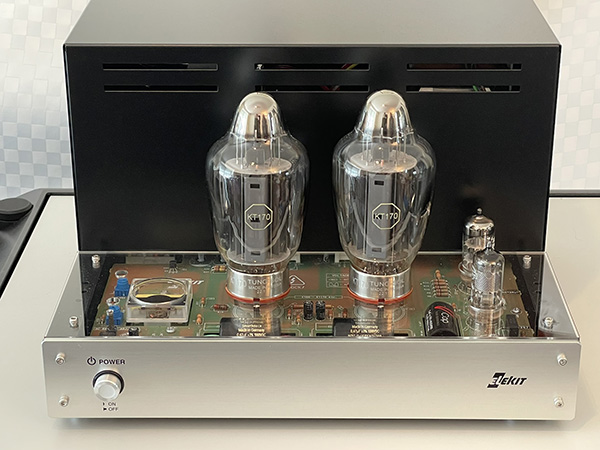 The ultimate DIY tube machine?
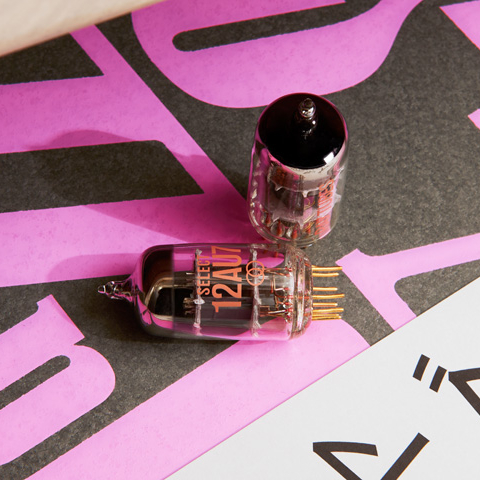
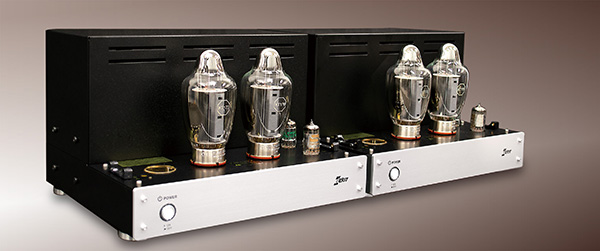
Introduced in Japan in December 2024, the Elekit TU-8888 tubed monoblock is a class-AB push-pull power amplifier that uses one EF86 at the input, amplifying voltage, and one 12AU7/ECC82, probably as a phase-splitter/driver feeding two KT170 (or KT150 or KT88) power tubes. The frequency response is specified as 10Hz–50kHz, –3dB, and output power as 60W with either KT150 or KT170 tubes or 50W with KT88s, all assessed with an 8 ohm load. The TU-8888 stands 13" wide × 12" deep × 8.5" high, weighs 22.5lb, and comes in any color you wish, as long as it's flat black. It's available in three configurations: as a kit with stock components but without tubes ($1275 each), as a kit with premium upgrades and tubes ($2054 each), or fully assembled by Victor Kung of US distributor VK Music, with premium upgrades, new-production power tubes, and NOS driver tubes ($2339 each). The 1.5m Furutech G-314Ag Plus Power Cable with Alpha Process Conductors included for this review is an available option. The assembled, upgraded version costs almost double what the basic kit version costs. What do you get for your money other than assembly? "The TU-8888s are assembled with WBT silver solder," Kung said. "The signal path uses 12 Audio Note Tantalum resistors. Coupling capacitors are two Mundorf MCap EVO SilverGold Oil 0.47s and one V-Cap CuTF 0.1 (Copper Foil Fluoropolymer Film). Driver tubes are a NOS Mullard (UK) EF86 (Mesh Plate) and a NOS RT (France) 12AU7W. Output tubes are a matched pair of Tung-Sol KT170s, yielding 66–70W output."
 I asked Emi Tamura about Elekit's design goals and sonic principles.
"We aim to create amplifiers that convey that sound exactly as it is, without adding anything superfluous," she replied. "We try to preserve the warm, easy-on-the-ears sound characteristic of vacuum tubes. To minimize hum and noise, we supply DC power for the heater and use [MOSFET] semiconductors in the high-voltage section to eliminate ripple, ensuring a stable, low-noise power supply. Our dealers and users can add their preferred sound character by swapping out components such as the output transformer and coupling capacitors. This can be easily achieved, which, in a sense, makes Elekit amps semicustom amplifiers."
Transformer turbulence
I asked Emi Tamura about Elekit's design goals and sonic principles.
"We aim to create amplifiers that convey that sound exactly as it is, without adding anything superfluous," she replied. "We try to preserve the warm, easy-on-the-ears sound characteristic of vacuum tubes. To minimize hum and noise, we supply DC power for the heater and use [MOSFET] semiconductors in the high-voltage section to eliminate ripple, ensuring a stable, low-noise power supply. Our dealers and users can add their preferred sound character by swapping out components such as the output transformer and coupling capacitors. This can be easily achieved, which, in a sense, makes Elekit amps semicustom amplifiers."
Transformer turbulence
The amp is sold as a kit or assembled, but when given free rein, Victor Kung, "the bartender," adds his secret sauce. "The Japanese sound is very clean," Kung wrote. "That is why I use Lundahl LL3733 output transformers and Mundorf and V-Cap coupling caps. I am a bartender. It's about taste. Americans want more MSG. Lundahl can provide just enough soy sauce to make the sound preferable by Western people. After many years of experience, my brain tells me what output transformer and what coupling caps have what type of sound.
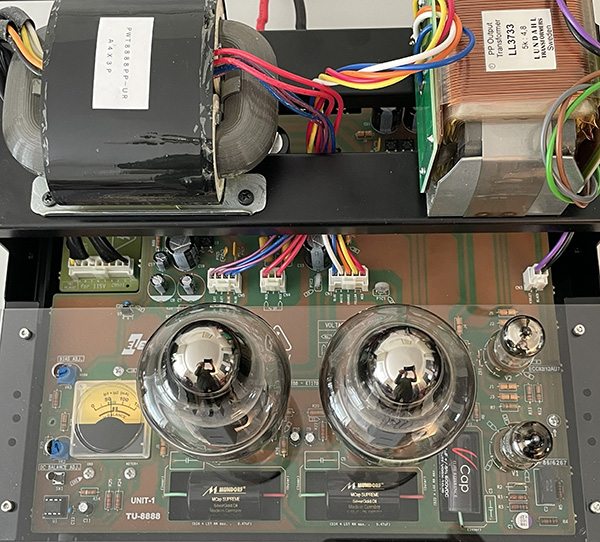
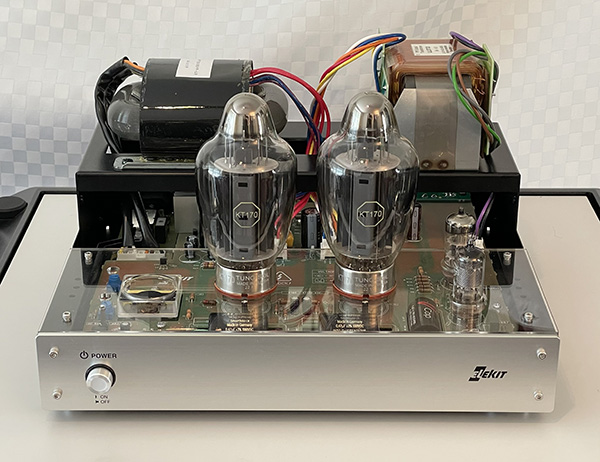
"Lundahl can make custom transformers," Victor continued, "but other premium Japanese transformer companies cannot. The TU-8888's amp design is based on the output transformer. The Lundahl output transformer we use can handle up to 140W output. We want the sweet range of the curve, so we limit the output to less than 50%. The advantages are better sound and higher reliability." The TU-8888 is a conversation starter the moment it hits your rack. Elekit isn't hiding anything: no hidden components under brushed aluminum, no mystery. A Canadian-made 4mm-thick acrylic top plate lays everything bare: user-friendly bias controls for the power tubes, Alps Alpine adjustment meter, V-Cap and Mundorf caps, assorted resistors, power tubes, driver tubes, all of it on full display like a tiny glowing city on a light-green PCB landscape.
Curiosity got the better of me, and I unscrewed the square steel transformer lid anchored to the amp's steel chassis, the faceplate a sleek slab of 4mm aluminum. Inside: a large, square, rounded cross-section Phoenix R-Core power transformer, stationed alongside the Swedish Lundahl LL3733 output transformer. Two transformers, two countries of origin. Which raises the obvious question: Why both?
"The Phoenix R-Core in the TU-8888 is custom made in Japan," Victor replied. "An R-core transformer features a rectangular, closed-loop iron core with a round cross-section and physically separated bobbin windings. Both R-core and toroidal transformers are highly efficient and compact options often used in high-end audio and sensitive electronic equipment. The fundamental difference lies in their core shape and winding method: Toroidal transformers have a continuous 'doughnut' shape, while R-core transformers use a rectangular core with rounded, cylindrical pillars."
As I write this, the World Cup is taking place in the US. An R-core transformer is shaped much like a soccer/football stadium, with straight sides wrapped by bobbins with windings inside and rounded ends to complete the magnetic circuit. The main differ ence between an R-core transformer and the better-known toroidal is that usually in a toroidal the windings overlap; in an R-core, they are separate: primary on one side, secondary on the other. That gives toroidals the advantage for maximum magnetic coupling efficiency, but the R-core has much lower capacitive coupling, which means that less electrical noise is transmitted.
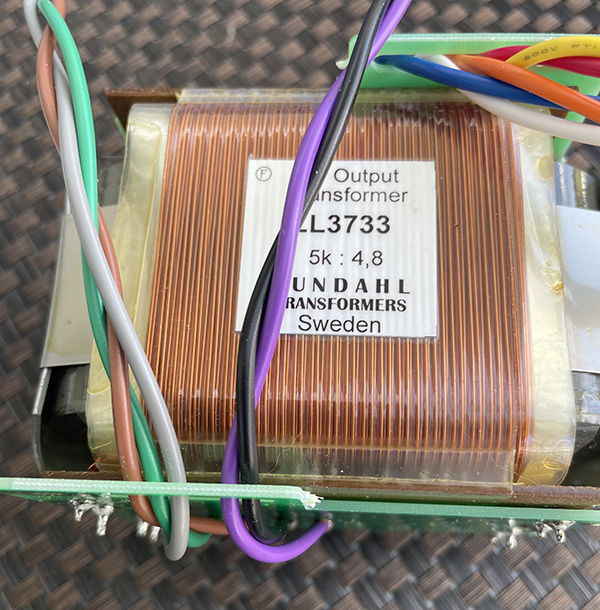 At the output there's a different kind of transformer. "The Lundahl LL3733 is a push-pull tube amplifier output transformer with 50% UL taps and a separate winding for 2% NFB (negative feedback)," Lundahl states on its website (footnote 1). "UL" here stands for Ultralinear. In the context of output transformers, that means that the screen grid is connected to the primary winding at a point some percentage of the way along its length—in this case 50% of the way.
This Lundahl transformer has a two-section secondary corresponding to different speaker loads, one for 4 ohms, the other for 8 ohms. "The windings are arranged to minimize destructive capacitive coupling between primaries and secondaries and for extremely small phase error between anode and UL tap. The C-core is a high-quality, grain-oriented silicon steel from our own production."
Why does Kung prefer Lundahl transformers to other brands for Elekit amps?
"Hashimoto/Tamura in Japan will not make transformers to custom specifications," he replied. "Lundahl will make custom output transformers to meet our specs and can make large quantities in a short period of time. Hashimoto cannot. This is how I keep the amplifiers affordable, by ordering Lundahl in quantity to get the maximum discount.
"Five or six years ago, Lundahl was much cheaper than Hashimoto, but Lundahl is now more expensive. Elekit amps work better with Lundahl than Hashimoto; we've tried both. It is just like mixing a wonderful cocktail drink: Blend the Lundahl output transformer with the Elekit amp—it's a perfect combo."
Other high-value components in the TU-8888 include custom printed circuit boards with much thicker traces. "While the standard copper foil thickness for PCBs is often 18µm, the TU-8888 PCB uses 70µm," Kung wrote. The tube sockets are Belton, from South Korea. The RCA jacks are Kai Yui Technologic from Taiwan.
You may recall from the description that the Lundahl output transformer has a built-in feedback winding. Yoshitsugu Fujita, Elekit's chief engineer and lead designer, dialed in the negative feedback (NFB) at a modest 10.5dB. "An output transformer's feedback winding—often called a tertiary winding—is a dedicated, third coil wind alongside the primary and secondary windings," Kung explained. "Its primary purpose is to provide an isolated, out-of-phase voltage signal to earlier amplifier stages. This creates a negative feedback loop to reduce distortion and improve loudspeaker damping. This is the best way to include NFB to make the amp more stable."
At the output there's a different kind of transformer. "The Lundahl LL3733 is a push-pull tube amplifier output transformer with 50% UL taps and a separate winding for 2% NFB (negative feedback)," Lundahl states on its website (footnote 1). "UL" here stands for Ultralinear. In the context of output transformers, that means that the screen grid is connected to the primary winding at a point some percentage of the way along its length—in this case 50% of the way.
This Lundahl transformer has a two-section secondary corresponding to different speaker loads, one for 4 ohms, the other for 8 ohms. "The windings are arranged to minimize destructive capacitive coupling between primaries and secondaries and for extremely small phase error between anode and UL tap. The C-core is a high-quality, grain-oriented silicon steel from our own production."
Why does Kung prefer Lundahl transformers to other brands for Elekit amps?
"Hashimoto/Tamura in Japan will not make transformers to custom specifications," he replied. "Lundahl will make custom output transformers to meet our specs and can make large quantities in a short period of time. Hashimoto cannot. This is how I keep the amplifiers affordable, by ordering Lundahl in quantity to get the maximum discount.
"Five or six years ago, Lundahl was much cheaper than Hashimoto, but Lundahl is now more expensive. Elekit amps work better with Lundahl than Hashimoto; we've tried both. It is just like mixing a wonderful cocktail drink: Blend the Lundahl output transformer with the Elekit amp—it's a perfect combo."
Other high-value components in the TU-8888 include custom printed circuit boards with much thicker traces. "While the standard copper foil thickness for PCBs is often 18µm, the TU-8888 PCB uses 70µm," Kung wrote. The tube sockets are Belton, from South Korea. The RCA jacks are Kai Yui Technologic from Taiwan.
You may recall from the description that the Lundahl output transformer has a built-in feedback winding. Yoshitsugu Fujita, Elekit's chief engineer and lead designer, dialed in the negative feedback (NFB) at a modest 10.5dB. "An output transformer's feedback winding—often called a tertiary winding—is a dedicated, third coil wind alongside the primary and secondary windings," Kung explained. "Its primary purpose is to provide an isolated, out-of-phase voltage signal to earlier amplifier stages. This creates a negative feedback loop to reduce distortion and improve loudspeaker damping. This is the best way to include NFB to make the amp more stable."
 Setup
Setup
The TU-8888's modest weight and small footprint made for an easy setup in my West Village walk-up. I noticed a "Master Gain" dial on the amplifier's back panel. I asked Kung what it's for: Why does an amplifier need a gain dial? Answer: It's basically a safety feature for adjusting bias. "For adjusting the bias, always turn the gain to lowest point to prevent any accident. Once the adjustment of the bias meter is perfect, set the gain to max." I biased the amps following the clear instructions on the amplifier's top panel, adjusting the two potentiometers to where the needle falls in the middle green section of the meter.
I started my appraisal of the TU-8888 amplifiers with the J.Sikora Standard Max Supreme turntable with the Aidas Tru-Stone Gold Web MC cart into the Manley Chinook phono stage. The line preamp was the Rogue RP7. The 8888s drove the 99dB-sensitive Volti Audio Lucera loudspeakers. Over the course of the review, I also used the DeVore Fidelity Super Nines and the Voxativ Ampeggios. The TU-8888s brought out the very different sonic qualities of each loudspeaker.
 Listening
I've got thousands of shiny black discs, yet every review finds me staring at the shelves, stumped. What should I play? Should I roll out the trusty standbys? Dive headlong into new releases with dicey sonics? It's a genuine conundrum, especially now, with contemporary jazz artists pressing to vinyl again. But, sonically speaking, the recordings rarely touch the depth and dimensionality of what DuNann, Schmitt, Plaut, and Van Gelder achieved in their tube- and transformer-packed studios. Still, Looking for Consonance by the jazz collective called George, pianist/composer Marta Sánchez's For the Space You Left, Adam O'Farrill's Elephant (all on Out of Your Head Records), and alto saxophonist Lakecia Benjamin's We Dream (on Artwork Records) gave the Elekit plenty to wrestle with. Let's not jump to conclusions: Would these records demonstrate the romance, continuity, and three-dimensional magic of '50s/'60s/'70s analog jazz? They would not. But the music itself is challenging, alive, and engaging.
But not yet. Before diving into the new releases, I spun some all-analog classics: Joni Mitchell's Court and Spark (Asylum 7ES 1001), Gene Ammons's Boss Tenor (Prestige PRLP 7180), and The Three Sounds' Introducing the 3 Sounds (Blue Note BLP 1600). The Elekits got out of the way—no grandstanding, no coloration, just music. They played it straight, revealing the warmish, totally tubular personality of the Rogue Audio preamp, and drove the stalwart Volti Audio Luceras with ease and speed. Bass was weighty, the midrange and treble were clear, and the sound was seamless. Joni shimmered, as she does. Ammons woozed and sustained in that unmistakable RVG milieu. The Three Sounds? Palpable, liquid, present. The TU-8888s had no discernible agenda—no etched treble, dull midrange, or fat, sloppy bass. Just honest, straight-up, true-to-the-source music.
 O'Farrill plays trumpet. His music is a complex tableau of enthusiastic, rhythmic sound, and the Elekit/Volti pairing showed that the recording is practically mono. Drums hit warm, punchy, and deep, while delicate snare stickings and twinkling upper-register trumpet notes floated free with excellent sustain. The music was forceful, palpable, and fast—charged, alive. Three words define the experience I was having with these Elekits: drama, speed, life.
Off the bat, the Elekit was see-through and clear-headed. I was hearing the contributions of the components upstream and downstream, and the music itself, more than I heard the Elekits. I could have wished for a tad more harmonic richness, a little more soundstage depth, but the TU-8888 did a fantastic job of playing the music.
Massive, sub-worthy bass came off the George record and out into my room. Drummer John Hollenbeck's metrically modulating math-jazz rhythms sounded super chunky and earthy. But it was Marta Sánchez's treated piano solo that provided the best sound of these Out of Your Head recordings; her plasticky upper-register piano notes sounded appropriately crinkly and tactile. Toward the middle of the keyboard, her right-hand notes were gossamer, atmospheric, transparent, while her left-hand chordal work had good power and tone. This solo piano outing is incredibly engaging and vital, and the Elekit nailed its (re)production ID to a T.
The Lakecia Benjamin record sounded entirely different through the Elekit than those Out of Your Head records. I heard more and better upper-tier air, more satisfying atmospherics, and vastly improved layering and depth and deep, rich bass.
Sure, this is a tube amp, and the Voltis are high-sensitivity horns. But don't expect this team to flatter or warm things up. The Elekit was a truth serum: coherent, balanced, wide-staged, and, when the music calls for it, plenty of oomph down below.
The DeVore Fidelity Super Nines reshuffled the deck; again, the Elekit stepped aside and let the speakers show their character. Now the sound was more midrange-focused, with softer yet still-snappy bass, laserlike treble, improved resolution, and a deeper soundstage that more completely unlocked the interior atmospherics of recordings. Compared to the Luceras, they gave up some weight and slam—7" versus 15" woofers will do that—but the sound was just as captivating.
The German-made Voxativ Ampeggio rearranged the deck chairs again. This floorstander pairs an 8" full-range driver with a large horn-loaded cabinet; designer Marie Vogel's magic touch is all over it. The Ampeggios are smooth, harmonically rich, and gloriously coherent. Day to day, I bathe in their fast, tone-rich sound.
O'Farrill plays trumpet. His music is a complex tableau of enthusiastic, rhythmic sound, and the Elekit/Volti pairing showed that the recording is practically mono. Drums hit warm, punchy, and deep, while delicate snare stickings and twinkling upper-register trumpet notes floated free with excellent sustain. The music was forceful, palpable, and fast—charged, alive. Three words define the experience I was having with these Elekits: drama, speed, life.
Off the bat, the Elekit was see-through and clear-headed. I was hearing the contributions of the components upstream and downstream, and the music itself, more than I heard the Elekits. I could have wished for a tad more harmonic richness, a little more soundstage depth, but the TU-8888 did a fantastic job of playing the music.
Massive, sub-worthy bass came off the George record and out into my room. Drummer John Hollenbeck's metrically modulating math-jazz rhythms sounded super chunky and earthy. But it was Marta Sánchez's treated piano solo that provided the best sound of these Out of Your Head recordings; her plasticky upper-register piano notes sounded appropriately crinkly and tactile. Toward the middle of the keyboard, her right-hand notes were gossamer, atmospheric, transparent, while her left-hand chordal work had good power and tone. This solo piano outing is incredibly engaging and vital, and the Elekit nailed its (re)production ID to a T.
The Lakecia Benjamin record sounded entirely different through the Elekit than those Out of Your Head records. I heard more and better upper-tier air, more satisfying atmospherics, and vastly improved layering and depth and deep, rich bass.
Sure, this is a tube amp, and the Voltis are high-sensitivity horns. But don't expect this team to flatter or warm things up. The Elekit was a truth serum: coherent, balanced, wide-staged, and, when the music calls for it, plenty of oomph down below.
The DeVore Fidelity Super Nines reshuffled the deck; again, the Elekit stepped aside and let the speakers show their character. Now the sound was more midrange-focused, with softer yet still-snappy bass, laserlike treble, improved resolution, and a deeper soundstage that more completely unlocked the interior atmospherics of recordings. Compared to the Luceras, they gave up some weight and slam—7" versus 15" woofers will do that—but the sound was just as captivating.
The German-made Voxativ Ampeggio rearranged the deck chairs again. This floorstander pairs an 8" full-range driver with a large horn-loaded cabinet; designer Marie Vogel's magic touch is all over it. The Ampeggios are smooth, harmonically rich, and gloriously coherent. Day to day, I bathe in their fast, tone-rich sound.
 With the Elekits and the Voxativs, George and Marta sounded small and lifeless. But when I played my 1980 all-analog Japanese copy of Steely Dan's Katy Lied, the sound jumped out at me, surrounded me, and punched me in the middle. Jeff Porcaro's drums had bite; Denny Dias's guitar solos and Donald Fagen's vocal soared, singed, and hit me like a rolling tsunami. It was uncanny how the Elekit changed personality—rather, revealed the full personality of every loudspeaker with speed, grace, and illumination.
Enter the Air Tight
With the Elekits and the Voxativs, George and Marta sounded small and lifeless. But when I played my 1980 all-analog Japanese copy of Steely Dan's Katy Lied, the sound jumped out at me, surrounded me, and punched me in the middle. Jeff Porcaro's drums had bite; Denny Dias's guitar solos and Donald Fagen's vocal soared, singed, and hit me like a rolling tsunami. It was uncanny how the Elekit changed personality—rather, revealed the full personality of every loudspeaker with speed, grace, and illumination.
Enter the Air Tight
At $14,975, the 35Wpc Air Tight ATM-1 SE costs three times what the Elekit costs, runs EL34s, and ranks among the finest amps I've reviewed. The Air Tight painted a grander stage, with more dimensional 3D texture, more deliberate layering, richer tonal color, and a top end that was smoother if less punchy and precise. It matched the Elekit's speed and bettered its bass—a little. The Air Tight is a more sophisticated machine, for sure, but the Elekit played in the same ballpark, and that speaks volumes for Elekit's engineering skills. The Elekit went toe-to-toe with the Air Tight and battled to a near draw.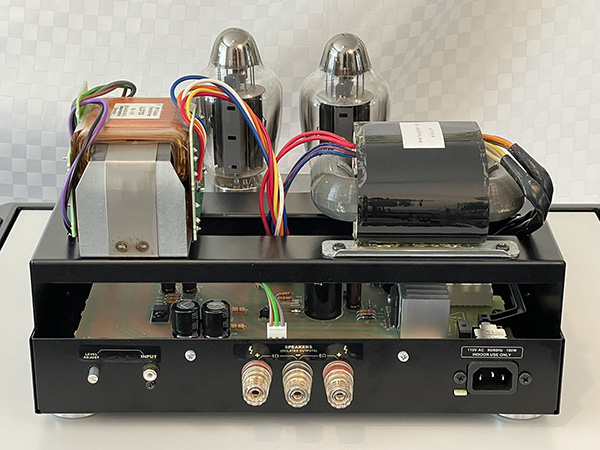 Conclusion
Gramophone Dreams columnist Herb Reichert has raved about Elekit amps, including the TU-8600R 300B. He wrote that it "may look like a generic, old-school, single-ended 300B integrated amplifier, but its sonic character is clean, neutral, and precise in a distinctly 21st-century way. It doesn't sound at all warm or soft, but fast and vigorous, as transparent as any amplifier, and extremely captivating." Herb's description of the Elekit TU-8600R maps perfectly onto my TU-8888 experience: fast, vigorous, transparent, and deeply captivating across all manner of loudspeakers. At $4678 assembled—or considerably less if you can solder—the TU-8888 stands among hi-fi's great bargains, stock or upgraded, kit or built.
Footnote 1: See lundahltransformers.com/wp-content/uploads/datasheets/3733.pdf.
The ultimate DIY tube machine?Introduced in Japan in December 2024, the Elekit TU-8888 tubed monoblock is a class-AB push-pull power amplifier that uses one EF86 at the input, amplifying voltage, and one 12AU7/ECC82, probably as a phase-splitter/driver feeding two KT170 (or KT150 or KT88) power tubes. The frequency response is specified as 10Hz–50kHz, –3dB, and output power as 60W with either KT150 or KT170 tubes or 50W with KT88s, all assessed with an 8 ohm load. The TU-8888 stands 13" wide × 12" deep × 8.5" high, weighs 22.5lb, and comes in any color you wish, as long as it's flat black. It's available in three configurations: as a kit with stock components but without tubes ($1275 each), as a kit with premium upgrades and tubes ($2054 each), or fully assembled by Victor Kung of US distributor VK Music, with premium upgrades, new-production power tubes, and NOS driver tubes ($2339 each). The 1.5m Furutech G-314Ag Plus Power Cable with Alpha Process Conductors included for this review is an available option. The assembled, upgraded version costs almost double what the basic kit version costs. What do you get for your money other than assembly? "The TU-8888s are assembled with WBT silver solder," Kung said. "The signal path uses 12 Audio Note Tantalum resistors. Coupling capacitors are two Mundorf MCap EVO SilverGold Oil 0.47s and one V-Cap CuTF 0.1 (Copper Foil Fluoropolymer Film). Driver tubes are a NOS Mullard (UK) EF86 (Mesh Plate) and a NOS RT (France) 12AU7W. Output tubes are a matched pair of Tung-Sol KT170s, yielding 66–70W output."
I asked Emi Tamura about Elekit's design goals and sonic principles.
"We aim to create amplifiers that convey that sound exactly as it is, without adding anything superfluous," she replied. "We try to preserve the warm, easy-on-the-ears sound characteristic of vacuum tubes. To minimize hum and noise, we supply DC power for the heater and use [MOSFET] semiconductors in the high-voltage section to eliminate ripple, ensuring a stable, low-noise power supply. Our dealers and users can add their preferred sound character by swapping out components such as the output transformer and coupling capacitors. This can be easily achieved, which, in a sense, makes Elekit amps semicustom amplifiers."
Transformer turbulenceThe amp is sold as a kit or assembled, but when given free rein, Victor Kung, "the bartender," adds his secret sauce. "The Japanese sound is very clean," Kung wrote. "That is why I use Lundahl LL3733 output transformers and Mundorf and V-Cap coupling caps. I am a bartender. It's about taste. Americans want more MSG. Lundahl can provide just enough soy sauce to make the sound preferable by Western people. After many years of experience, my brain tells me what output transformer and what coupling caps have what type of sound.
At the output there's a different kind of transformer. "The Lundahl LL3733 is a push-pull tube amplifier output transformer with 50% UL taps and a separate winding for 2% NFB (negative feedback)," Lundahl states on its website (footnote 1). "UL" here stands for Ultralinear. In the context of output transformers, that means that the screen grid is connected to the primary winding at a point some percentage of the way along its length—in this case 50% of the way.
This Lundahl transformer has a two-section secondary corresponding to different speaker loads, one for 4 ohms, the other for 8 ohms. "The windings are arranged to minimize destructive capacitive coupling between primaries and secondaries and for extremely small phase error between anode and UL tap. The C-core is a high-quality, grain-oriented silicon steel from our own production."
SetupThe TU-8888's modest weight and small footprint made for an easy setup in my West Village walk-up. I noticed a "Master Gain" dial on the amplifier's back panel. I asked Kung what it's for: Why does an amplifier need a gain dial? Answer: It's basically a safety feature for adjusting bias. "For adjusting the bias, always turn the gain to lowest point to prevent any accident. Once the adjustment of the bias meter is perfect, set the gain to max." I biased the amps following the clear instructions on the amplifier's top panel, adjusting the two potentiometers to where the needle falls in the middle green section of the meter.
ListeningI've got thousands of shiny black discs, yet every review finds me staring at the shelves, stumped. What should I play? Should I roll out the trusty standbys? Dive headlong into new releases with dicey sonics? It's a genuine conundrum, especially now, with contemporary jazz artists pressing to vinyl again. But, sonically speaking, the recordings rarely touch the depth and dimensionality of what DuNann, Schmitt, Plaut, and Van Gelder achieved in their tube- and transformer-packed studios. Still, Looking for Consonance by the jazz collective called George, pianist/composer Marta Sánchez's For the Space You Left, Adam O'Farrill's Elephant (all on Out of Your Head Records), and alto saxophonist Lakecia Benjamin's We Dream (on Artwork Records) gave the Elekit plenty to wrestle with. Let's not jump to conclusions: Would these records demonstrate the romance, continuity, and three-dimensional magic of '50s/'60s/'70s analog jazz? They would not. But the music itself is challenging, alive, and engaging.
O'Farrill plays trumpet. His music is a complex tableau of enthusiastic, rhythmic sound, and the Elekit/Volti pairing showed that the recording is practically mono. Drums hit warm, punchy, and deep, while delicate snare stickings and twinkling upper-register trumpet notes floated free with excellent sustain. The music was forceful, palpable, and fast—charged, alive. Three words define the experience I was having with these Elekits: drama, speed, life.
Off the bat, the Elekit was see-through and clear-headed. I was hearing the contributions of the components upstream and downstream, and the music itself, more than I heard the Elekits. I could have wished for a tad more harmonic richness, a little more soundstage depth, but the TU-8888 did a fantastic job of playing the music.
With the Elekits and the Voxativs, George and Marta sounded small and lifeless. But when I played my 1980 all-analog Japanese copy of Steely Dan's Katy Lied, the sound jumped out at me, surrounded me, and punched me in the middle. Jeff Porcaro's drums had bite; Denny Dias's guitar solos and Donald Fagen's vocal soared, singed, and hit me like a rolling tsunami. It was uncanny how the Elekit changed personality—rather, revealed the full personality of every loudspeaker with speed, grace, and illumination.
At $14,975, the 35Wpc Air Tight ATM-1 SE costs three times what the Elekit costs, runs EL34s, and ranks among the finest amps I've reviewed. The Air Tight painted a grander stage, with more dimensional 3D texture, more deliberate layering, richer tonal color, and a top end that was smoother if less punchy and precise. It matched the Elekit's speed and bettered its bass—a little. The Air Tight is a more sophisticated machine, for sure, but the Elekit played in the same ballpark, and that speaks volumes for Elekit's engineering skills. The Elekit went toe-to-toe with the Air Tight and battled to a near draw.
ConclusionGramophone Dreams columnist Herb Reichert has raved about Elekit amps, including the TU-8600R 300B. He wrote that it "may look like a generic, old-school, single-ended 300B integrated amplifier, but its sonic character is clean, neutral, and precise in a distinctly 21st-century way. It doesn't sound at all warm or soft, but fast and vigorous, as transparent as any amplifier, and extremely captivating." Herb's description of the Elekit TU-8600R maps perfectly onto my TU-8888 experience: fast, vigorous, transparent, and deeply captivating across all manner of loudspeakers. At $4678 assembled—or considerably less if you can solder—the TU-8888 stands among hi-fi's great bargains, stock or upgraded, kit or built.
Footnote 1: See lundahltransformers.com/wp-content/uploads/datasheets/3733.pdf.