Sidebar 3: Measurements
As the Elekit TU-8888 is supplied as a kit, it carries no serial number; the sample I measured was fitted with a matched pair of Tung-Sol KT170 output tubes, a Telefunken EF86, and a Radiotechnique 12AU7WA. The TU-8888 uses a manually adjusted fixed-bias scheme, set with the front-panel meter according to Elekit's prescribed procedure; I adjusted the bias at 50-minute intervals throughout a 30-minute warmup at 1W into 8 ohms before commencing the measurements, which were performed with an Audio Precision APx555 analyzer. Unless otherwise noted, measurements were taken from the 8 ohm output-transformer tap with the rear-panel input level control set to its maximum.
The Elekit TU-8888 preserved absolute polarity, ie, was noninverting. The voltage gain at 1kHz into 8 ohms was 28.2dB with the level control at its maximum. Elekit does not specify the input impedance, which will vary with the position of the level control. With the control at maximum, I measured approximately 36k ohms at 20Hz, 35k ohms at 1kHz, and 33k ohms at 20kHz, which will be an easy load for any preamplifier or source.
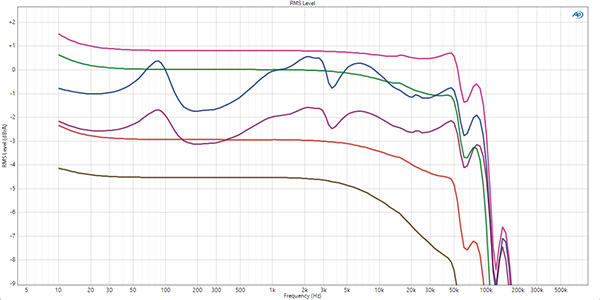
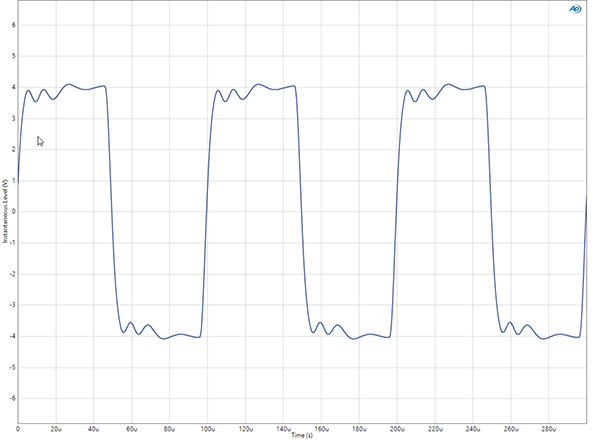
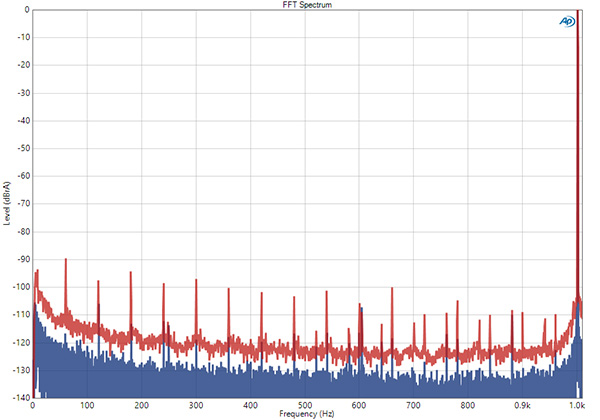
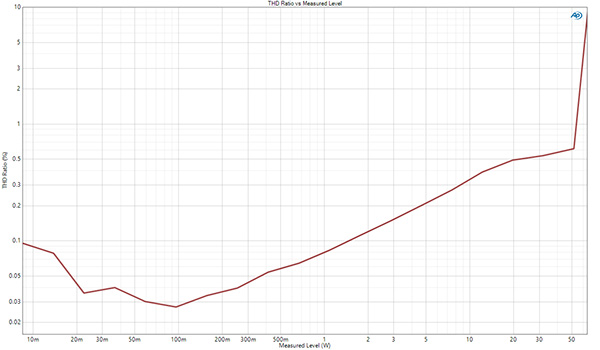
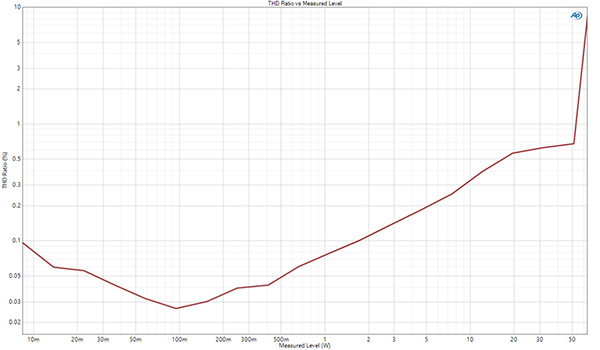
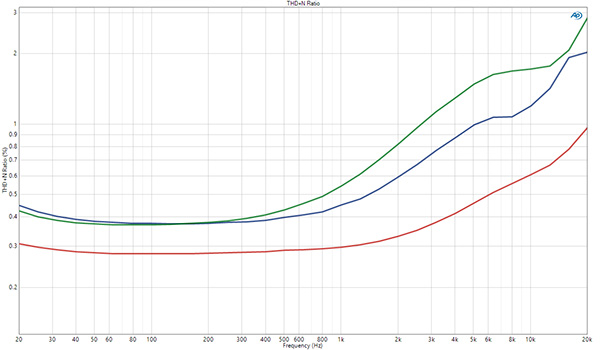
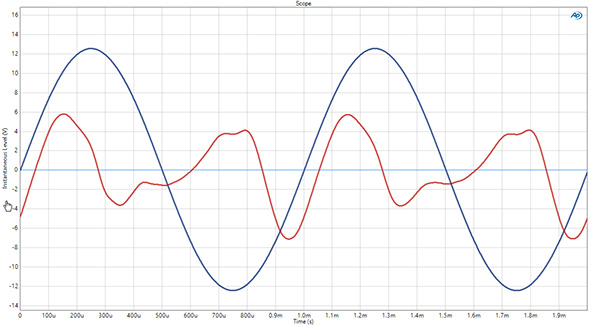
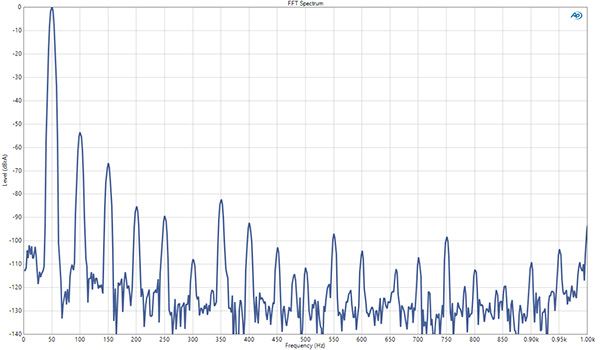
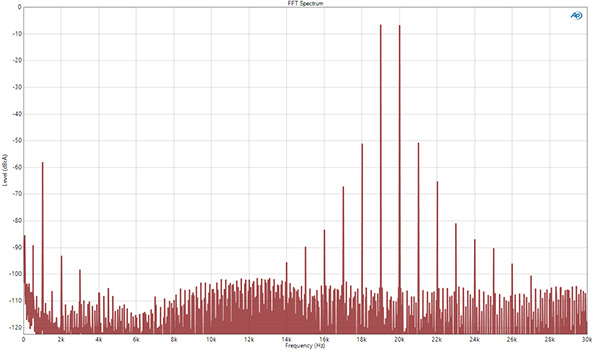
Fig.1 ElekitTU-8888, frequency response at 2.83V into: simulated loudspeaker load on 8 ohm tap(blue) and 4 ohm tap (purple), 16 ohms on 8 ohm tap (pink), 8 ohms on 8 ohm tap (green), 4 ohms on 4 ohm tap (red), and 2 ohms on 4 ohm tap (olive) (1dB/vertical div.).
Fig.2 Elekit TU-8888, small-signal 10kHz squarewave into 8 ohms.
The output impedance from the 8 ohm tap was 1.6 ohms at 20Hz and 1.5 ohms at 1kHz, rising to 2.4 ohms at the top of the audioband. From the 4 ohm tap, the corresponding figures were 1.0 ohm, 1.2 ohms, and 1.5 ohms. (That the 4 ohm tap's source impedance is not half that of the 8 ohm tap will be due to the TU-8888's overall negative feedback being taken from a dedicated winding on the Lundahl LL3733 output transformer rather than from the output tap itself.) As a result, the modulation of the amplifier's frequency response by the impedance of our standard simulated loudspeaker was somewhat greater from the 8 ohm tap (fig.1, blue trace), at ±1.1dB, than from the 4 ohm tap (fig.1, purple trace), at ±0.7dB. Into resistive loads matching each tap—16 ohms and 8 ohms on the 8 ohm tap (pink and green traces), 4 ohms and 2 ohms on the 4 ohm tap (red and olive traces)—the response was flat through the audioband, the –3dB point lying above 55kHz, comfortably meeting Elekit's bandwidth specification of 10Hz–50kHz, –3dB. The TU-8888's reproduction of a 10kHz squarewave into 8 ohms (fig.2) revealed a small, well-damped perturbation on the tops and bottoms of the waveform. This behavior was invariant with signal level, which indicates that it is a benign artifact of the output transformer. A 1kHz squarewave (not shown) was essentially perfect, with only a brief high-frequency perturbation at the transitions.
Fig.3 Elekit TU-8888, spectrum of 1kHz sinewave, DC–1kHz, at 1W into 8 ohms, with the input level control at maximum (red) and reduced to give full output with a 800mV input (blue) (linear frequency scale).
The Elekit's unweighted, wideband signal/noise ratio (ref. 1W into 8 ohms and measured with the unbalanced input shorted to ground and the level control at its maximum) was an excellent 88.2dB. This ratio improved to 90.7dB when the measurement bandwidth was restricted to 22Hz–22kHz and to 94.5dB when A-weighted. The A-weighted residual of 55µV is in line with Elekit's specified residual noise of 50µV (IHF-A, 8 ohm load). From the 4 ohm tap driving 4 ohms, the A-weighted residual was 44µV. Usefully, because the amplifier's noise is dominated by its input stage, these ratios were essentially unchanged with the level control at its minimum. Fig.3 illustrates the practical value of the rear-panel level control with a driven source: The red trace shows the spectrum of the TU-8888's output as it drove a 1kHz tone at 1W into 8 ohms with the control at maximum; for the blue trace, the control was backed off so that a 1W output would be reached with a 800mV input. The random noisefloor dropped by close to 10dB, with power-supply–related spuriae remaining at or below –105dB in both conditions. Owners with high-output sources or efficient loudspeakers should take advantage of this control.
Fig.4 Elekit TU-8888, distortion (%) vs 1kHz continuous output power into 8 ohms, 8-ohm tap.
Fig.5 Elekit TU-8888, distortion (%) vs 1kHz continuous output power into 4 ohms, 4 ohm tap.
Elekit specifies the TU-8888's maximum power with KT170 tubes as 60W into 8 ohms (17.8dBW), though at a relaxed 10% THD. With our usual definition of clipping, which is when the THD+noise reaches 1%, the Elekit clipped at 49.5W into 8 ohms (16.9dBW, fig.4) from the 8 ohm tap, requiring 790mV at the input against the rated input of 1V. Relaxing the definition to 3% THD+N, the TU-8888 clipped at 52.5W (17.2dBW). With a 16 ohm load on the 8 ohm tap, the amplifier reached 1% THD+N at 33W (18.2dBW) and 3% at 35W (18.4dBW). From the 4 ohm tap into 4 ohms (fig.5), the amplifier clipped at the same input voltage as from the 8 ohm tap, delivering the same 49.5W at 1% THD+N (13.9dBW), equivalent to 14.1V into 4 ohms. The FTC's updated "Amplifier Rule" states that maximum power should also be assessed at frequencies other than 1kHz;2 therefore, I repeated the power test at 20kHz. With this signal, the TU-8888 reached 1% THD+N into 8 ohms at just 4.71V, equivalent to 2.8W (2.4dBW), though the distortion rose only gradually beyond that point, reaching 4.1% at the input voltage that had produced 3% THD+N at 1kHz.
Fig.6 Elekit TU-8888, THD+N (%) vs frequency at 9V into: 16 ohms, 8 ohm tap (red), 8 ohms, 8 ohm tap (green), and 4 ohms, 4 ohm tap (blue).
Fig.6 shows how the percentage of THD+N varies with frequency at 9V—equivalent to 5W into 16 ohms, 10W into 8 ohms, and 20W into 4 ohms—into 16 ohms on the 8 ohm tap (red trace), 8 ohms on the 8 ohm tap (green trace), and 4 ohms on the 4 ohm tap (blue trace). The distortion was lowest into the 16 ohm load and rose in the top audio octaves into all three loads, which will be due to the circuit's limited open-loop bandwidth.
Fig.7 Elekit TU-8888, 1kHz waveform at 10W into 8 ohms, 0.35% THD+N (blue); distortion and noise waveform with fundamental notched out (red, 100dB gain).
Fig.8 Elekit TU-8888, spectrum of 50Hz sinewave, DC–1kHz, at 10W into 8 ohms (linear frequency scale).
Fig.9 Elekit TU-8888, spectrum of intermodulation distortion with an equal mix of 19 and 20kHz tones at 20W peak into 4 ohms (linear frequency scale).
Fig.7 shows the waveform of the residual distortion and noise at 10W into 8 ohms. Spectral analysis at this level revealed that the TU-8888's distortion signature predominantly comprised the subjectively benign second harmonic, which lay at –51dB (0.28%), closely followed by the third at –54dB (0.2%); all the higher-order harmonics lay at or below –67dB (0.045%). At low frequencies, the second harmonic became still more dominant: Fig.8 shows the spectrum of a 50Hz tone at 10W into 8 ohms, with the second harmonic lying at –54dB (0.2%) and the third at –67dB (0.045%). Despite the rise in THD+N in the top octaves shown in fig.6, intermodulation distortion with an equal mix of 19 and 20kHz tones at 20W peak into 4 ohms was low in level (fig.9): the 1kHz difference product lay at –58dB (0.13%) and the higher-order products at 18 and 21kHz at –51dB (0.28%).
The Elekit TU-8888 offers impressive measured performance for a push-pull tube amplifier, let alone one supplied as a kit. Its noise levels are low, its distortion signature is benign, and it approaches (but does not quite reach) its specified output power at a stricter distortion criterion than the one Elekit uses. The restricted maximum power at 20kHz suggests the TU-8888 is best partnered with loudspeakers that don't demand high power in the top octaves. The output impedance is high (though lower than that of some similar amplifiers), which means that its response will vary audibly with that of loudspeakers whose impedance swings widely.
The TU-8888 is an admirably well-engineered design, though it should be used with an appropriate loudspeaker and with the rear-panel level control sensibly set.—James Grinalds