Sidebar 3: Measurements
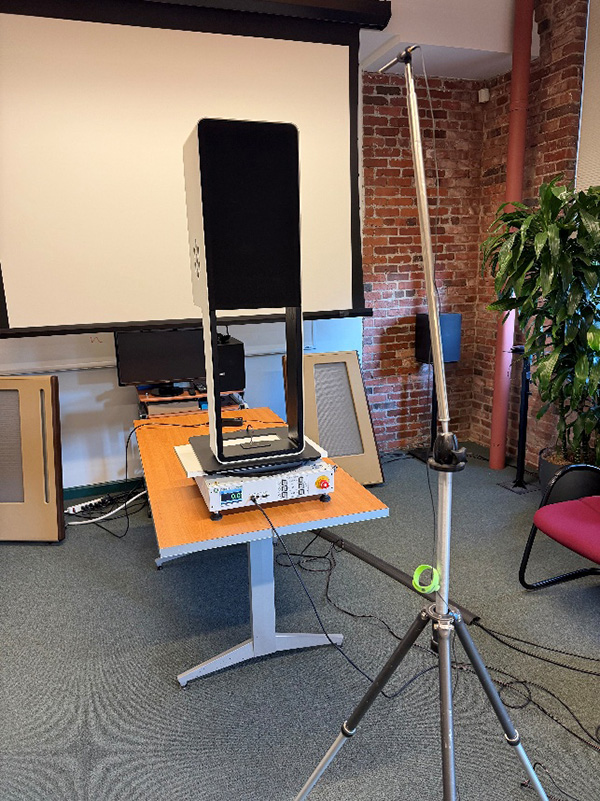 The Silent Pound Bloom loudspeaker was measured in a large conference room 11'11" H × 25'3" L × 15'8" W on top of a PT&D MDT turntable and with an accelerometer attached to the glass crossover cover. The speaker was measured on the tweeter axis at a 36" microphone distance. From the center of the tweeter to the floor was approximately 58". The first reflection was off the floor at about 5ms, limiting farfield resolution to 200Hz.
The equipment used for the measurements was a GRAS 40BD ¼" microphone and a 26CB preamp, with an SCM2 measurement ¼" microphone and an AmpConnect 621 audio interface and amplifier. The system was calibrated with a B&K 4231 acoustic calibrator at an SPL of 94dB at 1kHz.
The Bloom loudspeaker is a novel design. It's a challenging loudspeaker to measure due to its unconventional driver layout. For example, the tweeter is a 1.4" compression driver located in the throat of the 8" coaxial midrange driver with an acoustic lens in front. The two 12" woofers are arranged in an unusual dipole configuration.
The Silent Pound Bloom loudspeaker was measured in a large conference room 11'11" H × 25'3" L × 15'8" W on top of a PT&D MDT turntable and with an accelerometer attached to the glass crossover cover. The speaker was measured on the tweeter axis at a 36" microphone distance. From the center of the tweeter to the floor was approximately 58". The first reflection was off the floor at about 5ms, limiting farfield resolution to 200Hz.
The equipment used for the measurements was a GRAS 40BD ¼" microphone and a 26CB preamp, with an SCM2 measurement ¼" microphone and an AmpConnect 621 audio interface and amplifier. The system was calibrated with a B&K 4231 acoustic calibrator at an SPL of 94dB at 1kHz.
The Bloom loudspeaker is a novel design. It's a challenging loudspeaker to measure due to its unconventional driver layout. For example, the tweeter is a 1.4" compression driver located in the throat of the 8" coaxial midrange driver with an acoustic lens in front. The two 12" woofers are arranged in an unusual dipole configuration.
The Silent Pound Bloom loudspeaker was measured in a large conference room 11'11" H × 25'3" L × 15'8" W on top of a PT&D MDT turntable and with an accelerometer attached to the glass crossover cover. The speaker was measured on the tweeter axis at a 36" microphone distance. From the center of the tweeter to the floor was approximately 58". The first reflection was off the floor at about 5ms, limiting farfield resolution to 200Hz.
The equipment used for the measurements was a GRAS 40BD ¼" microphone and a 26CB preamp, with an SCM2 measurement ¼" microphone and an AmpConnect 621 audio interface and amplifier. The system was calibrated with a B&K 4231 acoustic calibrator at an SPL of 94dB at 1kHz.
The Bloom loudspeaker is a novel design. It's a challenging loudspeaker to measure due to its unconventional driver layout. For example, the tweeter is a 1.4" compression driver located in the throat of the 8" coaxial midrange driver with an acoustic lens in front. The two 12" woofers are arranged in an unusual dipole configuration.
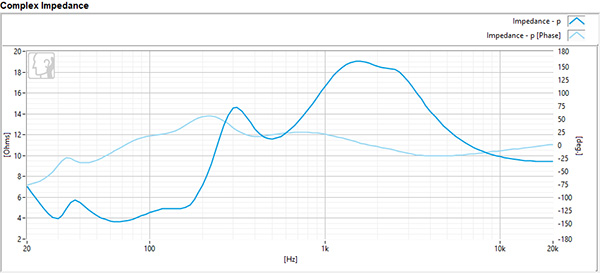
Fig.1 Silent Pound Bloom, electrical impedance (dark blue) and phase (light blue) (2 ohms/vertical div.).
The impedance is specified as 4 ohms. The minimum impedance is 3.7 ohms (fig.1, dark blue trace). The Bloom should be a fairly easy load for an amplifier with sufficient current due to the flat phase angle (light blue trace). Silent Pound specifies the Bloom's sensitivity as 87dB, but with no voltage or power mentioned. With the microphone pointing at the tweeter, the average sensitivity from 100Hz–10kHz was 87dB/2.83V/1m.
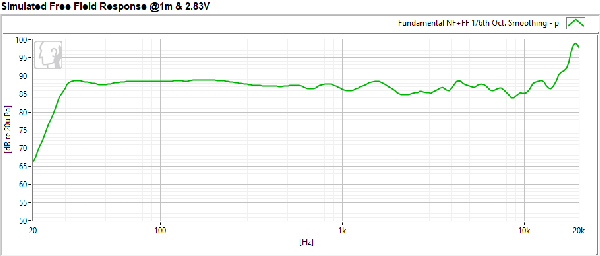
Fig.2 Silent Pound Bloom, 1/6-octave smoothed quasi-anechoic response with grille on tweeter axis at 36", corrected for microphone response.
The frequency response (fig.2) is fairly flat, with some high-frequency undulations, probably due to reflections from the acoustic lens, or phase plug, mounted in front of the 1.4" compression-driver tweeter.
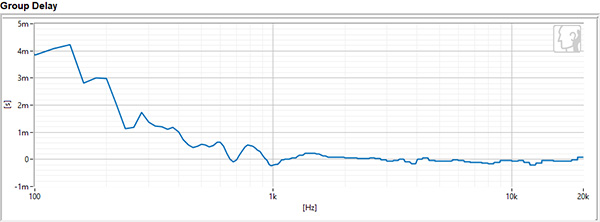
Fig.3 Silent Pound Bloom, group delay on tweeter axis at 36".
The group delay (fig.3) represents the difference in time it takes for sound at all frequencies to travel from the individual drivers and reach the measurement microphone. Ideally it should be zero but usually increases at low frequencies where the speaker driver is physically large and therefore difficult to time-align with the midrange and tweeter. As the Bloom's high-frequency driver is integrated into the coaxial 8" midrange cone, this time-aligns their acoustic centers. This results in a constant group delay above 700Hz.
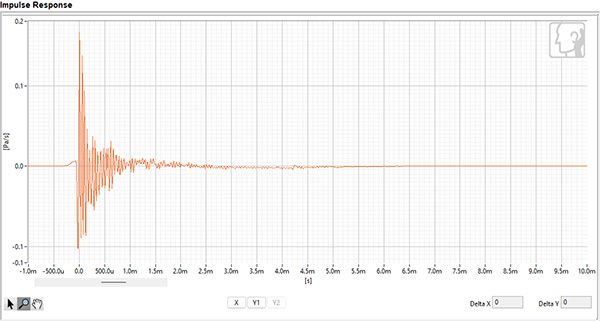
Fig.4 Silent Pound Bloom, impulse response with grille on tweeter axis at 36" (12ms time window).
There are some small, early reflections starting at about 0.3ms or 4" after the first arrival of sound at the measurement microphone. These could be caused by the edge of the midrange driver's cone, which is about 4" away from the tweeter. I could not remove the grille cloth to confirm. Otherwise, the impulse response (fig.4) is very compact, which should indicate good transient response.
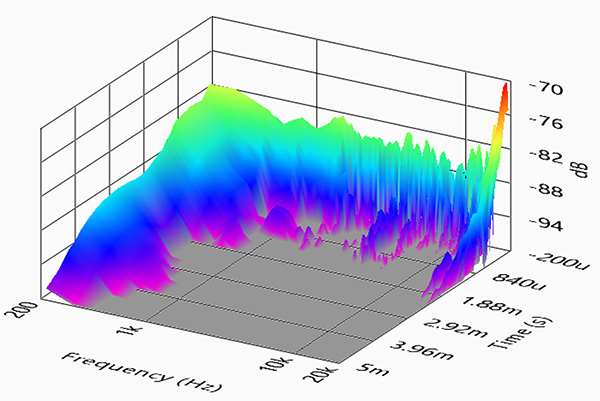
Fig.5 Silent Pound Bloom, cumulative spectral-decay plot with grille on tweeter axis at 36".
The waterfall, or cumulative spectral-decay, plot (fig.5) reveals good high-frequency transient response, though with a little bit of a resonance at 20kHz. There also appears to be some ringing at low frequencies around 200Hz, but that is quite common in woofers, especially near their resonance frequency.
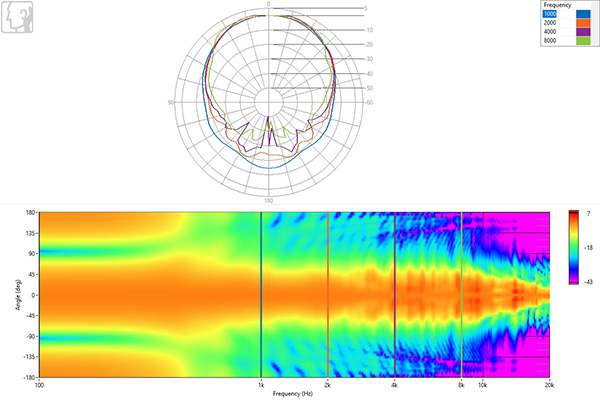
Fig.6 Silent Pound Bloom, lateral directivity with grille at 36", from back to front: differences in response 180–5° off axis, reference response, differences in response 5–180° off axis.
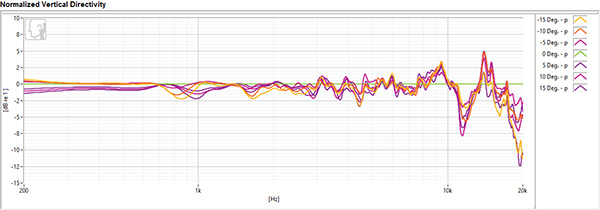
Fig.7 Silent Pound Bloom, vertical directivity with grille at 36": responses 15–5° above axis, reference response on tweeter axis (blue trace), responses 5–15° below axis.
The horizontal directivity (fig.6) is very good and well-controlled. There is an acoustic lens in front of the tweeter to help control directivity at high frequencies. At frequencies below 500Hz, where the two 12" woofers act as dipoles, there is very little output at the sides of the loudspeakers, but significant output comes out of the back. The low- and high-frequency directivity, as shown in the directivity plot, should help minimize early reflections off the listening room's sidewalls but increase the reflections at low frequencies off the room's rear wall. The speakers should not be placed too close to the rear wall, to prevent early reflections, and pointed at the listener to make sure they can hear the high frequencies. The owner's manual suggests placing the speakers a minimum of 3' from the rear wall and angling the speakers in towards the listening position. The Bloom owner's manual also shows the listener sitting with ears at roughly the same height as the tweeters but, based on the vertical directional measurements made (fig.7), there is not much difference in frequency response up to 10 kHz from –15° to +15° vertically.
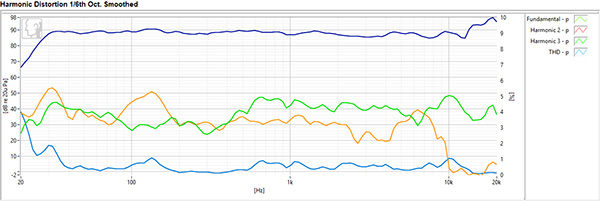
Fig.8 Silent Pound Bloom, harmonic distortion at 36" (fundamental, dark blue trace; second harmonic, orange trace, third harmonic, light blue trace; THD, green trace).
In order to measure harmonic distortion down to low frequencies, the microphone was placed closer to the loudspeaker, at 17", to reduce room reflections; the sound level was then corrected to a distance of 1m for an SPL of 90dB. For most of the frequency range, the total harmonic distortion (fig.8, green trace) is below 1%, which is quite good. There are a couple of bumps in the second harmonic at low frequencies around 30Hz and 150Hz (orange trace), which might be due to resonant frequencies.
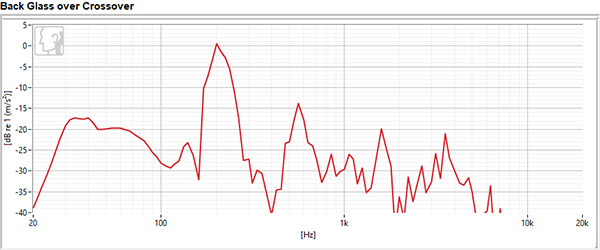
Fig.9 Silent Pound Bloom, cumulative spectral-decay plot calculated from output of accelerometer fastened to the glass back panel over the crossover. (Driving voltage to speaker, 2.83V; measurement bandwidth, 20kHz).
Finally, vibration measurements of the cabinet were made using an accelerometer to check for cabinet resonances that could impact the sound. The cabinet is made out of steel, so it is quite stiff, but steel can also ring, so there needs to be good damping as well as internal bracing. The accelerometer was placed at different positions on the panels and the vibration measured using the same sinewave sweep at 2.83V. The surface that had the highest vibration was the glass cover at 200Hz (fig.9). This could correlate with what was observed in the waterfall plot, which also showed some ringing at 200Hz.—Steve Temme