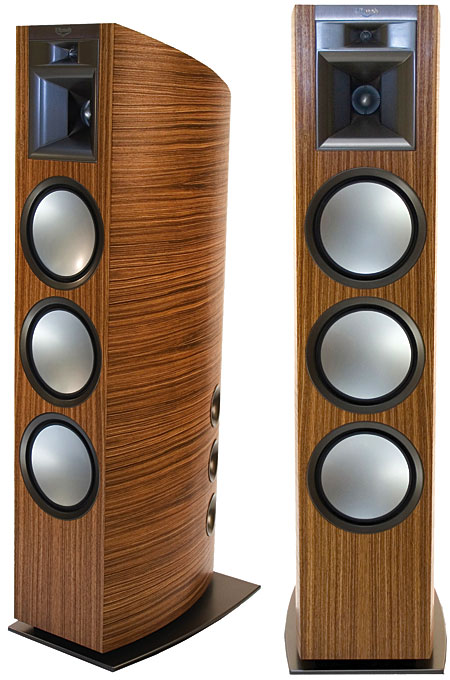
It ain't the stuff you don't know that trips you up, it's the stuff you know that ain't so. When, at the 2007 CEDIA Expo, I encountered Klipsch's startlingly new Palladium P-39F loudspeaker ($20,000/pair), I was impressed by its looks. Tall (56"), as beautifully contoured as the prow of a canoe, and clad in striking zebra-stripe plywood, the P-39F is possibly the best-looking speaker Klipsch has ever made.
 The Klipsch rep, too, was enthusiastic: "This is a loudspeaker that PWK would have approved of!" (Yes, seven years after the death of Paul W. Klipsch, employees still refer to the founder of Klipsch Audio Technologies as PWK—and why not? Most of them have worked there for so long that they knew PWK or were hired by him.)
"How so?" asked WP.
"Obviously, the midrange and tweeter are horn-loaded, but the P-39Fs are efficient, have low distortion, and controlled directivity—all goals that Paul Klipsch sought in every loudspeaker he ever designed. We kept those goals forefront in designing the Palladium line, and we went to DesignworksUSA for the industrial design of the speaker itself, although we developed all of the drivers in-house."
I ran my hand along the curved flank of one P-39F, admiring its fit'n'finish. Sensing weakness, the rep moved in for the kill. "Maybe you'd like to review them."
"No offense, but I don't really like horn speakers," I said.
As if I'd ever actually lived with a pair. I'd sold Klipsch speakers back when I was an audio salesman, but mostly two-way monitors—they were my fallback model when customers wanted more bass. I'd never spent much time with the "heritage" trio of Cornwall, La Scala, and Klipschorn—my loss, I now suspect.
In the late 1990s and early 2000s, I listened to many large, "retro" horns designed to complement single-ended-triode amplifiers, and I just didn't cotton to 'em. The bass frequently seemed completely disconnected from the mids and highs—and, in at least one example I heard at a Stereophile Home Entertainment Show, the outputs of the individual drivers didn't cohere until I was sitting about 30' away. Granted, I also heard many contemporary dynamic and electrostatic loudspeakers that didn't do it for me during those years, but I didn't dismiss those types of speakers out of hand—just horns.
The machinations of time and tide—not to mention an enthusiastic phone call from CNET's audio blogger Steve Guttenberg, who was rendered almost speechless by the P-39F—conspired to put a pair in my listening room, where indeed I did review them.
The horn, the horn, the lusty horn
The Klipsch rep, too, was enthusiastic: "This is a loudspeaker that PWK would have approved of!" (Yes, seven years after the death of Paul W. Klipsch, employees still refer to the founder of Klipsch Audio Technologies as PWK—and why not? Most of them have worked there for so long that they knew PWK or were hired by him.)
"How so?" asked WP.
"Obviously, the midrange and tweeter are horn-loaded, but the P-39Fs are efficient, have low distortion, and controlled directivity—all goals that Paul Klipsch sought in every loudspeaker he ever designed. We kept those goals forefront in designing the Palladium line, and we went to DesignworksUSA for the industrial design of the speaker itself, although we developed all of the drivers in-house."
I ran my hand along the curved flank of one P-39F, admiring its fit'n'finish. Sensing weakness, the rep moved in for the kill. "Maybe you'd like to review them."
"No offense, but I don't really like horn speakers," I said.
As if I'd ever actually lived with a pair. I'd sold Klipsch speakers back when I was an audio salesman, but mostly two-way monitors—they were my fallback model when customers wanted more bass. I'd never spent much time with the "heritage" trio of Cornwall, La Scala, and Klipschorn—my loss, I now suspect.
In the late 1990s and early 2000s, I listened to many large, "retro" horns designed to complement single-ended-triode amplifiers, and I just didn't cotton to 'em. The bass frequently seemed completely disconnected from the mids and highs—and, in at least one example I heard at a Stereophile Home Entertainment Show, the outputs of the individual drivers didn't cohere until I was sitting about 30' away. Granted, I also heard many contemporary dynamic and electrostatic loudspeakers that didn't do it for me during those years, but I didn't dismiss those types of speakers out of hand—just horns.
The machinations of time and tide—not to mention an enthusiastic phone call from CNET's audio blogger Steve Guttenberg, who was rendered almost speechless by the P-39F—conspired to put a pair in my listening room, where indeed I did review them.
The horn, the horn, the lusty horn
The Palladium P-39F is a three-way loudspeaker with a fourth-order crossover. The cones of its three 9" woofers are constructed from an outer aluminum skin bonded to a Rohacell core, this in turn bonded to Kevlar. The result is a rigid but lightweight diaphragm. Each woofer's basket is cast aluminum, and its 1.5"-diameter voice-coil is wound from flat copper-clad aluminum wire. Three different neodymium magnets make up the drive system.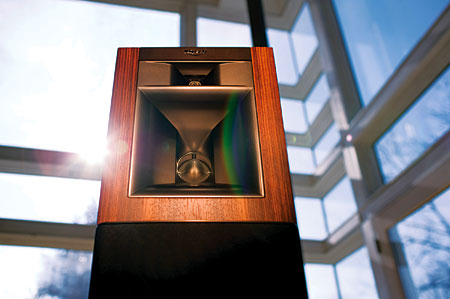 The mid-frequency driver is front-loaded with a modified Tractrix horn with a 4:1 high-compression phase plug in its center. The 4.5" inverted-dome driver is a first for Klipsch—although the company does credit PWK's famous dictum "The midrange is where we live." The midrange is claimed to have a raw sensitivity of 110dB. Like the woofers, the midrange driver uses three magnets (the primary magnet uses the other two to stabilize its output). The midrange driver is housed in its own tuned, sealed enclosure within the P-39F's shell.
The tweeter is also front-loaded with a Tractrix horn, this one with a 10:1 compression phase plug and a 0.75" dome diaphragm of titanium. The space behind the driver is a resistively damped tube. Klipsch says that the design of the phase plug "extends the upper frequency of the driver by 10kHz," which is said to have the salubrious effect of eliminating standing waves in the high-pressure layer between plug and driver.
The fourth-order crossover is built on two printed circuit boards mounted to the bottom plate of the speakers with isolation grommets. The parts quality is said to be superb: air-core conductors, polypropylene caps, ultra-low-inductance resistors, etc. The woofers cross over to the mids at 500Hz, the mids cruise from 500Hz to 3.2kHz, and Klipsch claims the tweeter goes from 3.2 to 30kHz!
The mid-frequency driver is front-loaded with a modified Tractrix horn with a 4:1 high-compression phase plug in its center. The 4.5" inverted-dome driver is a first for Klipsch—although the company does credit PWK's famous dictum "The midrange is where we live." The midrange is claimed to have a raw sensitivity of 110dB. Like the woofers, the midrange driver uses three magnets (the primary magnet uses the other two to stabilize its output). The midrange driver is housed in its own tuned, sealed enclosure within the P-39F's shell.
The tweeter is also front-loaded with a Tractrix horn, this one with a 10:1 compression phase plug and a 0.75" dome diaphragm of titanium. The space behind the driver is a resistively damped tube. Klipsch says that the design of the phase plug "extends the upper frequency of the driver by 10kHz," which is said to have the salubrious effect of eliminating standing waves in the high-pressure layer between plug and driver.
The fourth-order crossover is built on two printed circuit boards mounted to the bottom plate of the speakers with isolation grommets. The parts quality is said to be superb: air-core conductors, polypropylene caps, ultra-low-inductance resistors, etc. The woofers cross over to the mids at 500Hz, the mids cruise from 500Hz to 3.2kHz, and Klipsch claims the tweeter goes from 3.2 to 30kHz!
The Klipsch rep, too, was enthusiastic: "This is a loudspeaker that PWK would have approved of!" (Yes, seven years after the death of Paul W. Klipsch, employees still refer to the founder of Klipsch Audio Technologies as PWK—and why not? Most of them have worked there for so long that they knew PWK or were hired by him.)
"How so?" asked WP.
"Obviously, the midrange and tweeter are horn-loaded, but the P-39Fs are efficient, have low distortion, and controlled directivity—all goals that Paul Klipsch sought in every loudspeaker he ever designed. We kept those goals forefront in designing the Palladium line, and we went to DesignworksUSA for the industrial design of the speaker itself, although we developed all of the drivers in-house."
The Palladium P-39F is a three-way loudspeaker with a fourth-order crossover. The cones of its three 9" woofers are constructed from an outer aluminum skin bonded to a Rohacell core, this in turn bonded to Kevlar. The result is a rigid but lightweight diaphragm. Each woofer's basket is cast aluminum, and its 1.5"-diameter voice-coil is wound from flat copper-clad aluminum wire. Three different neodymium magnets make up the drive system.
The mid-frequency driver is front-loaded with a modified Tractrix horn with a 4:1 high-compression phase plug in its center. The 4.5" inverted-dome driver is a first for Klipsch—although the company does credit PWK's famous dictum "The midrange is where we live." The midrange is claimed to have a raw sensitivity of 110dB. Like the woofers, the midrange driver uses three magnets (the primary magnet uses the other two to stabilize its output). The midrange driver is housed in its own tuned, sealed enclosure within the P-39F's shell.