Musical Fidelity's founder, Antony Michaelson, arrived at my house to help me set up the two chassis of his sleek, limited-edition, $30,000 Titan power amplifier. (The task requires at least two people.) A week later, a representative of Musical Fidelity's US importer, KEF America, dropped by to listen and to deliver three of Musical Fidelity's new V-series products: a phono preamp, a DAC, and a headphone amp. All three fit comfortably into a small paper bag; the price of the three was $700.
 Michaelson would like Musical Fidelity to be all things to all audiophiles. While building and marketing high-performance products that range in price from $200 to $30,000 is a worthy, even magnanimous goal, it's a process fraught with difficulties.
Despite enviable reputations and worldwide name recognition, well-established branding and marketing constructs pressed Toyota and Nissan to establish the luxury lines of Lexus and Infiniti—something that automobile enthusiast Michaelson knows full well. Yet rather than develop different brands for his company's high- and low-priced gear, he insists on putting the Musical Fidelity badge on all of his products, apparently feeling that, unlike car buffs, audiophiles are an enlightened lot more interested in performance than in status or frills.
Is this the same Antony Michaelson who once experienced bitter disappointment when audiophiles rejected his bargain-priced X-Can components because they couldn't get past the cost-saving tubular shape to hear their high-performance sound? Yes. Budget-conscious audiophiles were more accepting of his X-series products, which came in more conventional—and more expensive—enclosures.
A few years ago, when Musical Fidelity issued its no-compromise, three-box kW amplifier ($24,000)—which, true to its name, put out a kilowatt per channel into 8 ohms (and 2kW into 4 ohms), Michaelson again figured that well-heeled enthusiasts would be more interested in the sound and the amp's measured performance than in svelte packaging, and that time he was right—the boxy, industrial-looking kW quickly sold out its limited edition of 75 units. I bought one of them, and it's since logged 27,978 trouble-free and, more important, musically satisfying hours (according to the information log on the front panel of its power supply).
But success in the upscale market didn't seem to burnish Musical Fidelity's perceived position in the high-end pecking order: sales of the kW 750, a two-channel, 750Wpc powerhouse ($10,000) that arguably sonically outperformed the original kW and represented far more bang for the buck, were, according to him, disappointing. Perhaps that was because his homely, industrial-looking flagship, the kW, hadn't created a trickle-down effect. But how could it have? Conceptually and physically, the kW 750 was an entirely new design.
Again, from the top!
Michaelson would like Musical Fidelity to be all things to all audiophiles. While building and marketing high-performance products that range in price from $200 to $30,000 is a worthy, even magnanimous goal, it's a process fraught with difficulties.
Despite enviable reputations and worldwide name recognition, well-established branding and marketing constructs pressed Toyota and Nissan to establish the luxury lines of Lexus and Infiniti—something that automobile enthusiast Michaelson knows full well. Yet rather than develop different brands for his company's high- and low-priced gear, he insists on putting the Musical Fidelity badge on all of his products, apparently feeling that, unlike car buffs, audiophiles are an enlightened lot more interested in performance than in status or frills.
Is this the same Antony Michaelson who once experienced bitter disappointment when audiophiles rejected his bargain-priced X-Can components because they couldn't get past the cost-saving tubular shape to hear their high-performance sound? Yes. Budget-conscious audiophiles were more accepting of his X-series products, which came in more conventional—and more expensive—enclosures.
A few years ago, when Musical Fidelity issued its no-compromise, three-box kW amplifier ($24,000)—which, true to its name, put out a kilowatt per channel into 8 ohms (and 2kW into 4 ohms), Michaelson again figured that well-heeled enthusiasts would be more interested in the sound and the amp's measured performance than in svelte packaging, and that time he was right—the boxy, industrial-looking kW quickly sold out its limited edition of 75 units. I bought one of them, and it's since logged 27,978 trouble-free and, more important, musically satisfying hours (according to the information log on the front panel of its power supply).
But success in the upscale market didn't seem to burnish Musical Fidelity's perceived position in the high-end pecking order: sales of the kW 750, a two-channel, 750Wpc powerhouse ($10,000) that arguably sonically outperformed the original kW and represented far more bang for the buck, were, according to him, disappointing. Perhaps that was because his homely, industrial-looking flagship, the kW, hadn't created a trickle-down effect. But how could it have? Conceptually and physically, the kW 750 was an entirely new design.
Again, from the top!
Five years after launching the kW, Antony Michaelson returns with the ambitious Musical Fidelity Titan, another limited-edition powerhouse with an output of 1kW, but this time with looks and fit'n'finish clearly commensurate with its $30,000 cost and intended marketplace positioning. Though Musical Fidelity developed the Titan during financial boom times and released it during a bust, Michaelson remains confident that its considerable R&D costs will be repaid. He says he's already been pleasantly surprised by the strong UK response, and he's hedged his bet somewhat by limiting production to 40 units. And unlike the kW, the Titan has enough glitter to attract a crowd to a less expensive, trickled-down, follow-up model, should there be one. Still, the Titan itself is a trickled-up design that borrows the kW 750's dual-mono architecture. The Titan's dual-mono AC power-supply circuitry is housed in one chassis, its dual-mono amplifiers and associated rectification and power storage in another. Musical Fidelity contends that its definition of a pair of monoblocks—dual-mono circuits in a single chassis that share the same zero-voltage point, and power-transformer magnetic fields placed well away from the signal-processing circuitry in a separate chassis—produces more a cohesive sound than do traditional, discrete monoblocks. The Titan's fully balanced circuitry is all new, though it carries forward basic design improvements that MF claims helped give the kW 750 a smoother, more refined sound than the kW.
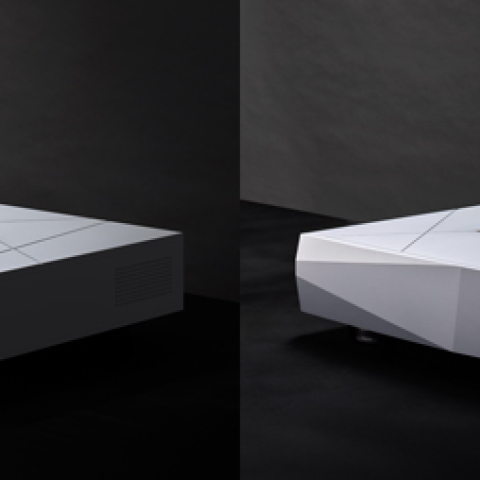
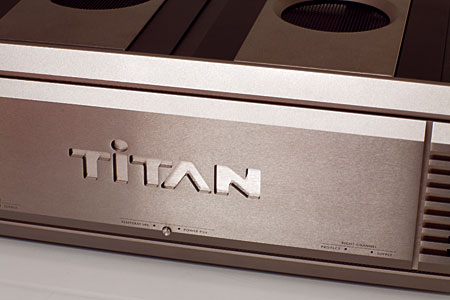
The kW 750's attractive but not wow-inspiring industrial design has not trickled up. Instead, the Titan sports a new, luxurious look, pleasing to eyes and fingers alike, that took away the breaths of most visitors to my listening room—and that's before they listened to it or knew its price. A few were less than taken by the size and style of the Titan logo routed out of the faceplates, but those reservations gave way to unconditional praise for every other design element, as well as for the superb construction quality of the various outer components. The Titan is the first Musical Fidelity product I've had here that looks as if it belongs in a top-tier audio system.
Still, the Titan itself is a trickled-up design that borrows the kW 750's dual-mono architecture. The Titan's dual-mono AC power-supply circuitry is housed in one chassis, its dual-mono amplifiers and associated rectification and power storage in another. Musical Fidelity contends that its definition of a pair of monoblocks—dual-mono circuits in a single chassis that share the same zero-voltage point, and power-transformer magnetic fields placed well away from the signal-processing circuitry in a separate chassis—produces more a cohesive sound than do traditional, discrete monoblocks. The Titan's fully balanced circuitry is all new, though it carries forward basic design improvements that MF claims helped give the kW 750 a smoother, more refined sound than the kW.
The kW 750's attractive but not wow-inspiring industrial design has not trickled up. Instead, the Titan sports a new, luxurious look, pleasing to eyes and fingers alike, that took away the breaths of most visitors to my listening room—and that's before they listened to it or knew its price. A few were less than taken by the size and style of the Titan logo routed out of the faceplates, but those reservations gave way to unconditional praise for every other design element, as well as for the superb construction quality of the various outer components. The Titan is the first Musical Fidelity product I've had here that looks as if it belongs in a top-tier audio system.
Michaelson would like Musical Fidelity to be all things to all audiophiles. While building and marketing high-performance products that range in price from $200 to $30,000 is a worthy, even magnanimous goal, it's a process fraught with difficulties.
Despite enviable reputations and worldwide name recognition, well-established branding and marketing constructs pressed Toyota and Nissan to establish the luxury lines of Lexus and Infiniti—something that automobile enthusiast Michaelson knows full well. Yet rather than develop different brands for his company's high- and low-priced gear, he insists on putting the Musical Fidelity badge on all of his products, apparently feeling that, unlike car buffs, audiophiles are an enlightened lot more interested in performance than in status or frills.
Five years after launching the kW, Antony Michaelson returns with the ambitious Musical Fidelity Titan, another limited-edition powerhouse with an output of 1kW, but this time with looks and fit'n'finish clearly commensurate with its $30,000 cost and intended marketplace positioning. Though Musical Fidelity developed the Titan during financial boom times and released it during a bust, Michaelson remains confident that its considerable R&D costs will be repaid. He says he's already been pleasantly surprised by the strong UK response, and he's hedged his bet somewhat by limiting production to 40 units. And unlike the kW, the Titan has enough glitter to attract a crowd to a less expensive, trickled-down, follow-up model, should there be one.
Still, the Titan itself is a trickled-up design that borrows the kW 750's dual-mono architecture. The Titan's dual-mono AC power-supply circuitry is housed in one chassis, its dual-mono amplifiers and associated rectification and power storage in another. Musical Fidelity contends that its definition of a pair of monoblocks—dual-mono circuits in a single chassis that share the same zero-voltage point, and power-transformer magnetic fields placed well away from the signal-processing circuitry in a separate chassis—produces more a cohesive sound than do traditional, discrete monoblocks. The Titan's fully balanced circuitry is all new, though it carries forward basic design improvements that MF claims helped give the kW 750 a smoother, more refined sound than the kW.