Sidebar 3: Measurements
Before I started testing the Linear Tube Audio Aero D/A processor, I carefully installed the two 12SN7 tubes and made sure the tubes' heater voltage had been correctly set with the rear-panel switch. I measured the Aero with my Audio Precision SYS2722 system, first using optical and coaxial S/PDIF data, then repeating some of the tests with USB data sourced from my MacBook Pro. (The TosLink input didn't lock consistently to data sampled at rates higher than 96kHz.)
The USB Prober utility identified the D/A processor as "LTA Aero" from "LTA," with the serial number string "mb=SN016064;serce=HEM016064," and indicated that the USB port operated in the optimal isochronous asynchronous mode. Apple's AudioMIDI utility showed that the Aero accepted 24-bit integer data via USB sampled at all rates from 44.1kHz to 192kHz.
The output level with a 1kHz signal at 0dBFS was 4.72V from the balanced outputs, 2.44V from the unbalanced outputs. Though usefully low, the output impedances were slightly higher than the specified 140 ohms, balanced, and 70 ohms, unbalanced. My estimates were 179 ohms at 20Hz and 1kHz for the balanced output, dropping to 161 ohms at 20kHz. The unbalanced impedance was 90 ohms at low and middle frequencies, 83 ohms at the top of the audioband. The LTA Aero preserved absolute polarity (ie, was noninverting) from both output types.


Footnote 1: See stereophile.com/reference/25/index.html.
Fig.1 Linear Tube Audio Aero, impulse response (one sample at 0dBFS, 44.1kHz sampling, 4ms time window).
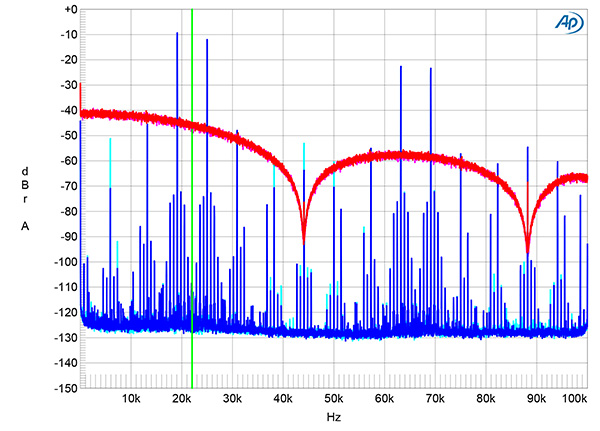
Fig.2 Linear Tube Audio Aero, wideband spectrum of white noise at –4dBFS (left channel red, right magenta) and 19.1kHz tone at –6dBFS (left blue, right cyan), with data sampled at 44.1kHz (20dB/vertical div.).
The LTA Aero's impulse response with 44.1kHz data is a delta function (fig.2), with none of the usual ringing before and after the single sample at 0dBFS. (The tiny amount of ringing in this graph is due to the Audio Precision's antialiasing filter.) The time-perfect impulse response is due to the absence of the usual low-pass reconstruction filter (footnote 1). As a result, the LTA Aero's response with 44.1kHz-sampled white noise (fig.2, blue and red traces) rolls off very slowly above the audioband, with sharply defined nulls at 44.1 and 88.2kHz. There is virtually no suppression of the aliased images of the audioband data, which means that the image at 25kHz of a 19.1kHz tone (blue and cyan traces) lies at almost the same level.
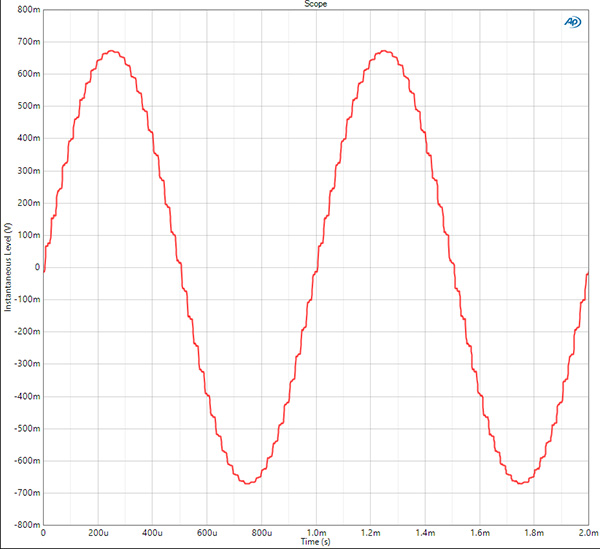
Fig.3 Linear Tube Audio Aero, waveform of 1kHz sinewave at 0dBFS (2ms time window).
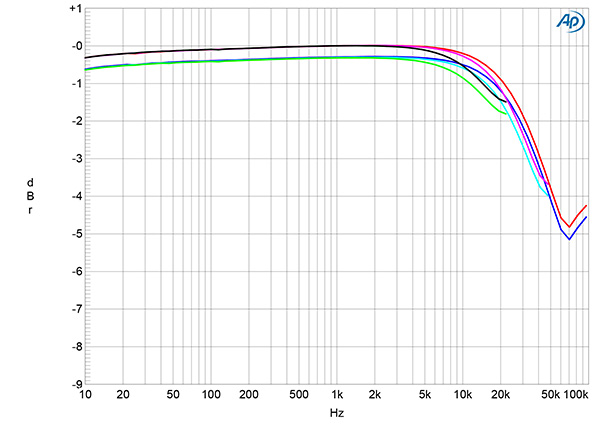
Fig.4 Linear Tube Audio Aero, frequency response at –12dBFS into 100k ohms with data sampled at: 44.1kHz (left channel green, right gray), 96kHz (left cyan, right magenta), and 192kHz (left blue, right red) (1dB/vertical div.).
Without a reconstruction filter, the LTA outputs a broken-looking sinewave (fig.3) because each sample presented to the DAC chip results in a DC output voltage that is sustained until the next sample. The effect with 44.1kHz data is a small rolloff in the top octave of the audioband due to the aperture effect (the pulses have a finite length). This can be seen in the Aero's frequency responses with data sampled at 44.1, 96, and 192kHz (fig.4). This graph also reveals that the right channel (gray, magenta, and cyan traces) is 0.32dB higher in level than the left (green, cyan, blue). This imbalance was identical with both the balanced and unbalanced outputs.
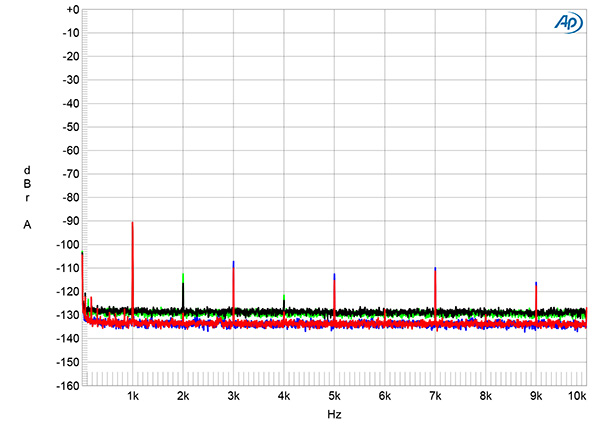
Fig.5 Linear Tube Audio Aero, balanced output, spectrum of 1kHz sinewave, DC–1kHz, at 0dBFS into 100k ohms (left channel blue, right red) (linear frequency scale).
Channel separation (not shown) ranged from 120dB at low frequencies to a still-excellent 90dB at the top of the audioband. No power supply–related spuriae were present in the Aero's low-frequency noisefloor with a 1kHz tone at 0dBFS (fig.5). However, spuriae of unknown origin were present at 500Hz and 750Hz in both channels. Because they lie between –90dB and –100dB in level, they are unlikely to have audible consequences.
Fig.6 Linear Tube Audio Aero, spectrum with noise and spuriae of dithered 1kHz tone at –90dBFS with 16-bit data (left channel cyan, right magenta) and 24-bit data (left blue, right red) (20dB/vertical div.).
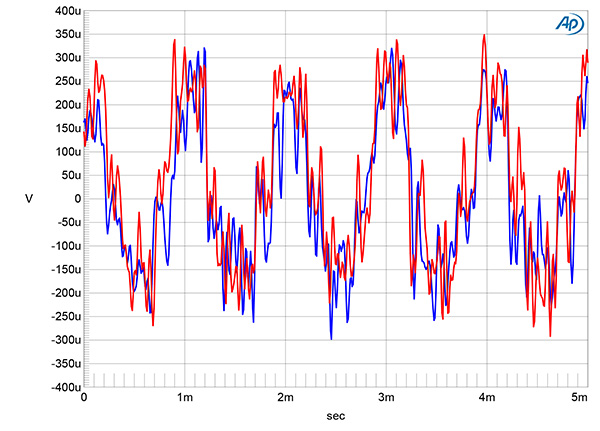
Fig.7 Linear Tube Audio Aero, waveform of undithered 1kHz sinewave at –90.31dBFS, 16-bit data (left channel blue, right red).
Fig.6 shows the spectrum of the Aero's output while it decoded data representing a 1kHz tone at –90dBFS with dithered 16-bit and 24-bit data. The increase in bit depth lowers the noisefloor level by 6dB, which suggests that the LTA Aero offers 17 bits of resolution. (The processor uses an Analog Devices AD1865 DAC chip, which is an 18-bit part.) The only harmonics visible in this graph with 16-bit data (green and gray traces) are the second and fourth. However, with 24-bit data (blue, red), odd-order harmonics are present due to truncation of the six least-significant bits. In this respect, the LTA Aero's behavior is identical to that of the Audio Note DAC 2.1x Signature D/A processor reviewed by Art Dudley in January 2016, which also used the AD1865. With undithered 16-bit data representing a tone at exactly –90.31dBFS, the three DC voltage levels described by the data were symmetrically reproduced but overlaid with noise (fig.7).
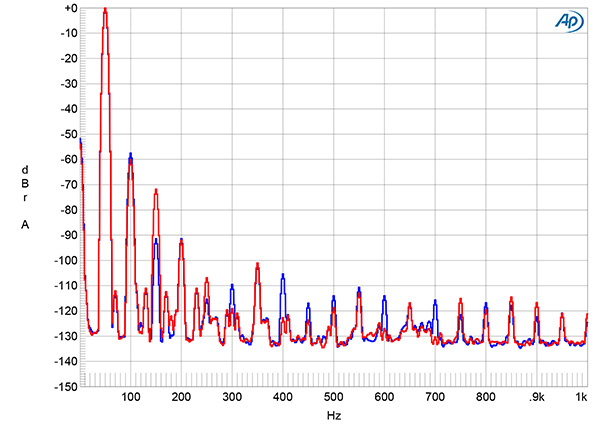
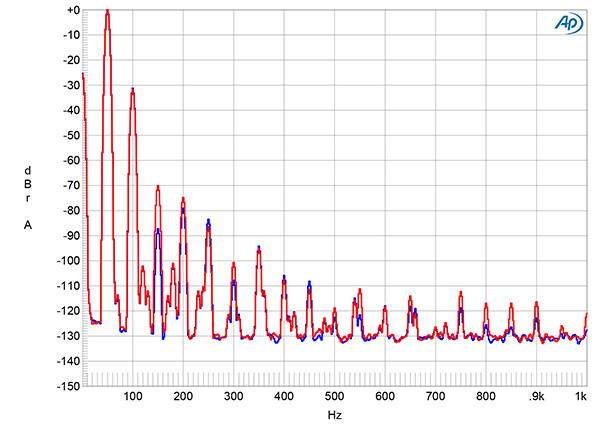
Fig.8 Linear Tube Audio Aero, balanced output, spectrum of 24-bit, 50Hz, 0dBFS sinewave, DC–1kHz (left channel blue, right red; linear frequency scale).
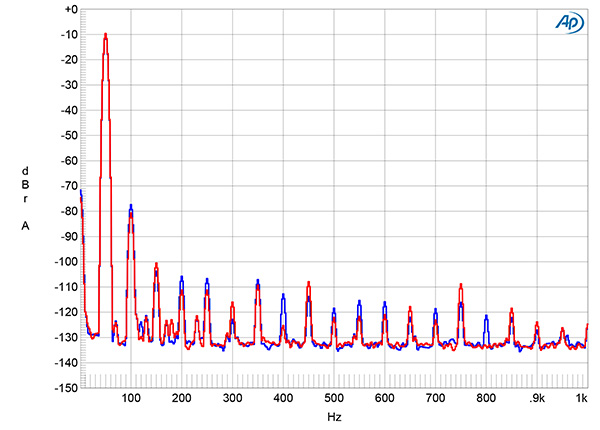
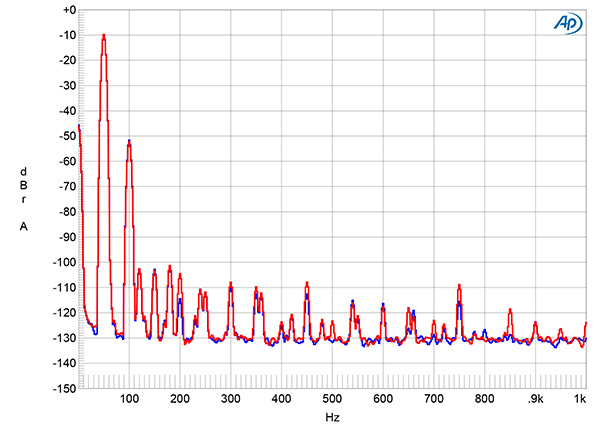
Fig.9 Linear Tube Audio Aero, balanced output, spectrum of 24-bit, 50Hz, –10dBFS sinewave, DC–1kHz (left channel blue, right red; linear frequency scale).
Fig.10 Linear Tube Audio Aero, unbalanced output, spectrum of 24-bit, 50Hz, 0dBFS sinewave, DC–1kHz (left channel blue, right red; linear frequency scale).
Fig.11 Linear Tube Audio Aero, unbalanced output, spectrum of 24-bit, 50Hz, –10dBFS sinewave, DC–1kHz (left channel blue, right red; linear frequency scale).
Harmonic distortion from the LTA Aero's balanced outputs was dominated by the second harmonic, which lay at –60dB (0.1%) with a 50Hz tone at 0dBFS into 100k ohms (fig.8). With the same signal at –10dBFS, the second harmonic dropped in level to –70dB (0.03%) ref. the signal level (fig.9). The third harmonic was much higher in the right channel (red trace) than the left (blue) with the full-scale signal but still 12dB lower in level than the second harmonic. With the demanding 600 ohm load, the second and third harmonics were equal in level, at –50dB (0.3%). Repeating these spectral analyses with the unbalanced outputs proved disappointing, as the second harmonic now lay at –31dB (3%; fig.10) and was still at –40dB (1%) ref. the signal level when I reduced the level of the data by 10dB (fig.11).
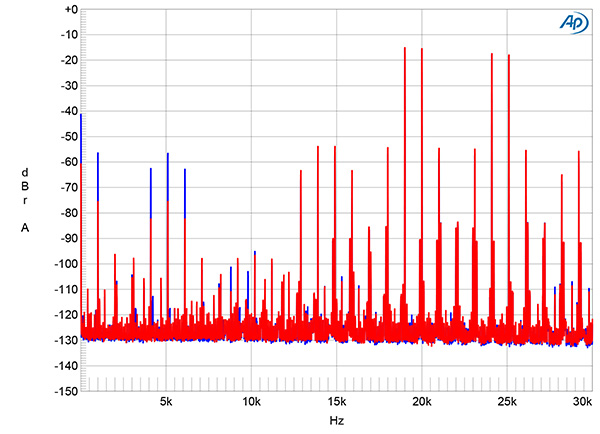
Fig.12 Linear Tube Audio Aero, HF intermodulation spectrum, DC–30kHz, 19+20kHz at –6dBFS peak into 100k ohms, sampled at 44.1kHz.
As expected from fig.2, when I examined intermodulation distortion with an equal mix of 19kHz and 20kHz tones sampled at 44.1kHz, the Aero's output spectrum was dominated by high-level aliased products (fig.12). The second-order difference product at 1kHz lay at –57dB (0.14%) in the left channel (blue trace), which was the same level as that of the aliased product at 5.1kHz. The levels of the difference and aliased products were significantly lower in the right channel (red trace).
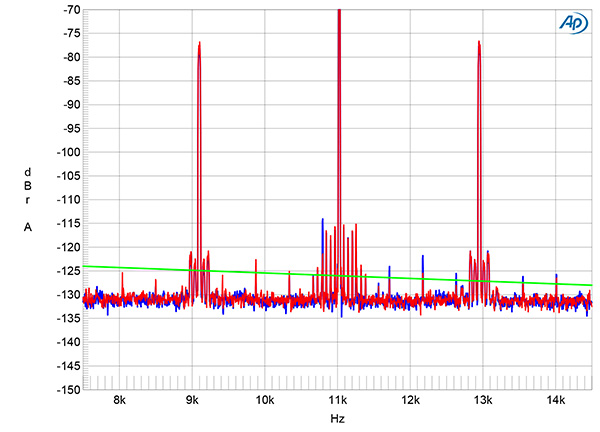
Fig.13 Linear Tube Audio Aero, high-resolution jitter spectrum of analog output signal, 11.025kHz at –6dBFS, sampled at 44.1kHz with LSB toggled at 229Hz: 16-bit Toslink data (left channel blue, right red). Center frequency of trace, 11.025kHz; frequency range, ±3.5kHz.
The LTA Aero's reproduction of 16-bit optical J-Test data sampled at 44.1kHz was also affected by aliasing. While the odd-order harmonics of the LSB-level, low-frequency squarewave are close to the correct levels, indicated by the sloping green line, high-level sidebands are present at ±1.8kHz (fig.13). Both these sidebands and the spectral spike at one-quarter the sample rate are surrounded by sidebands at the supply-related frequencies of ±60Hz and its harmonics.
The Linear Tube Audio Aero's measured performance is paradoxical. As I pointed out in my Richard Heyser Memorial lecture at the 131st Audio Engineering Society Convention in 2011, people tend to like the sound of nonoversampling DACs that dispense with the usual reconstruction filter, perhaps due to their accurate time-domain behavior. But the price paid for this benefit is the presence of a large number of aliased products in the audioband with high-level, high-frequency audio data. And although the Aero's distortion signature is dominated by the subjectively benign second harmonic, this probably won't be of concern, at least from the balanced outputs. I was puzzled by the fact that this harmonic was so much higher from the unbalanced outputs, though this discrepancy is mentioned in the Aero's specifications.—John Atkinson
Footnote 1: See stereophile.com/reference/25/index.html.