Sidebar 3: Measurements
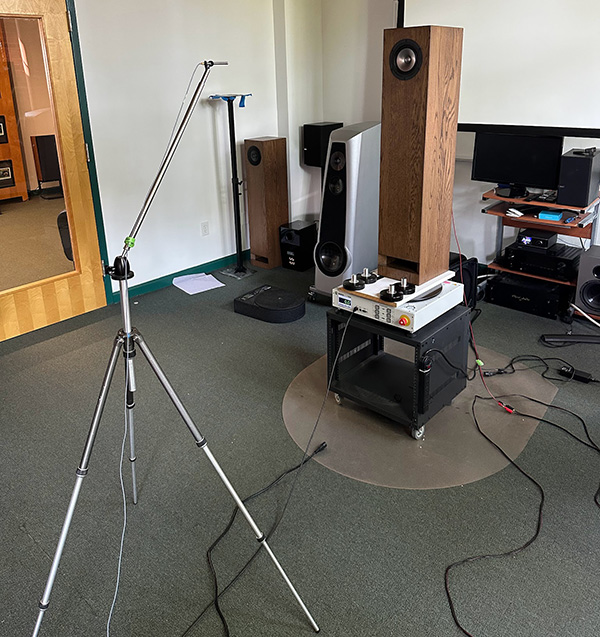
Measurement setup: the Pearl Acoustics Model One on the measurement turntable, with the measurement microphone 1m from the driver.
The Pearl Acoustics Model One was measured in a large conference room, 11'11" H × 25'3" L × 15'8" W. The first reflection was from the floor, at about 5ms, which corresponds to a lower frequency limit of about 200Hz. The loudspeaker was measured with the microphone 1m from the driver. From the center of the driver to the floor was approximately 68.5". I used a GRAS 40BD ¼"-capsule microphone and 26CB mike preamp; an SCM2 measurement ¼"-capsule microphone; a seven-mike array at 15° vertical increments; an AmpConnect 621 audio interface and amplifier; a PT&D MDT turntable; a Brüel & Kjær 4231 acoustic calibrator at 94dB, 1kHz; and a B&K Type 4534-B-001 accelerometer.
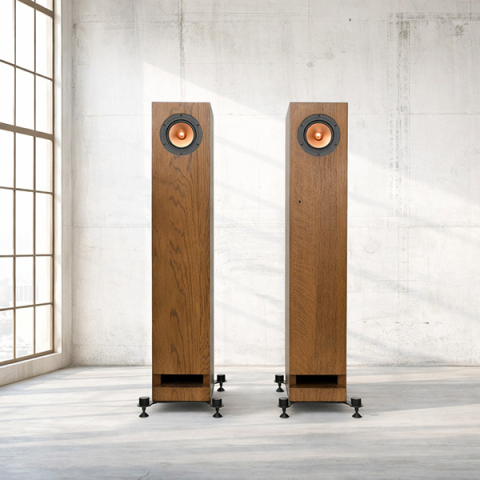
The Pearl Acoustics Model One is an unusual loudspeaker in that it has a single custom-designed 4" drive unit married to a Voigt pipe enclosure, which combines transmission line, ported, and horn characteristics. Because it is a single-driver design, there is no need for a crossover, no need to time-align different drivers, and consequently no off-axis lobing due to a crossover.
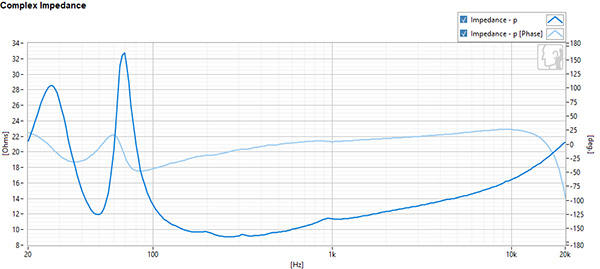
Fig.1 Pearl Acoustics Model One, electrical impedance (dark blue trace) and phase (light blue trace) (2 ohms/vertical div.).
I measured a minimum impedance of 9 ohms (fig.1), with a very small phase angle; this should be an easy load for an amplifier to drive. However, due to the higher impedance, the Model One requires about 50% more voltage to achieve the same output level as a typical 4 ohm loudspeaker.
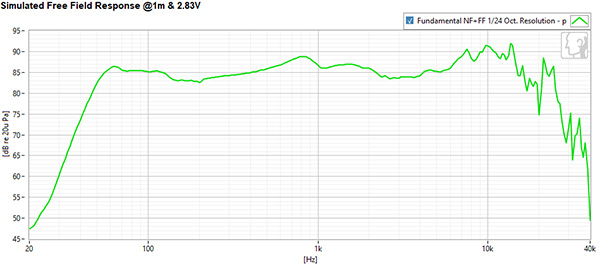
Fig.2 Pearl Acoustics Model One, 1/24-octave smoothed quasi-anechoic response on driver axis at 1m, 2.83V (nearfield and farfield responses spliced at 200Hz).
With the microphone pointing at the full-range driver, the average sensitivity from 100Hz to 10kHz was 86dB/2.83V/m. The frequency response (fig.2) measured 45Hz–20kHz, ±3dB, with a few resonances above 8kHz. Even though it uses a single 4" driver, the Model One maintained meaningful output all the way down to the upper 30Hz range.
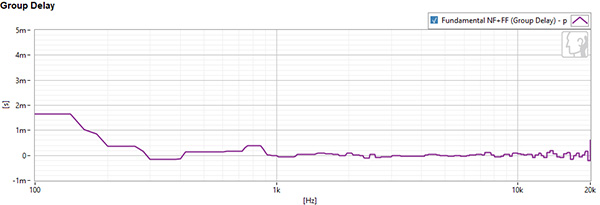
Fig.3 Pearl Acoustics Model One, group delay on driver axis at 1m.
Group delay (fig.3) was very good because this is a single-driver unit without a crossover. There was, as there always is, some group delay at extreme frequencies, where a speaker starts to roll off.
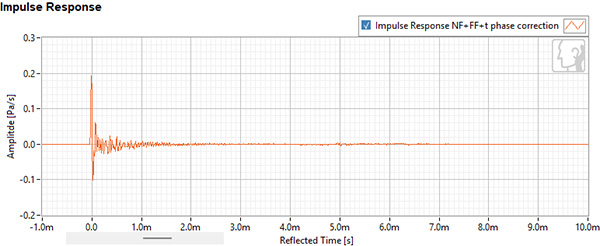
Fig.4 Pearl Acoustics Model One, impulse response on driver axis at 1m (10ms time window).
The transient response (fig.4) was also very good, for the same reason, with some ringing at low frequencies due to the Voigt pipe and at high frequencies due to cone breakup. One of the advantages of crossing over from a low-frequency woofer to a high-frequency tweeter is that the tweeter has a smaller and stiffer diaphragm, which pushes resonances higher. That advantage is missing when a single driver must manage a very wide range of frequencies.
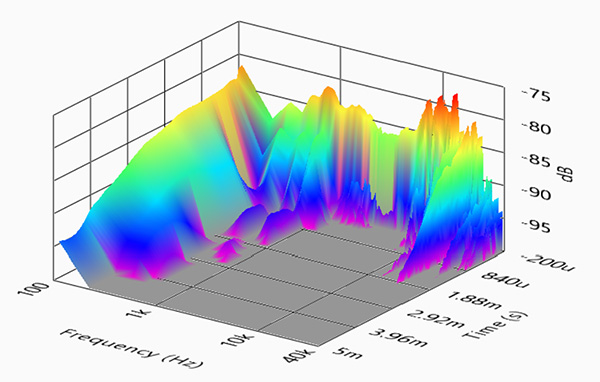
Fig.5 Pearl Acoustics Model One, cumulative spectral decay plot on driver axis at 1m.
Looking at the waterfall plot (fig.5), again some ringing is noticeable at lower and higher frequencies due to the Voigt pipe resonances and woofer cone breakup, but there is little ringing in the critical midrange, from 800Hz to 7kHz, where the human ear is most sensitive.
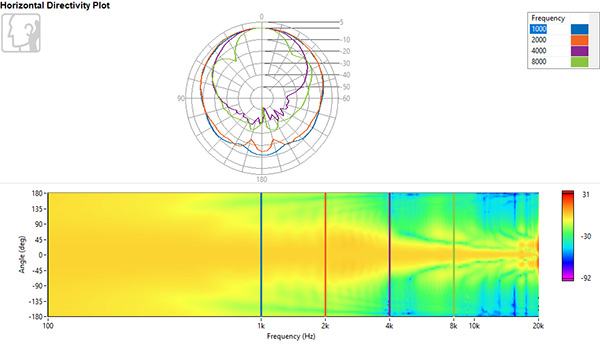
Fig.6 Pearl Acoustics Model One, horizontal directivity: polar responses at 1kHz (blue), 2kHz (orange), 4kHz (purple), and 8kHz (green) (top); contour plot of off-axis response, ±180°, 100Hz–20kHz (bottom).
The horizontal directivity (fig.6) is uniform over the whole frequency range, though there is some off-axis lobing above 7kHz due to cone breakup. As a result of this uniformity, placement of the loudspeaker and the seating position in the room should not be overly position dependent. The 4" woofer is about level with an average listener's ears, so a stand is not needed, and the speaker's footprint is quite small, making it easier to put closer to a wall.
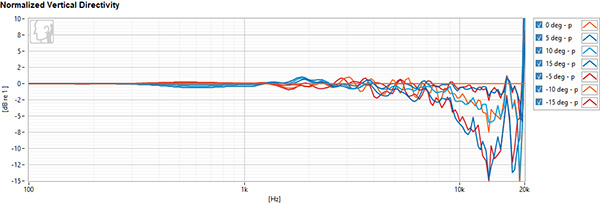
Fig.7 Pearl Acoustics Model One, vertical directivity, normalized to driver-axis response: responses from –15° to +15° in 5° increments.
The loudspeaker's vertical directivity (fig.7) is very smooth and uniform off-axis, as you would expect from its single-driver configuration. Normally there is bumpiness in the vertical response at frequencies near crossover regions; here that is not an issue.
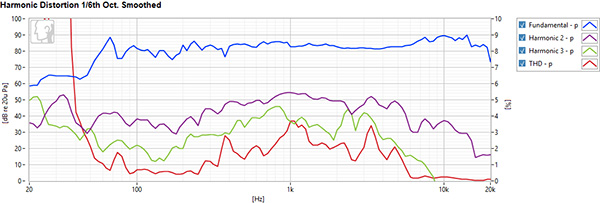
Fig.8 Pearl Acoustics Model One, harmonic distortion at 90dB SPL, 1/6-octave smoothed: fundamental (dark blue), second harmonic (purple), third harmonic (green), and THD (red). Note that THD is in %, scale at right.
One of the trade-offs of using a single driver to cover the full audio frequency range is that the driver must work harder at low frequencies. To reproduce low frequencies at high levels requires more displacement, which inevitably leads to increased distortion. Here the distortion (fig.8) exceeded 3% at 1kHz, which is on the high side, at frequencies where the ear is quite sensitive.
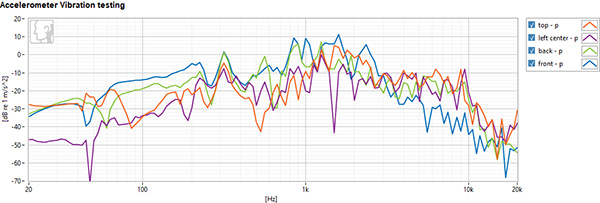
Fig.9 Pearl Acoustics Model One, cabinet vibration measured with an accelerometer at four positions: top (orange), left center (purple), back (green), and front (blue) (driving voltage, 2.83V).
I used an accelerometer to check for resonances in the cabinet that could impact the sound (fig.9). The cabinet is made from 1¼"-thick solid wood, so it is fairly rigid. The accelerometer was placed at different positions on the panels, and the vibration measured using the same sine sweep at 2.83V. Most surfaces were relatively free of resonances; the surface with the most intense vibrational modes was the front, with modes between 850Hz and 2kHz, most likely due to the 4" woofer vibrating the surface in which it is mounted.
Although the distortion is somewhat high in the midrange, overall, this novel single-driver design delivers excellent measured performance.—Steve Temme