 Setup
Setup
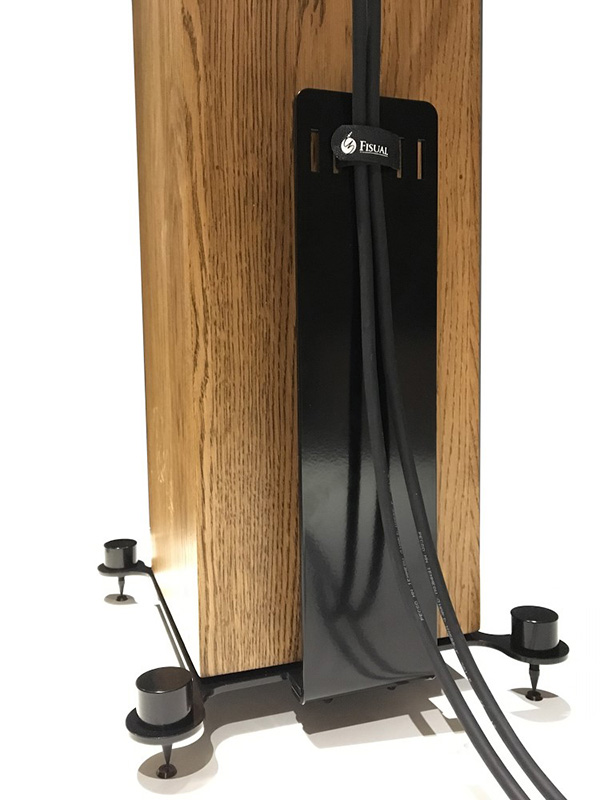
The Model One doesn't have threaded holes for the usual spikes or outriggers. It comes instead with a custom steel stand with adjustable spikes and a metal backrest to prevent the speaker from tipping backward; otherwise, it relies on its 55lb weight to keep it anchored. Because the speaker and stand are separate pieces, positioning the speakers incrementally required a different approach than with a conventional floorstander.
When I solicited Harley for setup advice, his recommendation was to "move the loudspeakers around off their stands first, one at a time. Asymmetric placement can work in some rooms. When you find the right spot, you put the speakers on their stands."
This worked surprisingly well, helped in part by my adult son, who lifted and maneuvered the speaker as I positioned the stand underneath it.
Harley told me he liked to begin by "positioning my Model One pair about 10"–12" from the back wall. I found that the difference between close to the wall or further into the room was much less critical than with most loudspeakers.
"When it comes to toe-in, in larger rooms, I like firing flat into the room," he said. "This gives a very spacious soundstage and good sound from a very wide seating position. You move around the room, and the musicians stay where they are. Toeing in in an equilateral triangle will give you wonderful depth, but I like to have the distance between the loudspeakers just a bit longer than the distance of the center line to my listening position. Ideally, you will be able to sit at least 3m (10') back from the center line, with them being about 3.5m (11.6') apart."
"Frequencies as low as 25Hz should be audible," he added, "with sounds extending at least 1m (3.3') diagonally past the left and right loudspeakers, along with a very three-dimensional soundstage."
My room isn't large enough to accommodate a speaker spread as wide as Harley suggested, but I got very good results with the speakers positioned not quite 9' apart and 8' from the listening position. I also preferred no toe-in, even though my space isn't large. This gave a layered soundstage that extended beyond the sides of the cabinets by about the 3' Harley mentioned.
Using the
"Bass Decade" track on
Stereophile's discontinued
Test CD2 (CD, STPH004-2), I heard solid bass down to 50Hz, with a significant rolloff at 40Hz, and—just as Harley said—some slight energy at 25Hz. There was a lot of energy in the upper-bass region, around 160Hz, suggesting that I might've gotten even better-integrated bass response with a slightly wider speaker placement.

As a final positioning test, this one centered on locking in the soundstage, I used the first track, "The Ballad of Bill Hubbard," from Roger Waters's
Amused to Death (CD, Columbia CK 47127) to tweak the setup further. I knew I'd nailed it the moment I returned to my seat and wondered if I'd ever heard a soundstage this wide, enveloping, and seamlessly layered in my listening room, with such incisive yet naturally contoured images.
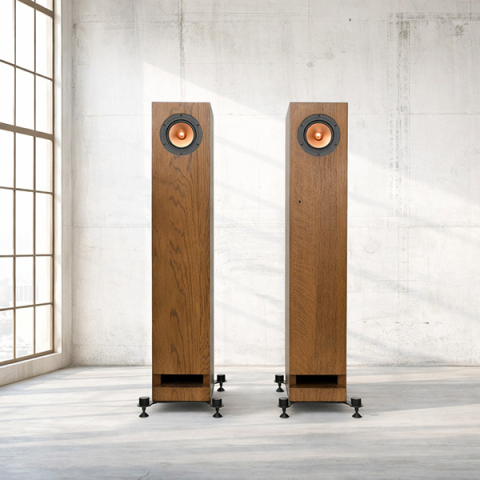
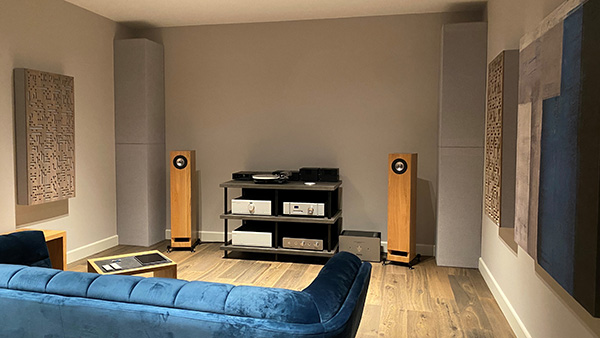
When setup was complete, I leaned back on my couch's cushy headrest to take in the speakers' appearance. With their "Copper Gold" cones and cherry-stained oak cabinet, they looked chic and sturdy. Though not especially
tall, they looked stately in my room, adding flair to my basement décor.
You can have the Model One
your way—to borrow from a popular burger slogan—from a range of finishes, a choice of Baltic Birch Plywood or Natural European Oak, and a cone in either Copper Gold or Silver Grey.
 Listening
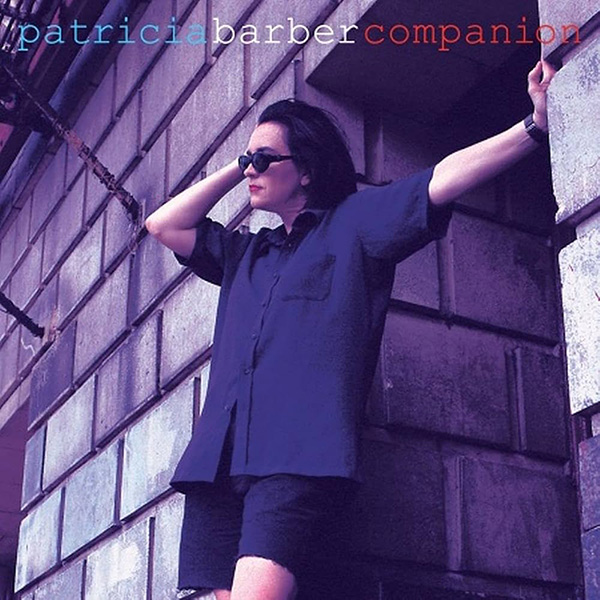
As soon as the first beat dropped on Patricia Barber's "The Beat Goes On," from
Companion (CD, Blue Note/Premonition 72435 22963 2 3), I forgot I was listening to just one little cone per speaker. It may as well have been three. From the speaker's smooth top end to the palpable midrange presence of the instruments (piano, vocals, percussion) to the burly double bass and bass drum, the Model One made a statement—and a strong second impression following the show demo.
It was immediately obvious that the Model One was not a typical single-driver-in-a-box design. It was also clear that the rectangular vent on the bottom edge was not your typical bass port. Via the Voigt pipe, it seemed to function much like a true woofer, delivering deep bass in lockstep with the sound radiating from the cone. It felt literally like a speaker
system, where a single cone reproduced the three tiers of the frequency range in one controlled wave pattern, unaltered by crossover parts.
How ample was the bass? There was more than enough for my room. More importantly, it sounded genuine. If I had any doubts that such a small driver and this port design could deliver real bass
definition, they were put to rest the moment the double-bass notes on
Companion's "Like JT" slapped inside my room, thick as limbs and bulging with texture. There was no amorphous flab around their structure, only musical information that spread all the way to the edges.
And it wasn't just about the double bass. Every instrument had substance and presence: Barber's vocals, chesty, nuanced, and glare-free; the organ, slats of dense, vibrant chords; percussion, micro-detailed down to the elastic texture of the bongo skins as the hand bounced off, even on the softest taps. The music traveled viscerally.
And freely! I sensed a liberation, a collective swagger, as if everything was moving efficiently and naturally. The Model Ones avoided the sizzling hash that, on many systems, can afflict parts of Barber's voice, or the scrunched, screeching overtones that can plague the piano's hardest-played notes and chords.
We audio writers often make note of reproductions of the piano whose tone, timbre, and imaging evoke a semblance of the real thing. Usually it's with the implicit understanding that it can't really reproduce the piano's scale and shuddering weight, except occasionally over speakers that themselves are as big as pianos. On
Companion's second track, "Like JT," the Model One came so eerily close to capturing those things that I kept glancing toward the piano in my room, thinking: "Would a piano actually sound like that
here? Hmm ..."
There was more: the piano's lifelike tone, from its percussive
thunk to its warbling, resonant bloom; the live-in-the-moment imaging of the hand coordination on the electric guitar and drum solos; and the laser focus on both crowd banter and the ceramic constitution of clinking dishes.
As I might be tempted to do at such a bar-music event, I played musical chairs in my room to try to find the best seat in the house sonically, this time among the three cushions on my couch. They were all good, each preserving a strong semblance of the band performing from the same central spot. Imaging remained consistent.

The title track on Can's album
Future Days (CD, Spoon Records 9385-2 724596938522) is known for its animated carousel of 3D sound effects. What I hadn't expected was the impact of the bass drum that begins the song in earnest. Each dropped with such an authoritative thump that I was momentarily worried it smothered detail in the process. It was the opposite: I heard more detail, and a refined caliber of it; more developed and purer in tone, within the bass region and the upper echelons.
As you might expect from its small, rigid cone and a purist design that eschews electronics in the signal path, the Model One's transient response and dynamics were immediate in a real-life way. Sounds were tactile; images, sharp—neither sounded etched. Can's singer Damo Suzuki's lyrics on "Future Days," which were
meant to sound murky and enigmatic, sounded crisp-without-the-bite intelligible, down to the subtle inflections of his Japanese accent.
Such was the perceived speed and in-room extension of the sound that some sound effects appeared ventriloquist-thrown so far from the speakers that I'd cock my ear and lower the volume to see if what I'd heard was coming from another room.
It didn't—well, except for a couple of times when I began questioning
everything, even sounds that obviously came from upstairs.
Oh, right, that's the toilet flushing. Bummer.
At some point early in my listening, I wondered if, through the Pearls, I was hearing a soundstage reproduced correctly
for the first time. The soundstage sounded nothing like a reconstruction: I didn't hear
parts or detect any discontinuity. I heard film-like moving pictures. Most other speakers' soundstages, in comparison, sounded somewhat misaligned.
Pivotally, that sense of seamlessness made the system subservient to the music. With mechanical distractions brought to imperceptible levels, the music had no problem drawing me into a dream state.
And it hit me, as the bongos and cymbals in
Future Days's second track, "Spray," came at me furiously yet never before this well-sorted, that the soundstage counts for practically everything; get that seamlessly right, iron out all the crinkles in the musical fabric, and the rest of sound reproduction falls into place: the detail, the imaging, the tonal density, the linearity of wave patterns, the corporeality of objects, the textural complexity of notes. I couldn't remember hearing this percussive track sound more dynamically impactful, instrumentally focused, and uniformly linear.

I heard much of the same on the Qobuz-sourced
Dragon—Concerto for Pipa and Orchestra (24/96 FLAC, GFN Classics/Qobuz), where the Model One laid out the music like a food spread at a fancy hotel. A pipa is an ancient Chinese stringed instrument, and through the Model One it didn't matter how soft a note was played on it, or whether it was strummed or picked—it popped out tangibly so you could feel its pressure puncture the air. Massed strings sounded both massed and collectively porous. Wind instruments sounded both wind-based and rich with the tone of real wood rather than some synthetic composite. Bass tones filled the floor, lifting the orchestra so it almost seemed to float.
The Fifth Beatle! I thought, as an image of George Martin flashed in my head. That's what a soundstage can be—and what the Model Ones were capable of. Just as George Martin's arrangements enhanced the Beatles' compositions, so does an immaculate soundstage bring out the best versions of the music.
The Model One's resolving nature reminded me that Pink Floyd's compilation
Echoes: The Best of Pink Floyd (2 CDs, Capitol 7243 5 36111 2 5) is among the band's best-sounding releases. When the drum roll that launches CD 1's first track, "Astronomy Domine," boomed out sounding gustily forceful, it triggered a flashback—to the Audiofest in the Galion/Pearl Acoustics room.
From there came a huge wreath encircling the speakers, made of thick, fuzzy guitar chords and soaring notes interspersed with rich, luminous vocals alternating between the left and right channels. Images were not only well separated but filled in between them with vivid sublayers that added depth and realism to the scene.
Such as the helicopter one that opens "The Happiest Days of Our Lives." I'd heard it many times in various rooms, but never quite this real. I even felt a twinge of the impulse to duck as the whipped wind and the
wop-wop-wopping of rotor blades bore down on me.
To cap off the listening portion of my review, I added a physical element to the mix: I was so engrossed by the next song, "Another Brick in the Wall, Pt. 2," with its pounding rhythm, saturated soundstage, and youthful rebellious streak, that I flung my notepad and pen onto the beer-stained table in front of me and, well, pretended I was that kid again, shuffling my feet to the music. It was a fitting end to my time with the Model Ones—that they should make me dance.
 The end
Sold direct, the Model Ones are shipped everywhere in the US from a warehouse in Milwaukee. They come with a 30-day in-home trial, with the caveat that the customer incurs all delivery charges.
If you order a custom pair, be prepared to wait. According to the Pearl Acoustics website, lead times can run from 12 to 22 weeks, depending on the model's color and finish.
The Model Ones are worth the wait. With their full-range, crossover-less, phase-coherent, bass-friendly design—implemented with what seems like meticulous precision—they sound transparent and natural.
Audio reproduction is fundamentally about
conveyance, about how much realism and emotion a system conveys from a recording. The Model One conveys a lot of both—realism and emotion—through a mixture of presence, coherence, transparency, a better-rendered soundstage than most speakers, regardless of price, and bass response with enough oomph, definition, and impact to satisfy most people with most music. The Model Ones are among a handful of speakers I've heard that can blur the line this well between reproduced sound and the natural world.