Sidebar 3: Measurements
I performed a full set of measurements on the Technics SL-G700M2 using Audio Precision's APx555 analyzer. The coaxial S/PDIF and optical TosLink inputs both accepted data sampled at rates up to 24/192. The UAC2-compliant USB-B port accepted 16-, 24-, and 32-bit integer data sampled at 44.1kHz and 48kHz on both MacOS and Windows, with full ASIO support. Depending on the manufacturing date, a firmware update, available via Technics's website or via the Technics Audio Center app, may be necessary to enable the standard UAC2 maximum sample rate of 384kHz.
I used optical S/PDIF data for the testing as well as ASIO output via Audio Precision's ASIO endpoint.
As a disc player, the SL-G700M2 produced no errors in reproducing the data spiral on the Pierre Verany Digital Test CD, even with gaps up to 4mm in length. (The Compact Disc, aka "Red Book," standard requires that a player cope only with gaps of up to 0.2mm.) The maximum output level did not depend on the disc type, SACD or CD.
The SL-G700M2 scales output levels to match, at 0dB, regardless of the input sample rate or bit depth across all possible digital inputs and on both the balanced and unbalanced analog terminations. The maximum output level with a 1kHz signal at 0dBFS was 2.17V, balanced and unbalanced. The output impedance was 245 ohms unbalanced, 490 ohms balanced. This is on the high side but not high enough to cause concern. Pin 2 of the balanced output is hot; the Technics's balanced output preserved absolute polarity.
Footnote 1: Julian Dunn, "Jitter: Specification and Assessment in Digital Audio Equipment," Presented at the 93rd AES Convention, October 1992. See www.nanophon.com/audio/jitter92.pdf.
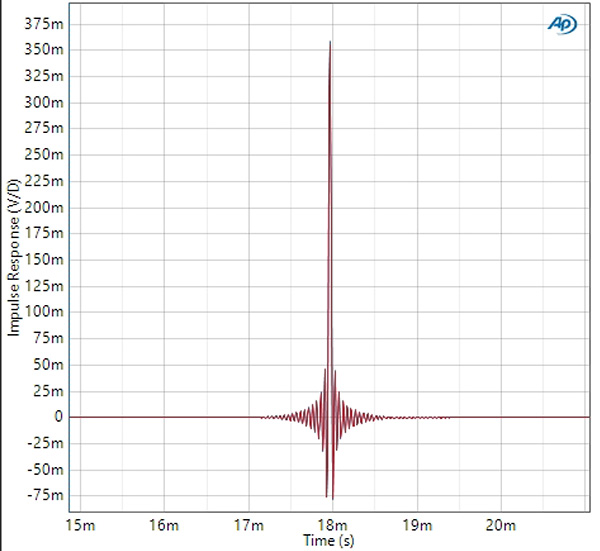
Fig.1 Technics SL-G700M2, impulse response with one sample at 0dBFS, 44.1kHz data, 4ms time window).
The impulse response of the Technics SL-G700M2 (fig.1) is typical of a long linear-phase reconstruction filter with equal amounts of pre-ringing and post-ringing surrounding the single sample at 0dBFS. Internal reclocking, combined with dithering of the oversampled signal, resulted in the exchange of harmonic distortion for uncorrelated noise outside the audio spectrum. The time delay from stimulus before the impulse at the output (fig.1) is due to the buffering necessary to handle gaps in the digital datastream.
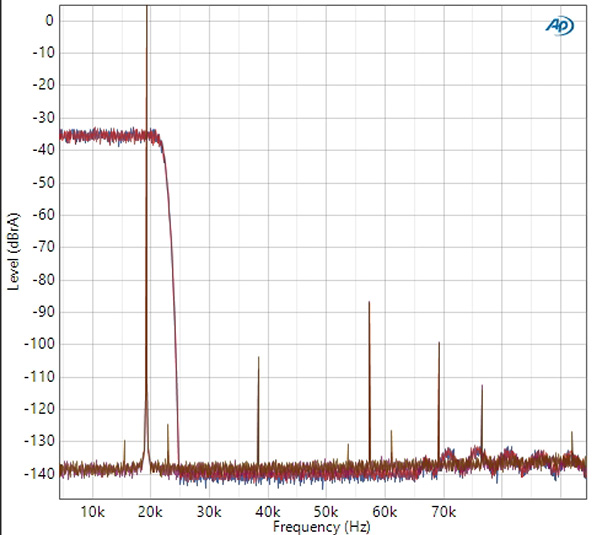
Fig.2 Technics SL-G700M2, wideband spectrum of white noise at –4dBFS (left channel red, right blue) and 19.1kHz tone at 0dBFS (left magenta, right brown) into 100k ohms with data sampled at 44.1kHz (10dB/vertical div.).
The blue and red traces in fig.2 show the SL-G700M2's wideband spectrum with 44.1kHz white noise data at –4dBFS. The response rolls off sharply above the audioband, with full stopband attenuation at just over half the sample rate (44.1kHz). Also in fig.2, the image at 25kHz of a full-scale 19.1kHz tone (brown, magenta traces) is suppressed by a high 125dB. Intermodulation components of the 25kHz tone are absent. The harmonic tones present in the ultrasonic noisefloor are almost exclusively harmonics of 19.1kHz. Their levels do not exceed –86dB.
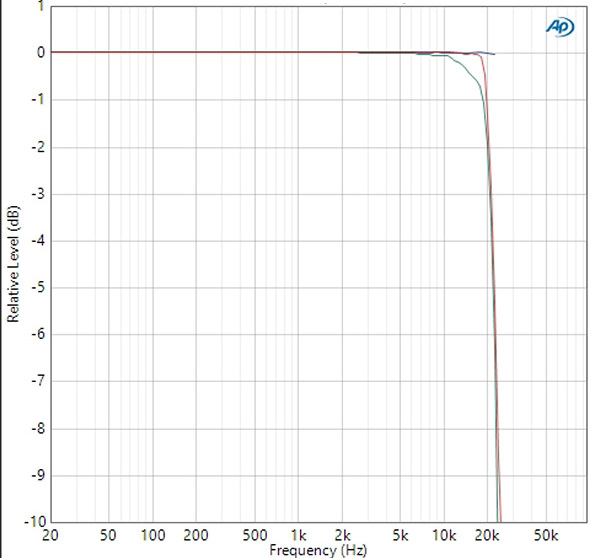
Fig.3 Technics SL-G700M2, frequency response at –12dBFS into 100k ohms with data sampled at: 44.1kHz (blue), 96kHz (red), and 192kHz (green) (1dB/vertical div.).
The Technics SL-G700M2's frequency response with 44.1kHz, 96kHz, and 192kHz data (fig.3) was flat through the audioband and followed the same shape at all three sample rates, with a sharp rolloff just below half of each rate.
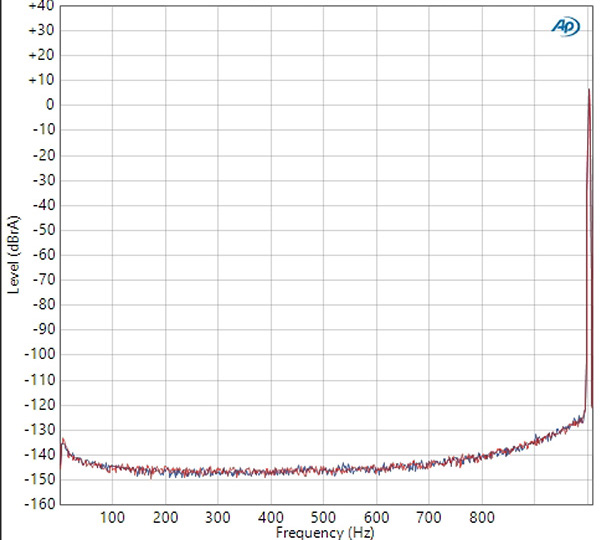
Fig.4 Technics SL-G700M2, spectrum of 1kHz sinewave, DC–1kHz, at 0dBFS (left channel blue, right red, linear frequency scale).
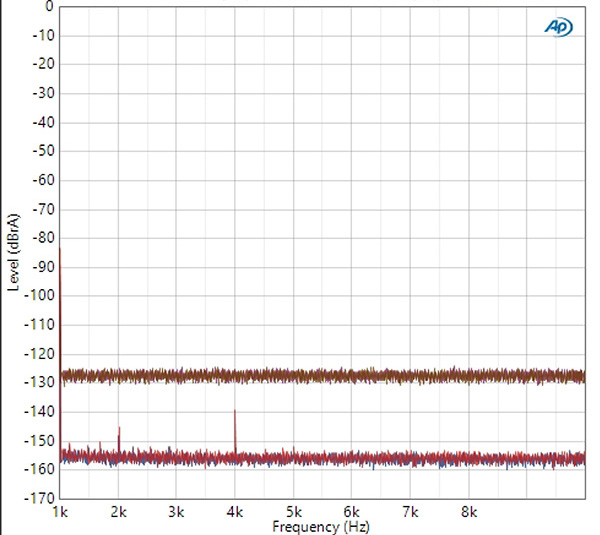
Fig.5 Technics SL-G700M2, spectrum with noise and spuriae of dithered 1kHz tone at –90dBFS with 16-bit data (left channel magenta, right brown) and 24-bit data (left blue, right red) (10dB/vertical div.).
When driven with a full-scale 24-bit, 1kHz tone, the low-frequency noisefloor (fig.4) lay mostly below –140dB and was free from power supply–related spuriae. The Technics SL-G700M2's channel separation was exemplary with better than 115dB of separation in both directions. An increase in the bit depth from 16 to 24 bits while reproducing a dithered 1kHz tone at –90dBFS (fig.5) resulted in an improvement in the noisefloor of nearly 29dB, for a "resolution" equivalent to about 20.8 bits. The harmonics at 2kHz and 4kHz are due to some kind of asymmetry: DC offset, asymmetric clipping, etc.
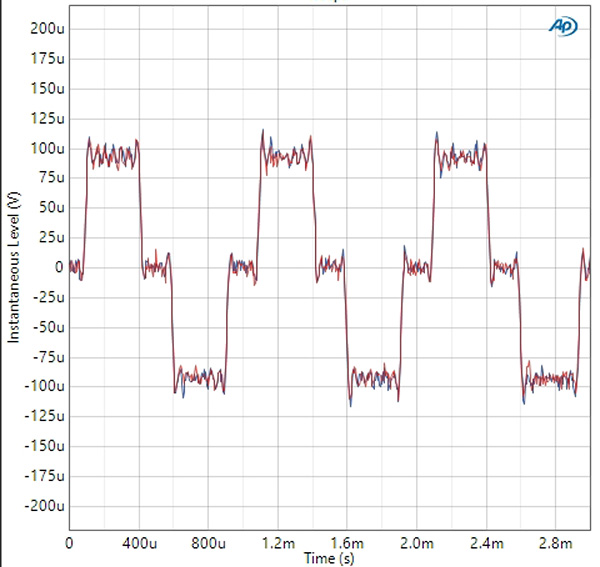
Fig.6 Technics SL-G700M2, waveform of undithered 16-bit, 1kHz sinewave at –90.31dBFS (left channel blue, right red).
With undithered 16-bit data representing a 1kHz tone at exactly –90.31dBFS, the three DC voltage levels described by the data were accurately resolved (fig.6). With undithered 24-bit data at –90dBFS, the Technics SL-G700M2 output a clean sinewave despite the very low signal level (not shown).
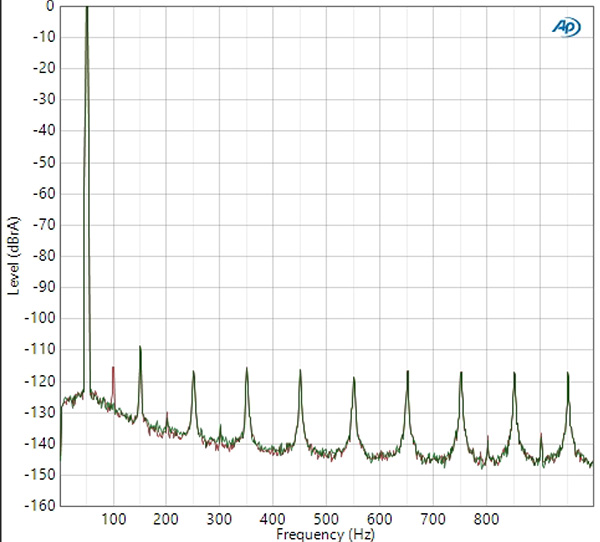
Fig.7 Technics SL-G700M2, spectrum of 50Hz sinewave, 24-bit data, at 0dBFS, DC–1kHz, into 600k ohms, balanced (green) and 300k ohms, unbalanced (red) (linear frequency scale).
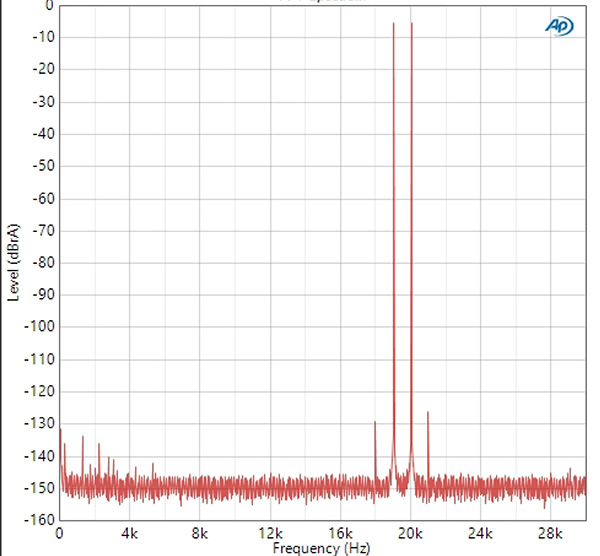
Fig.8 Technics SL-G700M2, HF intermodulation spectrum (DC–30kHz), 19+20kHz, 24-bit data, at 0dBFS into 100k ohms (left channel blue, right red; linear frequency scale).
The Technics SL-G700M2's distortion was primarily comprised of odd-order harmonics (fig.7, balanced green, unbalanced red), but these were low in level, below –110dB. The balanced and unbalanced outputs are the same except for even-order harmonics 6dB below the odd order on the unbalanced output. This difference is unlikely to have audible consequences. Intermodulation distortion with 24-bit data representing an equal mix of 19 and 20kHz tones, each at –6dBFS, was low in level, the 1kHz difference product lying at –135dB (0.0003%, fig.8).
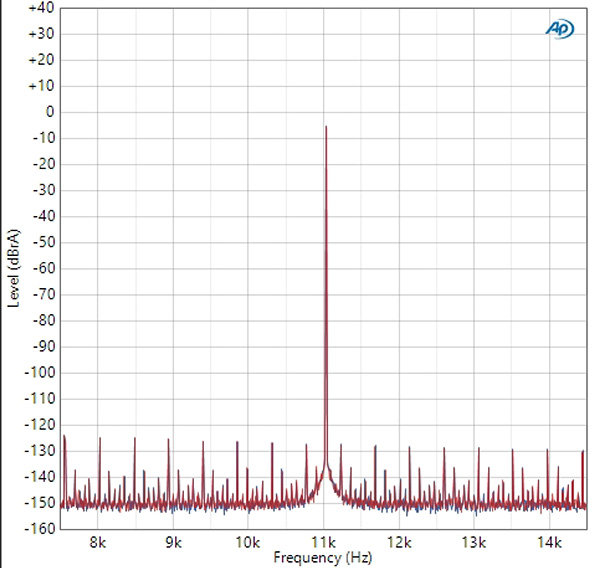
Fig.9 Technics SL-G700M2, 16-bit optical data, high-resolution jitter spectrum of analog output signal, 11.025kHz at –6dBFS, sampled at 44.1kHz with LSB toggled at 229Hz (left channel blue, right red). Center frequency of trace, 11.025kHz; frequency range, ±3.5kHz.
When tested via the jitter measurement standard laid out by Julian Dunn in his AES paper (footnote 1), the SL-G700M2's rejection of data-related jitter was satisfactory (fig.9). The odd-order harmonics of the undithered low-frequency, LSB-level, 16-bit squarewave all lay close to the correct levels, with an orderly linear decline across the tested range. Spurious tones—likely higher order sidebands, considering the apparent periodicity—are present, though safely 130dB below the fundamental.
The Technics SL-G700M2's measured performance leaves little to criticize, especially at the price.—James Grinalds
Footnote 1: Julian Dunn, "Jitter: Specification and Assessment in Digital Audio Equipment," Presented at the 93rd AES Convention, October 1992. See www.nanophon.com/audio/jitter92.pdf.