Sidebar 3: Measurements
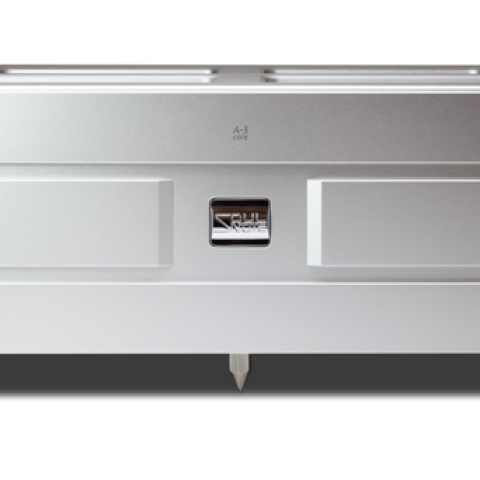
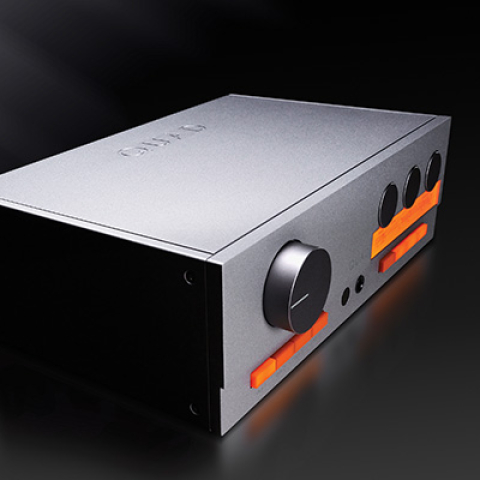
After one Soulnote A-3 Core arrived with shipping damage, I measured another, serial number 240730005, using an Audio Precision APx555 analyzer. The A-3 Core is the power-amplifier version of Soulnote's A-3 integrated amplifier. Like all the company's current designs, it operates without loop negative feedback. Unusually, its left- and right-channel signal grounds are fully separated from each other and are designed to float with respect to the chassis. Before measuring, I preconditioned the amplifier for 60 minutes at one-third the rated power, following which the top panel measured just 94°F; owing to its ample passive ventilation, the A-3 Core runs remarkably cool for an amplifier specified to draw 86W at idle.
The A-3 Core preserved absolute polarity, ie, was noninverting, via the balanced input. The voltage gain at 1kHz into 8 ohms was 22.2dB, far below Soulnote's specified maximum gain of 33dB; the published gain and sensitivity specifications appear to be carried over from the A-3 integrated's specifications.
The balanced input impedance was close to the 24k ohms specification at approximately 22.4k ohms at 20Hz, 22.3k ohms at 1kHz, and 22.1k ohms at 20kHz—an easy load for any preamplifier.
The A-3 Core's measured performance is in line with Soulnote's zero–loop-feedback philosophy. Its distortion is higher and more level- and load-dependent than that of conventional solid state amplifiers, but it rises progressively rather than abruptly, is dominated by the subjectively innocuous second and third harmonics, and is partnered with very low noise, an unusually wide and load-tolerant bandwidth, and a sensibly low output impedance for a design of this type. Prospective owners should note that, by Stereophile's typical 1% criterion, the A-3 Core is a 32W amplifier into 8 ohms; the 120W specification is a 4 ohm figure, at a more relaxed distortion level, and the A-3 Core's fixed 22dB voltage gain will demand a source with generous output or a preamp with substantial gain. Used within those constraints, this is a well-executed example of the zero-feedback breed.—James Grinalds
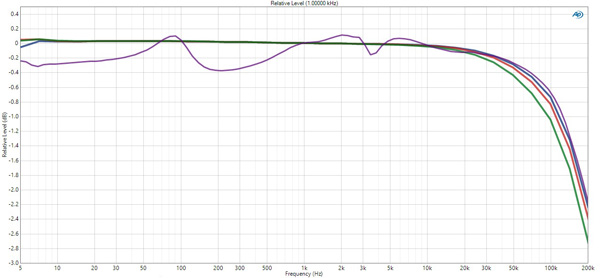
Fig.1 Soulnote A-3 Core, frequency response at 2.83V into: simulated loudspeaker load (purple), 8 ohms (blue), 4 ohms (red), and 2 ohms (green) (0.2dB/vertical div.).
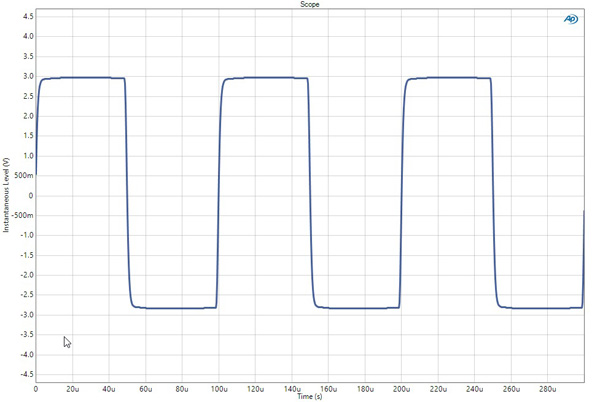
Fig.2 Soulnote A-3 Core, small-signal 10kHz squarewave into 8 ohms.
The A-3 Core's output impedance was 0.29 ohms at 20Hz and 0.30 ohms at 1kHz, rising very slightly to 0.31 ohms at 20kHz. While this is higher than most solid state amplifiers with loop feedback, it is admirably low for a zero-loop-feedback design. The modulation of the amplifier's frequency response by the impedance of our standard simulated loudspeaker was consequently mild, at ±0.25dB (fig.1, purple trace). Into resistive loads, the response was flat across the audioband, and the bandwidth was extraordinarily wide: At 200kHz, the output was down just 2.2dB into 8 ohms (blue trace), 2.4dB into 4 ohms (red), and 2.7dB into 2 ohms (green), comfortably meeting Soulnote's specification of 2Hz–200kHz, ±3dB. The A-3 Core's reproduction of a 10kHz squarewave (fig.2) was nearly perfect, with short risetimes and no overshoot or ringing.
The wideband (1MHz), unweighted signal/noise ratio, measured with the input disconnected and ref. 1W into 8 ohms, was a good 84dB. Restricting the measurement to the audioband improved the ratio to 96dB, and A-weighting improved it further, to 99dB, equivalent to a residual of just 32µV. Referenced to the amplifier's measured clipping power of 32W into 8 ohms, the wideband and audioband ratios are equivalent to 99.1dB and an outstanding 111.1dB, respectively.
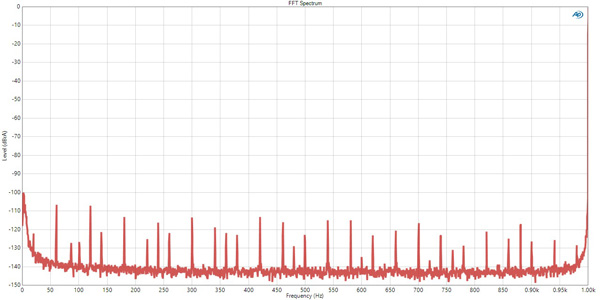
Fig.3 Soulnote A-3 Core, spectrum of 1kHz sinewave, DC–1kHz, at 32W into 8 ohms (linear frequency scale).
The conventional shorted-input measurement proved problematic with this amplifier in its intended "Ground Separation" configuration. The supplied power cable omits a ground pin, so the chassis is not referenced to mains earth. With the input shorted and the ground selector in its chassis position, the audioband ratio was 96dB; with the ground selector in its floating position, the measured noise was 30dB worse. In use, the A-3 Core's input will be connected to a source component, which provides the ground reference the amplifier omits. Spectral analysis of the A-3 Core's output as it drove a 1kHz tone at 32W into 8 ohms (fig.3) revealed power supply–related spuriae at 60Hz and its harmonics, but these all lay at or below –107dB referenced to the 32W fundamental at 8 ohms. The random noisefloor was otherwise commendably clean.
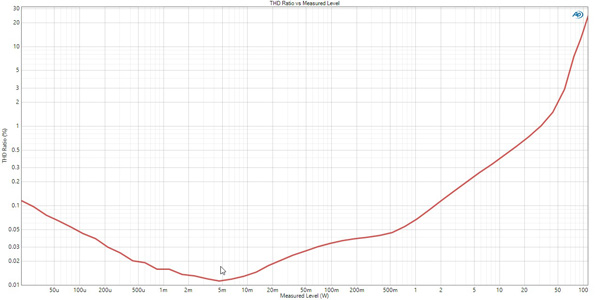
Fig.4 Soulnote A-3 Core, distortion (%) vs 1kHz continuous output power into 8 ohms.
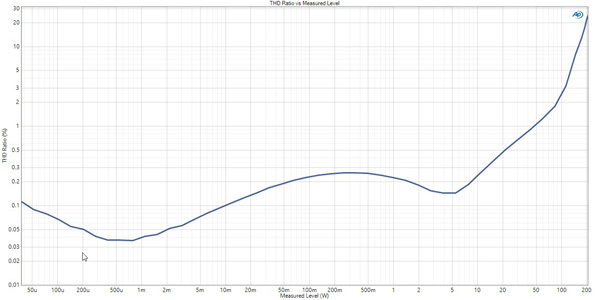
Fig.5 Soulnote A-3 Core, distortion (%) vs 1kHz continuous output power into 4 ohms.
Soulnote rates the A-3 Core at 120Wpc into 4 ohms but publishes neither an 8 ohm power rating nor the distortion criterion behind its specification. With our usual definition of clipping of 1% THD+N, the A-3 Core clipped at 31.9W into 8 ohms (15dBW) (fig.4). Into 4 ohms (14.1dBW) (fig.5), the 1% point was reached at approximately 52W. With a zero-feedback design, THD rises progressively with output level long before actual clipping; the sharp knee in figs.4 and 5—true clipping—lies at roughly 60W into 8 ohms and 120W into 4 ohms, which accords well with the rated 120W; the knee occurs at approximately 3%.
Following the FTC's updated Amplifier Rule, I repeated the maximum-power test at 20kHz: The A-3 Core reached 1% THD+N at 31.8W into 8 ohms, essentially identical to its behavior at 1kHz, as expected from an amplifier with such wide, load-tolerant bandwidth, and a marked contrast to transformer-coupled designs, which typically give up power at or near the top of the audioband.
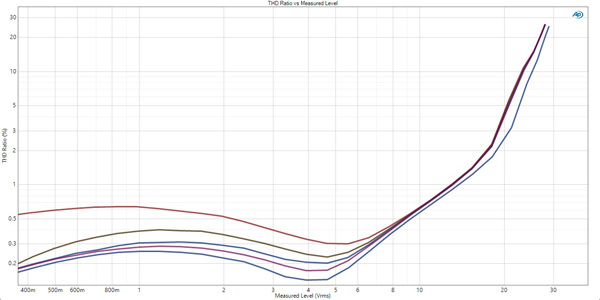
Fig.6 Soulnote A-3 Core, distortion (%) vs 1kHz output level (V RMS) into 4 ohms, taken as successive sweeps while the amplifier warmed from a cold start.
At 1W into 8 ohms, the A-3 Core's THD was just 0.042%, dramatically better than Soulnote's own specification of 0.27% under those conditions. The way distortion changes with level (figs.4 and 5) is characteristic of an amplifier without loop feedback: a smooth, progressive rise from a minimum of just 0.011% at a few milliwatts into 8 ohms with none of the low-level crossover discontinuities that loop feedback can exaggerate. The mild maximum in the 4 ohm trace at a few hundred milliwatts proved to be largely thermal in origin: Repeating the level sweep in a second measurement session as the amplifier warmed from cold (fig.6) produced successively lower distortion through this region, the curves converging as the power and thermal soaking increased. Such behavior is consistent with Soulnote's documentation, which notes that its circuits perform best with transistors at operating temperature. The A-3 Core's measured linearity settles as it warms, and critical measurement—and listening—is best done after a substantial warmup period.
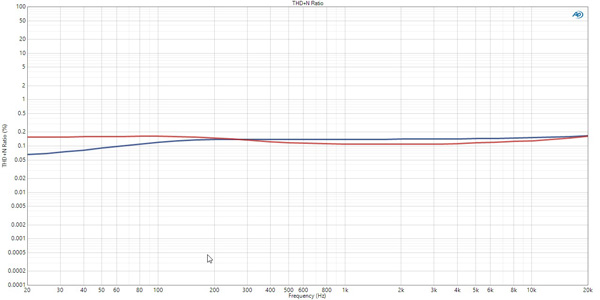
Fig.7 Soulnote A-3 Core, THD+N (%) vs frequency at 4.5V into 8 ohms (blue) and 4 ohms (red).
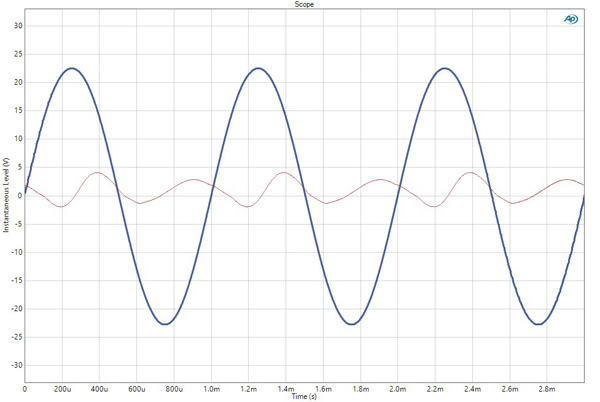
Fig.8 Soulnote A-3 Core, 1kHz waveform at 32W into 8 ohms, 1% THD+N (blue); distortion and noise waveform with the fundamental notched out (red, ×10, not to scale).
To ensure that the 1kHz stepped-level measurement did not overemphasize the performance at an arbitrary frequency, the entire frequency band was swept at the base of the no-loop rise (4.5V output, equivalent to 2.5W into 8 ohms and 5W into 4 ohms). Fig.7 shows that the THD+N ratio remains within a 0.06%–0.17% window from 20Hz to 20kHz with only a slight rise at the top of the audioband, which again is expected from a circuit with wide open-loop bandwidth. The waveform of the residual distortion and noise at 32W into 8 ohms (fig.8) is smooth and free of crossover discontinuities, its shape dominated by the second and third harmonics.
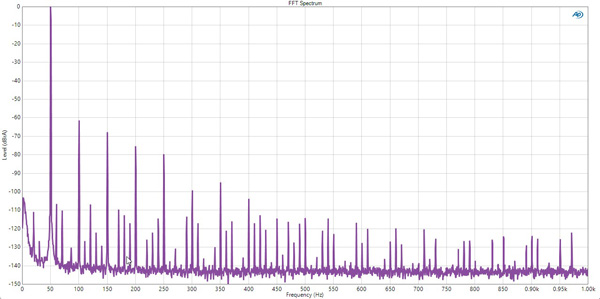
Fig.9 Soulnote A-3 Core, spectrum of 50Hz sinewave, DC–1kHz, at 1W into 8 ohms (linear frequency scale).
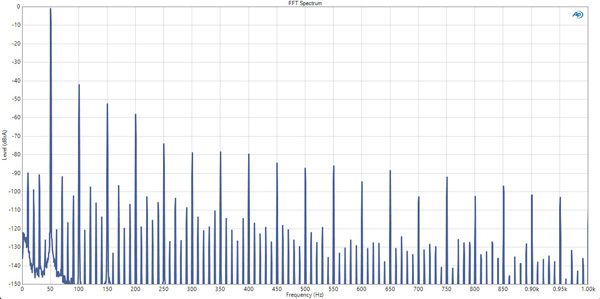
Fig.10 Soulnote A-3 Core, spectrum of 50Hz sinewave, DC–1kHz, at 32W into 8 ohms (linear frequency scale).
Spectral analysis of a 50Hz tone confirmed both the subjectively benign low-order harmonic signature and its dependence on level. At 1W into 8 ohms (fig.9), the second harmonic was the highest in level at –62dB (0.08%), followed by the third at –68dB (0.04%), the fourth at –75.5dB (0.017%), and the fifth at –80dB (0.01%), with all higher-order components at or below approximately –95dB (0.0018%). The low-level components spaced 10Hz apart are intermodulation of the 50Hz tone with the 60Hz supply frequency; all lie below approximately –105dB. At 32W (fig.10), the second harmonic rose to –42dB (0.8%), the third to –52.5dB (0.24%), and the fourth to –58dB (0.13%); the fifth and higher harmonics remained at or below –74dB (0.02%) in a regular, smoothly decaying series.
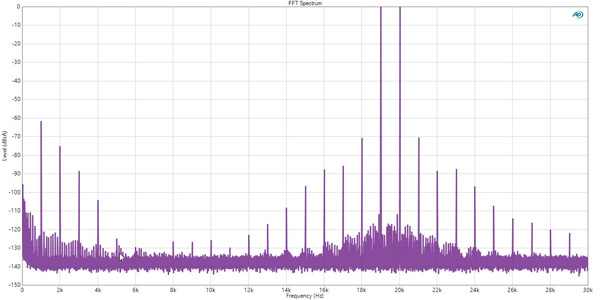
Fig.11 Soulnote A-3 Core, HF intermodulation spectrum, DC–30kHz, 19+20kHz at 1W peak into 8 ohms (linear frequency scale).
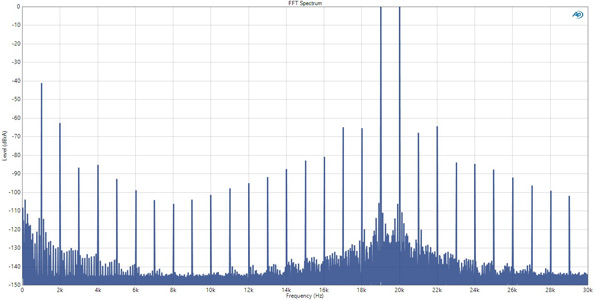
Fig.12 Soulnote A-3 Core, HF intermodulation spectrum, DC–30kHz, 19+20kHz at 32W peak into 8 ohms (linear frequency scale).
Intermodulation distortion followed the same level-proportional pattern. With an equal mix of 19 and 20kHz tones at 1W into 8 ohms (fig.11), the 1kHz difference product lay at –62dB (0.08%), and the higher-order products at 18 and 21kHz at approximately –71dB (0.03%). At the 1% clipping point into 8 ohms (fig.12), the 1kHz product rose to –41dB (0.9%), and the products at 17, 18, 21, and 22kHz rose to between –64 and –68dB (0.04%–0.06%).