I first spotted Audia Flight's exquisite-looking two-box phono preamplifier ($6100) at last year's Hi-End show in Munich, and now that Musical Sounds is importing Audia Flight gear, a review of the Phono seemed a good idea. I know nothing about Audia Flight or the designer, or what Italian audiophiles think of them, but the more time I spent with the versatile, exquisitely built Phono, the more I liked everything about it.
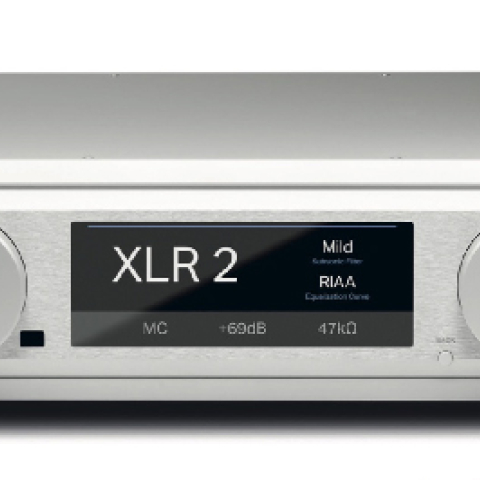
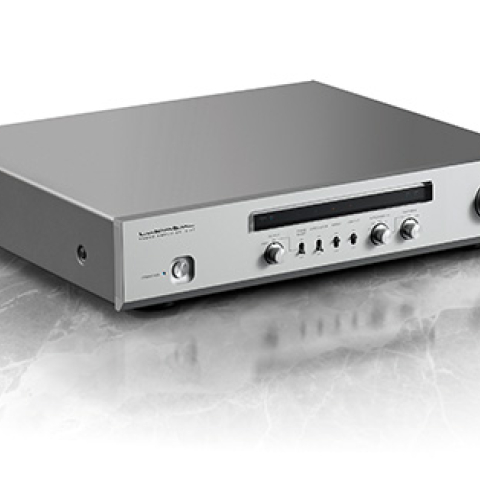
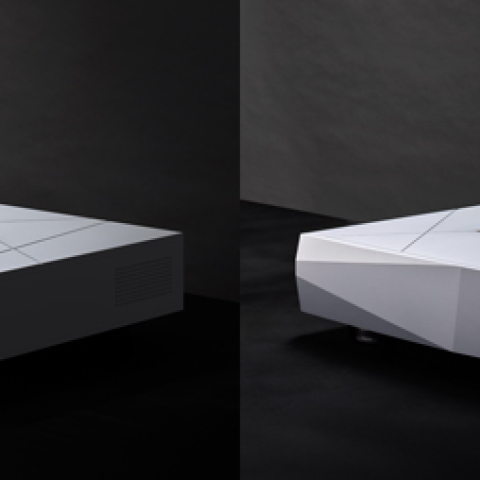
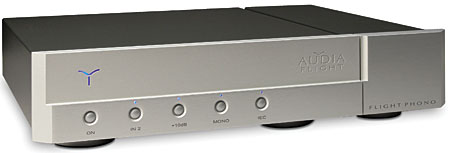 The Phono's good looks speak for themselves. Note the sculpted faceplate accent that integrates the main box with the power supply—a nice touch. And speaking of touch, the satiny finish of the thick front panel is as pleasing to the fingers as to the eyes.
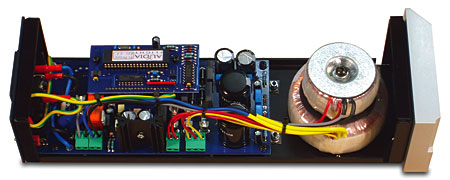
The Phono's insides are even more impressive. The power-supply box contains a dedicated 50VA toroidal transformer for the amplification stages. A second 15VA toroidal transformer supplies the relays and logic controls for the front-panel pushbutton selections stored in memory. Opto-isolators communicate the pushbutton choices without electrical connections.
The main unit is a modular, current-feedback preamplifier with passive RIAA equalization using 1%-tolerance polypropylene and polystyrene capacitors. Two inputs (one moving-magnet, one moving-coil) are provided as standard, but customers can order different confifgurations. The MM module produces 40dB of gain. The MC module offers 64dB gain without the use of transformers. A second gain/output stage, this one based on a proprietary module, lets you add another 10dB if necessary, for a total of 74dB gain (MC). This second gain stage, powered by an onboard, low-noise, MOSFET-based power supply, also offers a balanced XLR output via a separate module.
Resistive and capacitive loading are accomplished via gold-plated jumpers (supplied) inserted into sockets located very close to the input stage. To access these, you remove a small plate on the chassis rear. There are four sets of sockets, one for each channel of each of the maximum of two modules. If you're a fetishist, you can also insert custom resistor values in another set of sockets. The jumper system offers 16 logically chosen values between 60 ohms and 47k ohms, which was more than enough for me. Accessing the jumper sockets is inconvenient—unless you have easy access to your rack's rear, you'll have to turn the Phono around to insert or remove jumpers.
Using the Audia Flight Phono
The Phono's good looks speak for themselves. Note the sculpted faceplate accent that integrates the main box with the power supply—a nice touch. And speaking of touch, the satiny finish of the thick front panel is as pleasing to the fingers as to the eyes.
The Phono's insides are even more impressive. The power-supply box contains a dedicated 50VA toroidal transformer for the amplification stages. A second 15VA toroidal transformer supplies the relays and logic controls for the front-panel pushbutton selections stored in memory. Opto-isolators communicate the pushbutton choices without electrical connections.
The main unit is a modular, current-feedback preamplifier with passive RIAA equalization using 1%-tolerance polypropylene and polystyrene capacitors. Two inputs (one moving-magnet, one moving-coil) are provided as standard, but customers can order different confifgurations. The MM module produces 40dB of gain. The MC module offers 64dB gain without the use of transformers. A second gain/output stage, this one based on a proprietary module, lets you add another 10dB if necessary, for a total of 74dB gain (MC). This second gain stage, powered by an onboard, low-noise, MOSFET-based power supply, also offers a balanced XLR output via a separate module.
Resistive and capacitive loading are accomplished via gold-plated jumpers (supplied) inserted into sockets located very close to the input stage. To access these, you remove a small plate on the chassis rear. There are four sets of sockets, one for each channel of each of the maximum of two modules. If you're a fetishist, you can also insert custom resistor values in another set of sockets. The jumper system offers 16 logically chosen values between 60 ohms and 47k ohms, which was more than enough for me. Accessing the jumper sockets is inconvenient—unless you have easy access to your rack's rear, you'll have to turn the Phono around to insert or remove jumpers.
Using the Audia Flight Phono
The front-panel pushbuttons are On/Off, input module choice, +10dB, Mono, and an IEC-based subsonic filter. You can have both inputs connected simultaneously and switch between them at the push of a button.
Once I had the loading figured out, using the Flight Phono produced nothing but sonic pleasure. But be sure to give the Phono hundreds of hours of playing (not merely powered-up) time before judging its sound. It sounded good out of the box, but not great. That came much later.
How great? The Phono laid it all out on the pitch-blackest backgrounds. It was dead quiet. Those black backgrounds were reminiscent of the Boulder 2008 (+$30,000) and, to a somewhat lesser degree, my current solid-state reference, Einstein Audio's Turntable's Choice. However, the Flight Phono produced music out of what subjectively sounded like an even blacker backdrop, and probably partly because of that, its soundstage presentation was among the most transparent, deep, and three-dimensional I've heard from any phono stage.
 Nor did the Phono's dynamic presentation leave anything to be desired. It beat the Manley Labs Steelhead by a considerable margin, and possibly the Einstein as well, though that was too close to call. If you have problems with transformer-coupled MC stages (I don't), the Phono will take care of them. With up to 74dB of available gain, it can handle cartridges of even the lowest output.
The Flight's overall presentation was free of grain and edge, and as pure and smooth as I've heard from any other great phono preamp. Its bottom end was taut, extended, extremely well defined, and rhythmically proficient. The top end was clean, ultrafast without being bright or edgy, and transients were detailed without sounding clinical. In short, I was reminded not only of the far more expensive Boulder 2008, but also of the pricier Naim Superline with Supercap power supply.
Summing Up
Nor did the Phono's dynamic presentation leave anything to be desired. It beat the Manley Labs Steelhead by a considerable margin, and possibly the Einstein as well, though that was too close to call. If you have problems with transformer-coupled MC stages (I don't), the Phono will take care of them. With up to 74dB of available gain, it can handle cartridges of even the lowest output.
The Flight's overall presentation was free of grain and edge, and as pure and smooth as I've heard from any other great phono preamp. Its bottom end was taut, extended, extremely well defined, and rhythmically proficient. The top end was clean, ultrafast without being bright or edgy, and transients were detailed without sounding clinical. In short, I was reminded not only of the far more expensive Boulder 2008, but also of the pricier Naim Superline with Supercap power supply.
Summing Up
The Phono produced maximum musical excitement with all musical genres, and with both MM and MC cartridges. Its harmonic presentation and delivery of musical flow probably won't satisfy die-hard tube fanatics in search of that "golden glow," but if you're okay with solid-state—and I am—the Audia Flight Phono is a set-it-and-forget-it product that you happily will forget is contributing to the musical presentation. It just gets out of the way and lets the notes roll. With its good looks, convenient front-panel controls (including Mono and +10dB on demand), and high-tech and equally high build quality, the Audia Flight Phono is a superbly made product that produces superb sound—and, at $6100, is a superb value. I could live happily ever after with this pleasant surprise from Italy.
The Phono's good looks speak for themselves. Note the sculpted faceplate accent that integrates the main box with the power supply—a nice touch. And speaking of touch, the satiny finish of the thick front panel is as pleasing to the fingers as to the eyes.
The Phono's insides are even more impressive. The power-supply box contains a dedicated 50VA toroidal transformer for the amplification stages. A second 15VA toroidal transformer supplies the relays and logic controls for the front-panel pushbutton selections stored in memory. Opto-isolators communicate the pushbutton choices without electrical connections.
The front-panel pushbuttons are On/Off, input module choice, +10dB, Mono, and an IEC-based subsonic filter. You can have both inputs connected simultaneously and switch between them at the push of a button.
Nor did the Phono's dynamic presentation leave anything to be desired. It beat the Manley Labs Steelhead by a considerable margin, and possibly the Einstein as well, though that was too close to call. If you have problems with transformer-coupled MC stages (I don't), the Phono will take care of them. With up to 74dB of available gain, it can handle cartridges of even the lowest output.
The Phono produced maximum musical excitement with all musical genres, and with both MM and MC cartridges. Its harmonic presentation and delivery of musical flow probably won't satisfy die-hard tube fanatics in search of that "golden glow," but if you're okay with solid-state—and I am—the Audia Flight Phono is a set-it-and-forget-it product that you happily will forget is contributing to the musical presentation. It just gets out of the way and lets the notes roll. With its good looks, convenient front-panel controls (including Mono and +10dB on demand), and high-tech and equally high build quality, the Audia Flight Phono is a superbly made product that produces superb sound—and, at $6100, is a superb value. I could live happily ever after with this pleasant surprise from Italy.