"You're reviewing a class-D amplifier?" whined John Atkinson. "I hate measuring those."
"Because they measure badly? Dusty Vawter assures me this one measures pretty well."
"It's not that they measure badly, it's because I have to be extremely careful to ensure that I don't end up measuring my test equipment's limitations."
"Does that mean class-D actually measures better than other amps?"
"Let's just say the D stands for different."
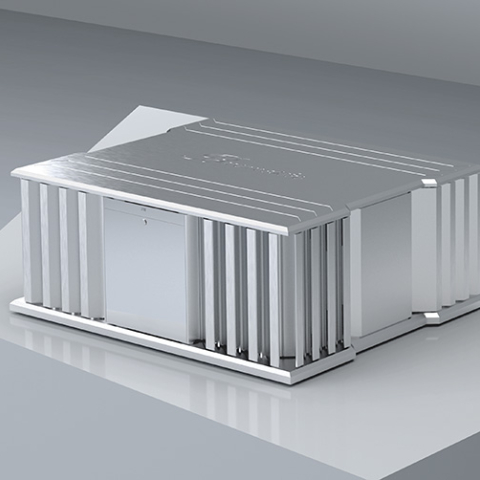
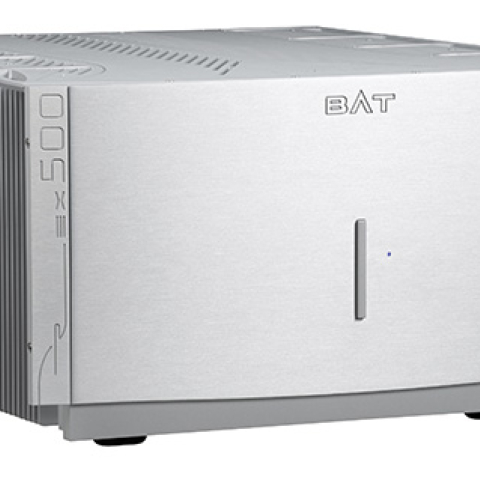
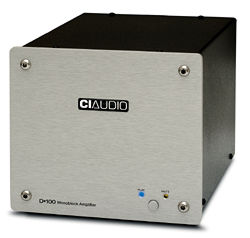 Yes, let's. And Channel Islands' D-100 monoblock is more different than most. It's small (6.25" wide by 5.5" high by 8.0" deep), relatively light (15 lbs), and reasonably inexpensive ($1599/pair). It's pretty, too, in that munchkin macho Tonka Toy sort of way. Look, Ma, it's built tough, just like the one Dad drives!
Actually, as I discovered once I'd connected a pair of them to a pair of Thiel CS1.6 speakers, the D-100 is built tough, just like the ones Dad drives—or should I say the one that drive Dad's speakers? Oh yes, indeedy. The D-100 is different.
The difference between ordinary and extraordinary is that little extra
Yes, let's. And Channel Islands' D-100 monoblock is more different than most. It's small (6.25" wide by 5.5" high by 8.0" deep), relatively light (15 lbs), and reasonably inexpensive ($1599/pair). It's pretty, too, in that munchkin macho Tonka Toy sort of way. Look, Ma, it's built tough, just like the one Dad drives!
Actually, as I discovered once I'd connected a pair of them to a pair of Thiel CS1.6 speakers, the D-100 is built tough, just like the ones Dad drives—or should I say the one that drive Dad's speakers? Oh yes, indeedy. The D-100 is different.
The difference between ordinary and extraordinary is that little extra
The D-100 is the first Channel Islands Audio product to be reviewed in Stereophile, but many readers will be familiar with CIA's Dusty Vawter from his many years as Audio Alchemy's manager of customer service. When AA went out of business, Vawter continued to offer upgrades and power-supply mods for AA products, and branched out with Monolithic Sound's Greg Schug, with whom he still works. (Schug is Vawter's partner in CIA, while Vawter is Schug's partner in Monolithic.) Vawter wanted to try his hand at some of his own projects, however, so he started CIA, where he designed an assortment of passive preamps, power supplies, small power amplifiers, and the VHP-1 headphone amp, which I wrote about in the March Stereophile eNewsletter. Channel Islands products are available direct from www.ciaudio.com and www.musicdirect.com.
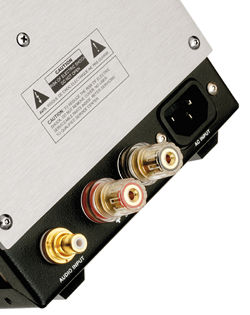
Instead of a power switch, the D-100 has a small pushbutton that toggles between Standby (green LED) and On (blue LED). The rear panel has an IEC power socket, one high-quality RCA input, and two high-quality five-way binding posts. If your speaker wire is particularly thick or rigid, or if your spades are oversized, you might have a slight problem fitting your cables onto the posts because of the D-100's low ground clearance and the overhang of that 3/16"-thick heatsink of a rear panel. On the other hand, if you're using a speaker cable that costs less than a pair of D-100s, you probably won't have any problems in this regard.
The amp comes in two versions. If you want to use a passive preamplifier, such as CIA's VPC-1, you can get a pair of D-100s with gain of 32dB; if you use an active preamp, you can get 'em with 26dB. The pair I auditioned were set with the 26dB option.
It don't make much difference what you study, so long as you don't like it
"Class-D does not mean digital," Dusty Vawter groused. "Class-D is basically an analog switching amplifier, unless a digital input is used to modulate the output, which we don't do. Class-D amplification uses a comparator/modulator scheme to look at the input signal and switch output devices on or off at a very high frequency to replicate the input signal. That's where the differences in class-D amplifiers come from—everybody does that slightly differently.
"Usually, the switching is done from a single rail of the power supply, which means that if the amplifier's circuit runs off 60V, it will have +30V at each speaker terminal—in reference to ground, not to each other. That's a shock hazard, and it won't pass CE or UL safety tests, which is why amps with that topology use Speakon connectors to get around that.
"There's another problem with this approach: The amps all have frequency-response fluctuations that are relative to the speaker load. If the amp was designed for flat response into a 6 ohm load, the high frequencies would rise into an 8 ohm load and roll off into a 4 ohm load.
 "But Bruno Putzeys [formerly chief engineer for class-D audio at Philips DSL, now chief R&D engineer at Hypex] came up with a better way to implement class-D. Putzeys' UcD [Universal class-D] technology addressed both of those issues. Most class-D amps place the sensors that turn the output devices on and off before an output filter; UcD can do it right at the speaker terminals, which is why it can have flat frequency response, since there is no circuit between that and the load. The frequency response is therefore ruler-flat no matter the load connected to it.
"When Philips licensed the UcD technology to Hypex, I began talking to Jan-Peter Amerongen there and obtained some modules to test. There were some things we loved about the design, but we wanted it to have higher performance in some areas, so we began working with them to produce a better stock module—and we also had some ideas we wanted to keep to ourselves. After a year or so of work, we developed the design that became the D-100 we're manufacturing now. We're using a modified version of the UcD 180. I'd say the D-100 uses about 80% of the UcD 180 circuit—we add the final 20% when we get our custom version of the board here."
When I opened a D-100, I was shocked at how much transformer was in there and how little of everything else there was. The D-100 boasts one huge toroid attached to the 3/16"-thick front panel. There's also a small, high-quality circuit board that contains eight capacitors and the power-supply electronics, and a small module, presumably the customized UcD-180, attached to the 3/16"-thick rear panel, which serves as a heatsink.
The D-100 looks as though it's mostly power supply, I said to Vawter.
"Well, I guess that depends on how you look at it. The majority of the circuitry is power supply—the D-100 has a big transformer and a large power-supply board. The actual amplifier module itself is a 2"-square circuit board, but the parts count for that real estate is tremendous. However, the quality of the power supply has a huge effect on the sound quality of the amplifier, which is really true of all amplifiers—basically, you're just modulating what you're taking from the wall, so the better the DC is that's running the amplifier, the better the output signal is going to be.
"But Bruno Putzeys [formerly chief engineer for class-D audio at Philips DSL, now chief R&D engineer at Hypex] came up with a better way to implement class-D. Putzeys' UcD [Universal class-D] technology addressed both of those issues. Most class-D amps place the sensors that turn the output devices on and off before an output filter; UcD can do it right at the speaker terminals, which is why it can have flat frequency response, since there is no circuit between that and the load. The frequency response is therefore ruler-flat no matter the load connected to it.
"When Philips licensed the UcD technology to Hypex, I began talking to Jan-Peter Amerongen there and obtained some modules to test. There were some things we loved about the design, but we wanted it to have higher performance in some areas, so we began working with them to produce a better stock module—and we also had some ideas we wanted to keep to ourselves. After a year or so of work, we developed the design that became the D-100 we're manufacturing now. We're using a modified version of the UcD 180. I'd say the D-100 uses about 80% of the UcD 180 circuit—we add the final 20% when we get our custom version of the board here."
When I opened a D-100, I was shocked at how much transformer was in there and how little of everything else there was. The D-100 boasts one huge toroid attached to the 3/16"-thick front panel. There's also a small, high-quality circuit board that contains eight capacitors and the power-supply electronics, and a small module, presumably the customized UcD-180, attached to the 3/16"-thick rear panel, which serves as a heatsink.
The D-100 looks as though it's mostly power supply, I said to Vawter.
"Well, I guess that depends on how you look at it. The majority of the circuitry is power supply—the D-100 has a big transformer and a large power-supply board. The actual amplifier module itself is a 2"-square circuit board, but the parts count for that real estate is tremendous. However, the quality of the power supply has a huge effect on the sound quality of the amplifier, which is really true of all amplifiers—basically, you're just modulating what you're taking from the wall, so the better the DC is that's running the amplifier, the better the output signal is going to be.
Yes, let's. And Channel Islands' D-100 monoblock is more different than most. It's small (6.25" wide by 5.5" high by 8.0" deep), relatively light (15 lbs), and reasonably inexpensive ($1599/pair). It's pretty, too, in that munchkin macho Tonka Toy sort of way. Look, Ma, it's built tough, just like the one Dad drives!
Actually, as I discovered once I'd connected a pair of them to a pair of Thiel CS1.6 speakers, the D-100 is built tough, just like the ones Dad drives—or should I say the one that drive Dad's speakers? Oh yes, indeedy. The D-100 is different.
The difference between ordinary and extraordinary is that little extra
The D-100 is the first Channel Islands Audio product to be reviewed in Stereophile, but many readers will be familiar with CIA's Dusty Vawter from his many years as Audio Alchemy's manager of customer service. When AA went out of business, Vawter continued to offer upgrades and power-supply mods for AA products, and branched out with Monolithic Sound's Greg Schug, with whom he still works. (Schug is Vawter's partner in CIA, while Vawter is Schug's partner in Monolithic.) Vawter wanted to try his hand at some of his own projects, however, so he started CIA, where he designed an assortment of passive preamps, power supplies, small power amplifiers, and the VHP-1 headphone amp, which I wrote about in the March Stereophile eNewsletter. Channel Islands products are available direct from www.ciaudio.com and www.musicdirect.com.
"Class-D does not mean digital," Dusty Vawter groused. "Class-D is basically an analog switching amplifier, unless a digital input is used to modulate the output, which we don't do. Class-D amplification uses a comparator/modulator scheme to look at the input signal and switch output devices on or off at a very high frequency to replicate the input signal. That's where the differences in class-D amplifiers come from—everybody does that slightly differently.
"But Bruno Putzeys [formerly chief engineer for class-D audio at Philips DSL, now chief R&D engineer at Hypex] came up with a better way to implement class-D. Putzeys' UcD [Universal class-D] technology addressed both of those issues. Most class-D amps place the sensors that turn the output devices on and off before an output filter; UcD can do it right at the speaker terminals, which is why it can have flat frequency response, since there is no circuit between that and the load. The frequency response is therefore ruler-flat no matter the load connected to it.
"When Philips licensed the UcD technology to Hypex, I began talking to Jan-Peter Amerongen there and obtained some modules to test. There were some things we loved about the design, but we wanted it to have higher performance in some areas, so we began working with them to produce a better stock module—and we also had some ideas we wanted to keep to ourselves. After a year or so of work, we developed the design that became the D-100 we're manufacturing now. We're using a modified version of the UcD 180. I'd say the D-100 uses about 80% of the UcD 180 circuit—we add the final 20% when we get our custom version of the board here."