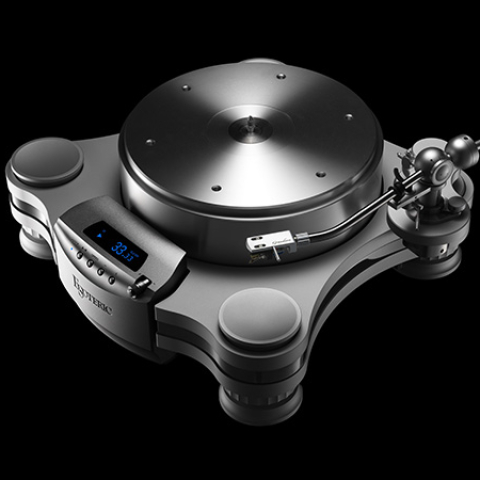
The La Luce turntable's elegant form usually stops audiophiles dead in their tracks. Then comes a long, low "Wow." I'm hardly immune myself. And that's not even considering the sound, which has always been wonderful, as it was in the Joseph Audio/Cardas room at CES '98.
Wonders never ceasing, the La Luce was designed by Judy Spotheim-Koreneef, an Israeli living in Eindhoven, Holland. Spotheim is proud to explain that her turntable was designed in the manner of a precision measuring instrument and manufactured to extremely fine tolerances from materials chosen to ensure neutral and accurate playback. So when George Cardas told me that he was importing this paean to analog beauty, my jaws snapped around the bait.
 La Luce proper
The La Luce 'table is described by Mrs. Spotheim (pronounced "Schpot-hime") as a low–energy-storage, direct-coupled, nonsuspended design driven by a stand-alone motor and a belt of elastic thread. The turntable's transparent, 2"-thick platter is machined from a solid block of acrylic and has a row of stainless-steel cylinder weights embedded in its outer edge. The handmade bearing assembly, snugged inside an attractive black Delrin housing, is individually matched to a chrome-hardened steel spindle shaft. The transparent central acrylic block contains the bearing housing and the armboard assembly for the dedicated SpJ tonearm. (The arm is available separately for use with a variety of turntables.)
Bolted perpendicularly to the underside of the central block under the armboard side is a 9" acrylic cylinder (about 1½" thick) pierced at either end by height-adjusting screws. La Luce sits triangulated on these and a third fixed leveling screw set outboard of the bearing housing. The concave tips of the threaded height-adjusting screws rest on small ball bearings set within cups at the centers of three supporting acrylic footers of about hockey-puck size. (The armboard side gets smaller balls than the bearing side.) Three rubber O-rings are supplied for optional use under the supporting footers.
Spotheim recommends that the 'table be placed on a very dead-sounding platform, one immune to feedback and "drumming effects." The motor should be placed on a separate platform that doesn't make contact with the 'table's platform. Placing either or both on springy supports will make for inconsistent belt tension and thus speed instability. When he came to set up the turntable, George Cardas brought along a Bright Star Air Mass 2 and Big Rock 1, which together provided a superlative level of isolation. The Air Mass 2/Big Rock 1 combo sitting atop a PolyCrystal equipment rack worked to perfection under La Luce: I could jump up'n'down next to the stand with no ill effects (except to myself). The hefty, Bauhausian motor sat on a Signal Guard II Resonance Attenuation Platform fitted with PolyCrystal spikes on a separate PolyCrystal equipment stand set at about the 9:15 position.
Arm base
The impressive-looking La Luce arm base is machined from stainless steel and consists of three main parts: the ground-plate, the VTA pillar, and a canted horizontal platform that extends out from it. The 15mm-thick ground-plate is bolted directly to the 'table and supports the overhang micrometer, its locking screw, and the VTA pillar's horizontal rails. Each full turn of the overhang micrometer knob changes the distance of the pivot from the spindle by 0.5mm (0.019685") forward or back over a range of 38mm (1½"). The horizontal platform either side of the VTA pillar is raised and lowered with the VTA micrometer knob. Each full turn represents a height adjustment of 1mm (0.03937"), a lock keeping the setting in check. Reference marks are engraved on a plate around the base of the VTA knob (adjustable during play) to keep track of your position.
The platform carries the main pivot. It's made of hardened, grained, polished steel with an upward-pointing tip centered in a cup that takes a dollop of damping fluid, if so desired. (I recommend that you so desire.) Just next to it, the azimuth micrometer pillar raises and lowers a small platform on which a secondary "traveling pivot" rides. (The SpJ arm is a dual-pivot design; more on this presently.) Amazingly, azimuth can be adjusted during play. As a result, what is a frustrating and time-consuming task with the Forsell Air Force One takes less than five minutes with La Luce using the Audio-Technica AT6020 Cartridge Analyzer and test LP. I really appreciated this beaucoup. But with only one SpJ arm on hand, I had to start from ground zero each time I changed cartridges.
(I know—you feel for me. But I have it much easier with the Forsell. I've amassed a collection of arms and slider combos with cartridges installed—azimuth and counterweight already set—ready to swap in at a moment's notice. Well, my shrink says you can't have everything.)
The horizontal platform also carries a central grounding post that extends from the canted edge on the far side of the platform. A Cardas high-purity shielded copper wire terminated with a spade lug is provided to tie the arm to ground at the preamp. If hum persists, additional grounding options include a smaller wire that clips to a pin on the arm itself. The main grounding post is a small, beautifully crafted aluminum cylinder, adjustable for angle, that features a "soft-bite" clamp that gently keeps the arm wires out of harm's way.
On the near side of the platform sits a pillar with yet another micrometer-operated device that raises and lowers the arm-lifter mechanism. Setting its height relative to the arm is easy and convenient, regardless of VTA. The edge of the platform becomes obliquely angled just beyond the lifter micrometer pillar. Pointing at an adjacent plate, it indicates the VTA setting—the tip is at the same horizontal level as the pivot tip. The VTA height indicator, which is attached to the base ground-plate, has an engraved scale facing the adjacent oblique-angled tip of the platform. Each of the longer lines on the scale above and below the center line represents 1.25° of change at the pivot tip. Turning the VTA height-indicator "instrument" raises and lowers the engraved scale. Calibrating the zero line with the tip of the horizontal platform marks a reference point for VTA when it's changed. Really well thought out.
SpJ tonearm
With those buttery-smooth micrometers, the SpJ tonearm allows for precise and accurate adjustments of overhang, azimuth and VTA. The armtube is machined from a solid titanium cylinder of six different inner diameters and five different outer ones; only three of the latter are visible. The titanium "cartridge mounting platform" (headshell) is crimp-connected to the armwand, which in turn is crimped at the pivot end to a titanium block. On the bottom of the block sits a cup with a jeweler's diamond bearing fitted over the fixed pivot on the base. A secondary down-pointing pivot is secured and locked from the top of the block. Behind and slightly below the pivot sits a decoupled brass micrometer-operated counterbalance that features three removable weight screws; three heavier screws are provided to adjust for a wide range of cartridges. The Side-Thrust Bias Controller (Spotheimese for anti-skating device) comprises a pair of smallish weights riding a horizontal threaded rod suspended on a carrier above the counterweight. Finishing it off, Cardas pure-copper arm wires are twisted together, reinforced, and run in parallel through the arm to extend up out of the titanium block, where they're terminated with Cardas rhodium RCA female connectors.
La Luce properThe La Luce 'table is described by Mrs. Spotheim (pronounced "Schpot-hime") as a low–energy-storage, direct-coupled, nonsuspended design driven by a stand-alone motor and a belt of elastic thread. The turntable's transparent, 2"-thick platter is machined from a solid block of acrylic and has a row of stainless-steel cylinder weights embedded in its outer edge. The handmade bearing assembly, snugged inside an attractive black Delrin housing, is individually matched to a chrome-hardened steel spindle shaft. The transparent central acrylic block contains the bearing housing and the armboard assembly for the dedicated SpJ tonearm. (The arm is available separately for use with a variety of turntables.)
Bolted perpendicularly to the underside of the central block under the armboard side is a 9" acrylic cylinder (about 1½" thick) pierced at either end by height-adjusting screws. La Luce sits triangulated on these and a third fixed leveling screw set outboard of the bearing housing. The concave tips of the threaded height-adjusting screws rest on small ball bearings set within cups at the centers of three supporting acrylic footers of about hockey-puck size. (The armboard side gets smaller balls than the bearing side.) Three rubber O-rings are supplied for optional use under the supporting footers.
The impressive-looking La Luce arm base is machined from stainless steel and consists of three main parts: the ground-plate, the VTA pillar, and a canted horizontal platform that extends out from it. The 15mm-thick ground-plate is bolted directly to the 'table and supports the overhang micrometer, its locking screw, and the VTA pillar's horizontal rails. Each full turn of the overhang micrometer knob changes the distance of the pivot from the spindle by 0.5mm (0.019685") forward or back over a range of 38mm (1½"). The horizontal platform either side of the VTA pillar is raised and lowered with the VTA micrometer knob. Each full turn represents a height adjustment of 1mm (0.03937"), a lock keeping the setting in check. Reference marks are engraved on a plate around the base of the VTA knob (adjustable during play) to keep track of your position.
With those buttery-smooth micrometers, the SpJ tonearm allows for precise and accurate adjustments of overhang, azimuth and VTA. The armtube is machined from a solid titanium cylinder of six different inner diameters and five different outer ones; only three of the latter are visible. The titanium "cartridge mounting platform" (headshell) is crimp-connected to the armwand, which in turn is crimped at the pivot end to a titanium block. On the bottom of the block sits a cup with a jeweler's diamond bearing fitted over the fixed pivot on the base. A secondary down-pointing pivot is secured and locked from the top of the block. Behind and slightly below the pivot sits a decoupled brass micrometer-operated counterbalance that features three removable weight screws; three heavier screws are provided to adjust for a wide range of cartridges. The Side-Thrust Bias Controller (Spotheimese for anti-skating device) comprises a pair of smallish weights riding a horizontal threaded rod suspended on a carrier above the counterweight. Finishing it off, Cardas pure-copper arm wires are twisted together, reinforced, and run in parallel through the arm to extend up out of the titanium block, where they're terminated with Cardas rhodium RCA female connectors.