
Sidebar 3: Measurements
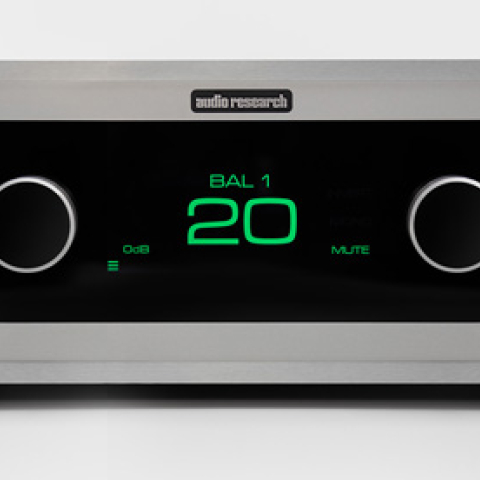
I measured the Audio Research Reference 20 (serial number 57165) with an Audio Precision APx555 analyzer. The REF20 has four sets of balanced and four sets of single-ended inputs. It has two main outputs plus a subwoofer output, each available on both balanced and single-ended jacks. After several hours of testing, the top panel's temperature, measured with an infrared thermometer, was a cool 85°F. All measurements presented here were taken after thermal equilibrium was reached.
The Reference 20's inputs are selected with relays. Absolute polarity was preserved via all the inputs, ie, the preamplifier is noninverting. The balanced and single-ended output jacks share signal lines, the single-ended outputs carrying one phase of the balanced signal. In my testing, this degraded the balanced connection's rejection of noise somewhat and slightly improved the single-ended output's noise rejection, though the balanced output remained the quieter of the two, as expected.
With the volume control set to its maximum of "99," the REF20's maximum gain at 1kHz was 15.65dB from the balanced output jacks; from the single-ended jacks the gain was, as expected, 6dB lower at 9.65dB. Unity gain was achieved with the volume control set to "68" via the balanced outputs and "80" via the single-ended outputs. This 12-step difference indicates that the REF20's volume control operates in 0.5dB steps.
Audio Research specifies the balanced input impedance as 50k ohms and single-ended input impedance as 25k ohms. The single-ended input impedance was close to that value, at 24.9k ohms at 20Hz and 1kHz and 24.2k ohms at 20kHz. Apparently this specification is intended to refer to each leg or phase of the balanced signal, since, unsurprisingly, the balanced input impedance was as large: 50k ohms at 20Hz, 49.3k ohms at 1kHz, and a still usefully high 46.5k ohms at 20kHz.
The REF20's output impedance is specified as 600 ohms balanced and 375 ohms single-ended. I measured values close to those specifications in the midrange and treble; 624 ohms at 1kHz and 570 ohms at 20kHz balanced, 317 ohms and 289 ohms single-ended, consistent with the shared output phases. As is usually the case with tube preamplifiers that use coupling capacitors on the output, the impedance rose at low frequencies, to 1521 ohms balanced and 913 ohms single-ended at 20Hz.

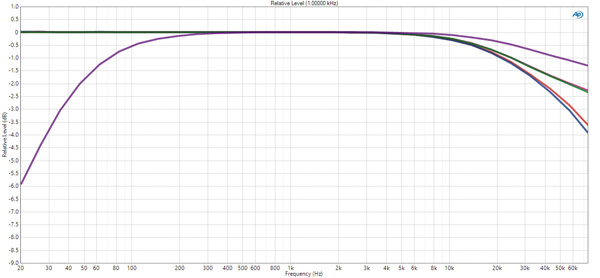
This variation in output impedance means that the Reference 20's frequency response depends on the load it drives (fig.1). Into high impedances, the response was down just 0.7dB to 20Hz. Into a punishing 300 ohm load (purple trace), the output shelved down below 200Hz, reaching –3dB at 42Hz and –6dB at 20Hz, exactly the behavior predicted by the measured source impedance. Driving a power amplifier with a 10k ohm input impedance, the loss at 20Hz will be barely (if at all) perceptible. Into 20k ohms and above, it will be negligible. Into much lower amplifier input impedances, the low-frequency rolloff will be easily audible. Using an amplifier with an input impedance of 10k ohms or higher is recommended. At the other end of the spectrum, the Reference 20 has a gentle ultrasonic rolloff. With the volume control at the unity-gain setting (red and blue traces), the response was down by 0.9dB at 20kHz, the –3dB point lying between 56kHz and 60kHz. At maximum volume (pink and green traces), the rolloff was slightly shallower, at –0.8dB at 20kHz and –2.1dB at 60kHz.
Channel separation via the balanced signal path was excellent for an all-tube design at nearly 94.8dB at 1kHz and 89.75dB at 20Hz, declining to a still-good 68.5dB at the top of the audioband due to the usual capacitive coupling between channels.

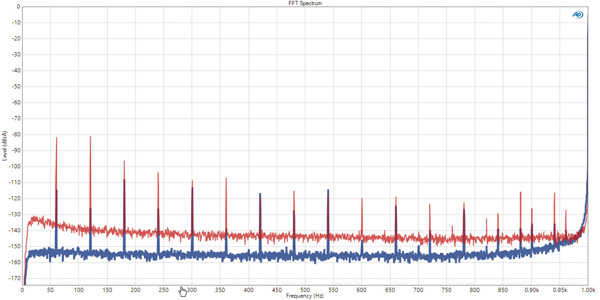
Fig.2 shows spectra of the Reference 20's output while it reproduced a 1kHz tone at 2V, taken from the balanced output (blue trace) and the single-ended output (red trace). The balanced output noisefloor lies about 12dB below the single-ended output's. Power supply–related spuriae are visible in both traces but well controlled in both. The single-ended output carries both even- and odd-order harmonics of the 60Hz supply frequency; the 60Hz and 120Hz components reach –82dB and –81dB (0.009%) respectively. Via the balanced output, the even-order components largely cancel as expected; the remaining odd-order components at 60Hz, 180Hz, 300Hz, and 540Hz all lie at or below –108dB. This is excellent performance.
The wideband, unweighted signal/noise ratio (ref. 1V output), measured with the input shorted and the volume control at its maximum, was 77.5dB via the single-ended output and 93.5dB via the balanced output. Restricting the measurement bandwidth to the audioband improved these ratios to 78.5dB and 101.7dB, and an A-weighting filter improved them further, to 95.5dB and 105.5dB. The single-ended ratio's large improvement with A-weighting confirms that the noise at that output is dominated by low-frequency hum; used balanced, the Reference 20 is a very quiet preamplifier, particularly considering its all-tube circuitry.

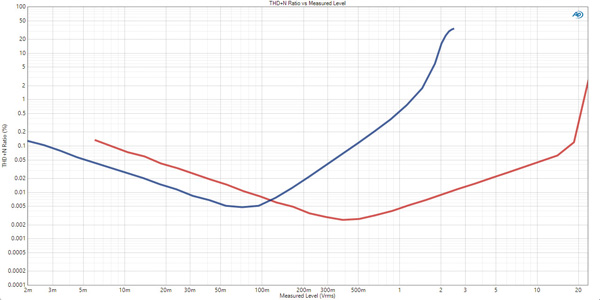
Fig.3 plots the percentage of THD+noise in the Reference 20's output against the 1kHz output voltage into 200k ohms (red trace) and into a demanding 300 ohm load (blue trace). The downward slope of the traces at low voltages indicates that the measurement in this region is dominated by noise rather than distortion, the THD+N reaching a superbly low 0.0024% at 380mV into 200k ohms and 0.0046% at 70mV into 300 ohms. We specify a preamplifier's clipping voltage as when the THD+N reaches 1%. Into 200k ohms, the Reference 20 didn't clip until more than 20V; even into 300 ohms it delivered 1.4V at clipping.

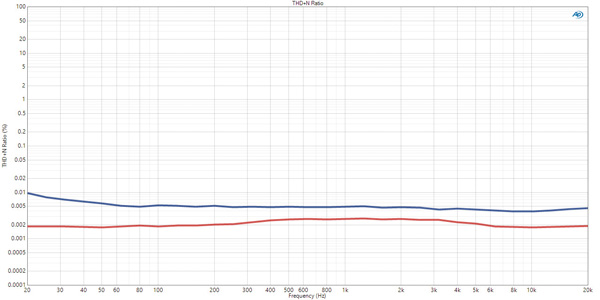
To examine how the distortion behaved with frequency, I plotted the THD+N percentage against frequency with each load driven at the level at which it had produced the lowest reading in fig.3 (fig.4). Into 200k ohms (red trace), the THD+N remained between 0.002% and 0.003% from 20Hz to 20kHz; into 300 ohms (blue trace), it was still superbly low, at 0.005% across most of the audioband, rising to 0.01% at 20Hz. The REF20's linearity is excellent across the board—not an artifact of testing at a single spot frequency.

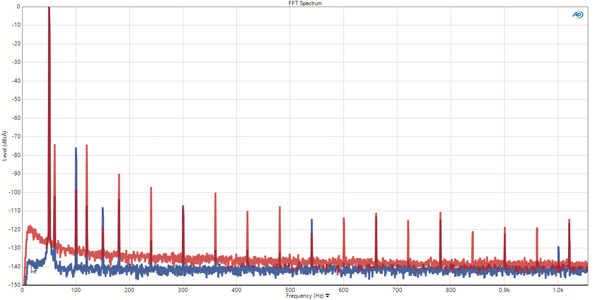
Fig.5 shows the spectrum of the Reference 20's output as it drove a 50Hz tone at 2V into 200k ohms from the balanced output (blue trace) and into 100k ohms from the single-ended output (red trace). The second harmonic, at 100Hz, is the highest in level, at –76dB (0.016%); the third harmonic, at 150Hz, lies at –108dB, and higher harmonics are all at or below –100dB. Power supply–relaed spuriae can again be seen between the signal's harmonics, at a higher level via the single-ended output: The component at 180Hz reaches –90dB. This aspect of the Reference 20's performance is neither exceptional nor concerning. The balanced output again offers the cleaner signal.

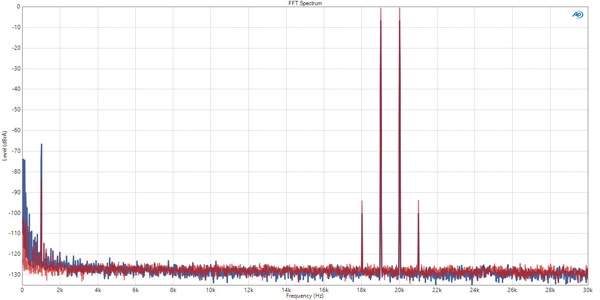
Tested for high-frequency intermodulation distortion with an equal mix of 19kHz and 20kHz tones summed at 2V RMS (fig.6), the Reference 20 again differed between the two loads. Into 200k ohms (red trace), the second-order difference product at 1kHz lay at –84dB (0.006% ref. levels of each of the tones). Into the 300 ohm load (blue trace), which both reduces the delivered signal and pushes the output stage toward its current limit, the 1kHz product rose to a still-good –67dB (0.045%). Higher-order products at 18kHz and 21kHz lay at –94dB (0.002%) or lower for both loads.
The Audio Research Reference 20 offers excellent measured performance, with superbly low distortion across the audioband, generous dynamic range, and, especially via its balanced outputs, very low noise, all the more impressive considering its all-tube circuitry. Prospective owners should partner it with power amplifiers with an input impedance of at least 10k ohms and use the balanced outputs where possible.—James Grinalds